
EP REVIEW
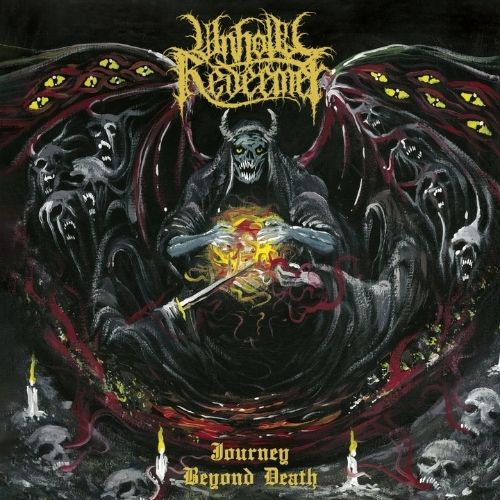
UNHOLY REDEEMER - Journey Beyond Death
The Dark Anatomy of Ancient Death Metal
UNHOLY REDEEMER, an international project, is taking a more formal step forward following its 2023 demo "A Fever to Dethrone All Kings", further consolidating its position on the death metal scene with its first EP, "Journey Beyond Death". The first thing that stands out about the recording is how deliberately the band narrows the range of motion available to riffs within old-school death metal's color palette, along with the atmosphere generated by that restricted space. The result is not death metal that constantly seeks momentum through sheer speed, but an interpretation of the genre that places its center of gravity in the mid and slower tempos, keeps its riffs under sustained pressure for extended stretches, occasionally approaches the death/doom boundary, and builds intensity through layered guitars and assertive drum direction. The real achievement of this five-track EP lies not in the variety of its genre references, but in its ability to keep those references within a shared compositional language without turning them into a scattered collage of nostalgia.
Steven Hull's guitars sit at the center of UNHOLY REDEEMER's musical identity. While the down-tuned tone preserves the low-end weight of classic death metal, the riffs generally move through structures that drag, grow heavier, and regain momentum rather than relying on abrupt changes of speed. 'Journey Beyond Death' is the most comprehensive example of this approach. Although the track moves into faster passages after opening with crushing drums and heavy guitars, its defining character comes not from speed but from the sense of expansion in its middle section as it approaches the death/doom threshold. When the riff's tempo changes, it is not merely the BPM that shifts; the physical weight of the track changes with it. As a result, the faster sections cease to function as showcase moments and instead become contrasts that intensify the pressure created by the heavier passages.
This approach becomes even more pronounced on 'Carrion of the Gods'. While the song's core is built around a mid-paced, crushing guitar-and-drum combination, the high-speed passages inserted between them do not fracture the composition; instead, they recalibrate its tension. Here, the riff-centered aggression of early American death metal meets a darker, doom-leaning approach within the same structure. UNHOLY REDEEMER, however, does not turn these two directions into a dramatic "fusion" showcase. Heavier movement is the song's natural language; speed is a controlled deviation placed within it.
Jared Mawdsley's drumming therefore does more than simply function as a rhythmic layer following the guitars' tempo. The drums occupy a clearly directive position, determining where the songs accelerate and when their weight comes back to the forefront. The transitions between faster passages and heavier, crushing sections shape the architecture of 'Carrion of the Gods' and 'Blazing Grave Cathedrals' in particular. Although 'Blazing Grave Cathedrals' brings out the EP's faster and more extreme side, even here UNHOLY REDEEMER's fundamental instinct is not an uncontrolled blast-beat barrage. Speed is layered over the heavy riffing backbone, with the track returning to its mid-paced weight when necessary.
This rhythmic preference allows the band to deliberately distinguish itself from the faster, more sterile production-oriented approach found in contemporary death metal. Many works released under the "old school" banner today reproduce period-appropriate guitar tones and vocal aesthetics while surrendering, on the compositional side, to contemporary death metal's obsession with speed and intensity. "Journey Beyond Death", by contrast, operates with a more patient riff economy. The riffs are allowed to carry their own weight for as long as possible. Rather than simply slowing the EP down, this changes the way its heaviness is perceived.
Tommi Grönqvist's bass does not disappear into this density either. Particularly in the slower-moving sections, the bass frequencies do more than merely fill the space beneath the guitars, giving the lower layer of the songs an additional sense of weight. 'Blazing Grave Cathedrals' is particularly significant in this regard; the bass presence beneath the dense wall of guitars gives the track's low end greater volume and substance. 'Ever Drifting... They Wait', meanwhile, introduces a small but meaningful variation into the EP's overall sonic architecture through moments when the bass is allowed to come further forward. This choice points to a mixing approach that preserves the characteristic murkiness of old death metal production without sacrificing instrumental separation.
Jens Pedersen's vocals, meanwhile, complement this musical framework rather than expanding it. His deep, cavernous death metal growls occupy the same frequency territory as the guitars' low-register character, positioning the vocals as an organic extension of the riffs rather than turning them into a melodic counterpoint. The impact of the vocal performance therefore comes less from technical variety than from its placement. Pedersen's voice does not feel like an "extreme metal" marker added on top of the songs; it functions within the compositions' heavy, enclosed character.
The lyrics reinforce this musical sense of enclosure. The decaying gods, ritual dissection, "obsidian blood", and images of cosmic decay in 'Carrion of the Gods'; the disharmonic pathways, dissolving colors, and a cosmos losing its dominion in 'Blazing Grave Cathedrals'; and the decaying crypts, poisonous fog, and entities rising from graves in 'Ever Drifting... They Wait' construct the band's lyrical world through images of physical decomposition and cosmic corruption rather than abstract darkness. This vocabulary directly aligns with the music's old-school death metal aesthetic. More importantly, a clear parallel emerges between the slow, drifting movement of the music and the lyrical imagery: like the subjects in the lyrics, the songs do not simply disintegrate; they decay slowly.
At this point, UNHOLY REDEEMER's position within the genre becomes clearer. The band does not carry references to Morbid Angel, Immolation, Incantation, Deicide, and Sadistic Intent merely as a list of names; it brings different elements of that legacy together within its own compositional approach. The balance between Incantation's strain of dark death metal and the riff-driven aggression of early American death metal is a defining element of "Journey Beyond Death". Added to this are tempos and atmospheres that occasionally approach death/doom. Yet this expansion does not go far enough to redefine the band's identity as a death metal act. The goal here is not to break the boundaries of the genre, but to use its old boundaries with greater density and consistency.
This is also where the EP's most interesting quality lies. UNHOLY REDEEMER does not add modern production tricks or instruments from outside the genre in order to update the "old school" death metal aesthetic. The expansion takes place directly within the compositions. The death/doom-leaning middle section of 'Journey Beyond Death' or the heavier progression of 'Ever Drifting... They Wait' represent less an attempt at a new genre synthesis than an exploration of death metal's own potential for tempo and atmosphere. The band's distinctiveness, therefore, does not emerge from the material it uses, but from how disciplined its use of that material is.
'The Blades of Inversion' is particularly noteworthy within this framework because, as an instrumental track, it removes the vocal layer entirely. This choice brings the band's compositional approach directly into view. The fact that its musical identity remains intact without vocals demonstrates that the relationship between riffs and rhythm is sufficiently well defined. At the same time, the track's position within the EP suggests that its five-track structure is not simply a sequence of death metal compositions placed one after another; it also creates a breathing space that temporarily pulls back the vocal intensity and brings the instrumental side to the forefront.
The production is another important complement to this compositional approach. The sound wall is dense without collapsing into an impenetrable mass of mud. The midrange layers of the guitars, the drums' commanding character, and the bass's ability to carve out space in the low end establish a controlled balance between cavernous aesthetics and performance clarity. The aim is not the clinical separation frequently heard in modern death metal, but to preserve the friction between the instruments without losing the shape of the riffs. For that reason, the production works less as an imitation of old-school aesthetics than as a controlled reinterpretation of them within contemporary recording conditions.
Still, the strength of "Journey Beyond Death" does not lie in creating a new vocabulary for the genre. The album's ambition is narrower and, for that very reason, more realistic: to reconstruct death metal's historically established building blocks through a more deliberate compositional logic than the rushed "retro" productions that have become increasingly common today. While all five tracks operate along the same dark axis, tempo shifts, drum direction, the weight of the bass within the mix, and passages opening toward death/doom serve as the primary tools for preventing monotony.
For this reason, "Journey Beyond Death" is an EP that asks the listener not to constantly search for new ideas, but to follow how existing ideas are made heavier and how they are connected to one another. This is precisely where UNHOLY REDEEMER's place within contemporary extreme metal becomes apparent: rather than using nostalgia as a visual and production filter, the band positions itself as an act reinterpreting the riff-writing and atmospheric discipline of early death metal. "Journey Beyond Death" does not open up a new direction; it takes the riskier route, going deep enough within the narrow corridor it has chosen without needing unnecessary exits.
