
ALBUM REVIEW
WARNING – Rituals Of Shame
A Worthy Continuation of Doom Metal’s Most Intimate Voice
Emerging from the British doom metal scene of the mid-1990s, WARNING gradually attained cult status over the years, largely on the strength of 2006’s Watching From A Distance, a record widely regarded as one of the genre’s most impactful and deeply personal statements. Centered around Patrick Walker, the band became known for combining crushing riffs with an unadorned simplicity free of technical showmanship, while expanding doom metal’s expressive vocabulary through a vocal approach defined by fragility and sincerity. Arriving twenty years later, Rituals Of Shame is more than a comeback album; it feels like a new chapter that continues WARNING’s unfinished narrative.
What stands out here is not only the construction of the riffs, the way the songs unfold, or the production choices, but also how the expressive language Walker has spent years building within doom metal has matured. WARNING still make heavy music, yet that heaviness is rooted less in sheer weight than in timing, repetition, and emotional delay.
The thirteen-minute title track that opens the album immediately establishes the band’s approach. Rather than relying on the dramatic crescendos, clearly defined turning points, or riff-driven structures commonly found in traditional doom metal, the song remains at a sustained level of tension for an extended period. The guitars are not the guiding force here; instead, they function as a supporting surface that creates ample space for Walker’s vocal narrative. The fact that the first major variation arrives only after several minutes may test the patience of some listeners, but WARNING’s music is built precisely upon this sense of delayed movement. These songs deepen rather than progress.
That approach is maintained throughout the album. “Stations” is a strong example of how minimalist guitar lines built from only a handful of notes can generate lasting tension through subtle alterations. The riffs are not technically complex; in fact, they are often remarkably simple. Yet through their harmonic placement and logic of repetition, they create an atmosphere that continually expands. This has long been WARNING’s defining method: generating emotional intensity not through musical spectacle, but through controlled repetition.

Positioned at the center of the album, “Night Comes Down” delivers one of the most powerful manifestations of that formula. Its opening ultra-slow riffs and melodic lead guitars draw closer to the band’s more traditional doom roots, while the overall character of the song is once again shaped by Walker’s vocal performance. Here, the vocals are not merely a melodic element; they are one of the key components influencing the song’s rhythmic flow. The way phrases are extended, the placement of words within the spaces, and the manner in which the guitars breathe around them all help explain why WARNING still sound distinct from many contemporary doom acts.
Despite being the shortest track on the album, “Landing Lights” is also one of its most accessible compositions structurally. The guitar harmonies and more pronounced melodic tendencies do not diminish the album’s overall darkness, but instead redirect its intensity toward a different axis. What is particularly striking is the band’s refusal to create a sense of dramatic relief, even when approaching hope. Rather than offering resolution, the song transforms tension into a different form.
Closing track “Teacher” is one of the clearest demonstrations of WARNING’s mastery of timing. For much of its duration, the song holds itself back, maintaining a constant sense of expectation, which in turn makes the melodic expansion that arrives near the end significantly more effective. The core principle that defines the album as a whole remains in place here as well: impact comes not from sudden outbursts, but from tension accumulated over time.
Patrick Walker’s vocal performance is unquestionably the album’s focal point. Compared to the recordings of twenty years ago, his voice now sits lower in register and carries a noticeably rougher texture. Yet this change works entirely in the music’s favor. On the contrary, it forms a more natural relationship with the themes of guilt, loss, dependency, and emotional alienation that run throughout Rituals Of Shame. While many clean-vocal doom metal bands embrace an epic or theatrical approach, Walker places vulnerability directly at the center of his performance. As a result, WARNING occasionally occupy a unique space somewhere between doom metal and the singer-songwriter tradition.
The contribution of the rhythm section may initially seem understated, but the performances of Marcus Hatfield and Andrew Prestidge account for a significant portion of the album’s weight. While the bass guitar often serves to reinforce the guitars, its warm placement within the mix adds harmonic depth. The drums, meanwhile, function as a stable backbone that preserves the songs’ natural flow rather than creating dramatic accents.
Chris Fullard’s production plays a defining role in shaping the album’s aesthetic identity. Avoiding the overly layered or artificially pristine production style frequently encountered in contemporary doom metal, the recording possesses a spacious and organic character, undoubtedly aided by the sessions taking place in a former church. Every instrument remains clearly audible, yet the album never feels sterile. This approach reinforces the sense of human vulnerability that lies at the heart of WARNING’s music.
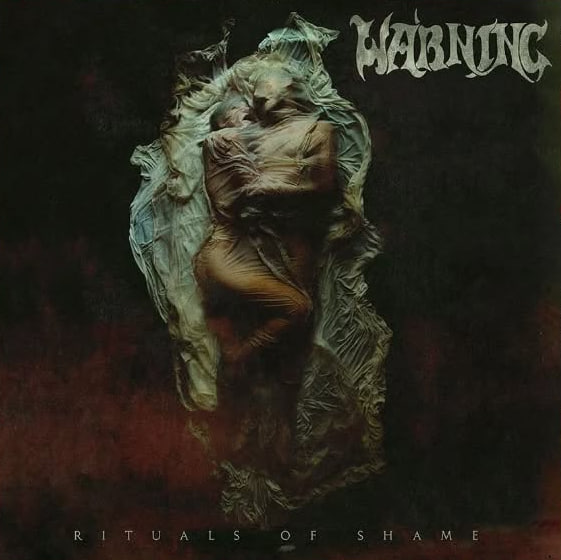
The artwork by Tekla Vály likewise completes the album’s aesthetic framework. The figures standing close together yet separated by an invisible barrier visually translate recurring lyrical themes of distance, emotional separation, and the inability to truly connect. Rather than relying on the imagery of death, decay, or occultism commonly associated with contemporary doom metal aesthetics, the cover embraces a more personal and human symbolism, creating a visual language that aligns closely with the music itself.
Rituals Of Shame is not an album that redefines WARNING’s identity. It introduces no new instruments, radical structural shifts, or genre-crossing experiments. Yet it is difficult to view that as a shortcoming. The album’s objective is not to expand boundaries, but to bring Patrick Walker’s long-developed mode of expression to a more mature and controlled stage. At a time when many doom metal bands build their sense of heaviness through scale and grandeur, WARNING continue to believe in the power of reduction, simplification, and space. For that reason, Rituals Of Shame stands out not as a work that changes the rules of the genre, but as one of the rare albums that manages to remain singular within them.
OZAN
https://warningdoom.bandcamp.com/album/rituals-of-shame