ALBUM REVIEW
WHARFLURCH - Mycodeath and Rebirth in the Outer Clusters
A bizarre take on psychedelic cosmic Death Metal.
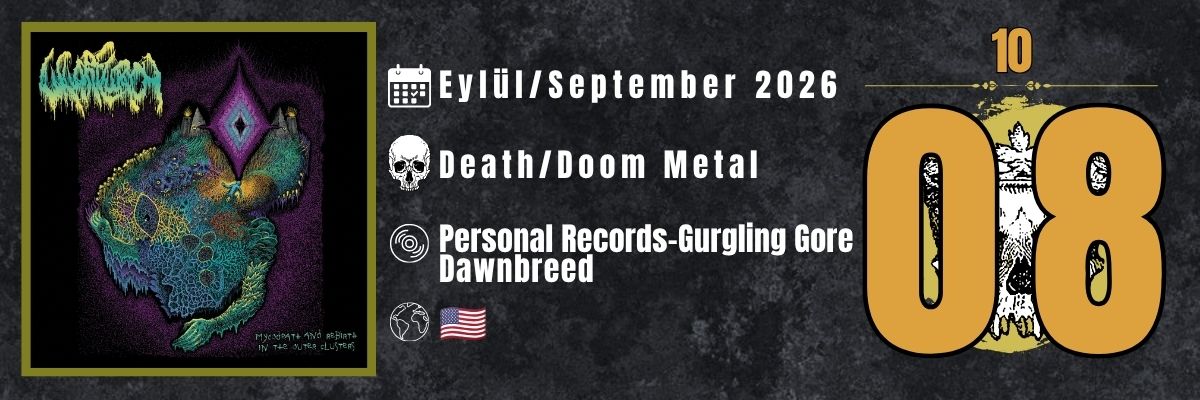
WHARFLURCH return with their second full-length, "Mycodeath and Rebirth in the Outer Clusters", injecting foreign matter into the familiar riff-driven backbone of Death Metal without dismantling it. Low-tuned, heavy guitars that lean into Doom at times, plodding rhythmic passages, and occasional shifts into more agile and technical riffing keep the band within the boundaries of old-school Death Metal, while synthesizers, processed vocals, and electronic sounds deliberately disrupt the natural flow of that framework. To give away the conclusion at the outset, the album presents an arrangement approach that consistently places the genre’s classic dark and rotten sonic vocabulary against a cosmic, artificial, and psychedelic layer.
This approach becomes particularly apparent in passages where the guitars function less as vehicles for melodic or technical display and more as tools for texture and directional shifts. Rather than holding a riff in place for too long, WHARFLURCH moves it through different levels of intensity, following heavy and memorable passages with more winding, measured, or unexpected movements. As a result, the architecture of the songs occasionally moves away from the straightforward progression traditionally associated with Death Metal. The crucial point here is that the band does not substitute experimentation for the music itself. The riff remains at the center; the synthesizers and electronic layers are placed over those riffs, altering the perceived space around them.
"Non Zero Expanse" is one of the clearest examples of this method. The use of robotic vocals immediately evokes a retro-futuristic aesthetic while establishing a distinct approach reminiscent of Death Metal’s fascination with outer space. But the point is not simply to add a synthesizer or an effect to the track. The shift in vocal tone from human harshness toward a mechanical character also changes the song’s narrative perspective. This choice can be read as part of the same historical lineage as Nocturnus’ approach to expanding Death Metal through science fiction, keyboards, and technological atmospheres. WHARFLURCH, however, are not reproducing that language so much as adapting its experimental boldness to their own Doom-Death and psychedelic framework.
The album’s concept is directly connected to these musical choices. Continuing the narrative that began with "Psychedelic Realms ov Hell", the protagonist is drawn into the interplanetary experiments of mushroom-like entities, with the Mycolords positioned as the hidden force behind life on Earth and its development on other planets. This idea is not merely a science-fiction backdrop confined to the lyrics. The artificial character of the synthesizers, robotic vocals, and occasionally unconventional electronic textures provide a musical counterpart to the narrative. In particular, the synthetic sounds layered over organic, heavy guitars make the album’s central biological/cosmic opposition audible on a sonic level.
One of WHARFLURCH’s greatest strengths here is that they turn their experimental elements into components of their own aesthetic system rather than constantly presenting them as "innovation". Synth use is not an extraordinary idea in itself, but when placed alongside the muddy weight of the guitars, it expands Death Metal’s expected sonic boundaries. The electronic sounds do not transform the music into an industrial form, nor does the psychedelic character completely eliminate the traditional riff structure. Instead, they insert a foreign signal into a familiar Death Metal body. That makes the album difficult to define through a single label such as "cosmic", "sci-fi", or "psychedelic"; each of these terms accounts for a different layer of the music.
The rhythm section, meanwhile, is what keeps the album grounded beneath these experimental layers. The contrast between the chunky, catchy, and plodding passages and the tricky, obtuse transitions described by the album’s own musical language defines much of its structural character. WHARFLURCH are not constantly trying to become more technical; instead, they place heavy, repetition-driven riffs alongside more complex movements. This is important because it prevents the psychedelic atmosphere from completely dissolving the music. The weight of the guitars and the rhythmic stability stand at the opposite pole from the alienation created by the synthesizers and vocal effects.
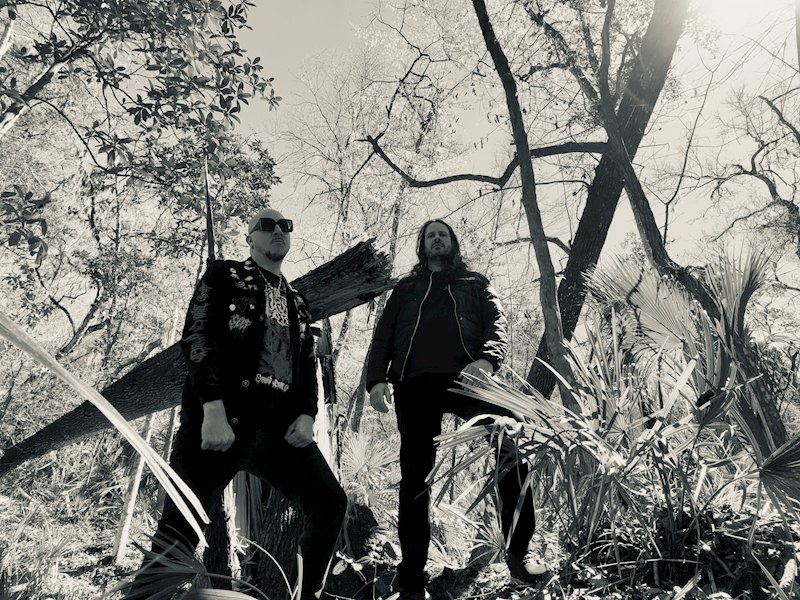
The vocal arrangement also expands the narrative dimension of the concept. John Mamo and Myk Colby share vocal duties, while Garrett Alvarado appears as the voice of the "Sporelords", and Jamie Stewart contributes narration and guest vocals. This allows different voices to assume different narrative functions across the album. The vocals therefore cease to be a single channel devoted solely to generating aggression. Particularly when considered alongside the processed and robotic vocal tones, they become a means of distinguishing the album’s characters and narrative perspectives from one another.
It is also important that the influence of bands such as Timeghoul and Demilich does not turn into direct stylistic imitation. What can be felt in WHARFLURCH’s music is less the sound of those bands than their approach to generating ideas — namely, the willingness to push Death Metal toward technical, cosmic, and conceptual extremes. Yet the resulting structure has an identity of its own beyond the sum of those influences. Doom’s slow, crushing movements, Death Metal’s riff-centered aggression, psychedelic layers, and science-fiction aesthetics coexist within the same compositions without completely dissolving into one another.
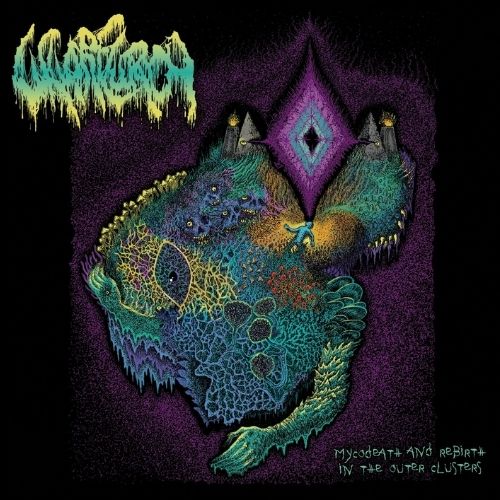
The album’s visual world reinforces this musical strategy as well. The artwork by Claw//Eight centers on psychedelic horror and transformation, creating a visual connection between the organic corruption and cosmic deformation present in the band’s sound. Rather than relying on Death Metal’s familiar graveyard, corpse, and gore imagery, the art direction foregrounds the album’s mushroom-based science-fiction universe. The cover therefore functions as more than an independent ornament alongside the music; it is a visual extension of the world-building established through the riffs and electronic textures.
However, not every WHARFLURCH track operates with the same experimental intensity. The songs that move closer to a more conventional Death Metal approach in the latter part of the album can fall short of the expectations established earlier. The problem is not that these tracks are weak. The riffs remain functional, the aggression is intact, and the band’s fundamental language does not disappear. WHARFLURCH are simply at their strongest when they disrupt a familiar Death Metal structure by introducing an unexpected sound or structural deviation. As a result, the more standard passages, while acceptable on their own, become less distinctive when placed alongside the album’s more characteristic moments.
This also reveals the album’s central criticism. It is clear that WHARFLURCH have developed a language of their own, so there is no need for every song to introduce twenty new ideas. But once such a distinctive aesthetic system has been established, the listener naturally begins looking for stronger individual identities across the tracks. The moments where electronic textures, robotic vocals, and psychedelic transitions are used most effectively demonstrate that the band can do more than simply expand Death Metal’s boundaries — they can alter their own compositional logic in the process. When more traditional riffing takes over, however, some of that potential recedes.
It is precisely here that the position of "Mycodeath and Rebirth in the Outer Clusters" within contemporary Death Metal becomes clearer. At a time when countless bands are increasingly converging around technical proficiency or polished production, WHARFLURCH’s distinguishing quality is not a greater degree of technical showmanship. It is the constant collision between the physical weight of old-school Death Metal and an unconventional psychedelic and science-fiction aesthetic. Crucially, they accomplish this without turning the record into entirely abstract atmospheric music. The riffs remain the load-bearing structures of the songs.
The most interesting aspect of the album, then, is not simply that it is experimental, but that it demonstrates when experimental ideas genuinely interfere with the music’s underlying structure. A robotic vocal, synthesizer, or electronic effect is not enough on its own; these elements become meaningful when they alter how a riff is perceived, shift the narrative perspective of a song, or change its sense of musical space. WHARFLURCH accomplish this in many places, while in others they retreat toward more traditional Death Metal instincts. The result is less a perfectly unified whole than an album that continually tests its own boundaries, occasionally pulling back behind them.
"Mycodeath and Rebirth in the Outer Clusters" is therefore not a Death Metal record that lends itself to easy consumption. It asks the listener to consider not only the riffs, but also the synthetic sounds embedded among the heavy guitars, the shifts in vocal character, and the unexpected changes in direction within the songs. WHARFLURCH’s central proposition lies precisely there: without abandoning a form of Death Metal shaped by familiar formulas for more than four decades, they attempt to insert another aesthetic logic into those formulas. They do not achieve this with equal force in every passage, but the band’s identity emerges precisely from that friction; the tension between the familiar riff and the foreign sound remains the album’s most distinctive compositional tool.

facebook.com/wharflurch
personal-records.com
personal-records.bandcamp.com
facebook.com/personalrecords666
gurglinggore.com
dawnbreed.com