
ALBUM REVIEW
TRISTANIA - Beyond the Veil
Timeless darkness that transcends Gothic Metal.
Albums that can carry themselves into the future may sound timeless, but some of them still carry the sound of the year they were released. Others carry the boundaries of the year they were released beyond it. TRISTANIA’s “Beyond the Veil” belongs to the latter group.
When it was released in 1999, Gothic Metal was no longer a new idea. The paths opened by bands such as THEATRE OF TRAGEDY, PARADISE LOST, ANATHEMA, and MY DYING BRIDE had already become clearly defined. The “Beauty and the Beast” vocal approach had evolved into a recognizable formula, pitting the gothic/operatic character of female vocals against the death/black metal harshness of male vocals. But the approach TRISTANIA brought to their second album was not simply a repetition of that formula. “Beyond the Veil” placed the harshness of black metal, the compositional logic of classical music, extensive choral arrangements, violin, layers of piano and keyboards, and three distinct vocal characters into that formula as essential parts of the same composition—like organs giving life to a body, carrying life through blood, bone, and flesh.
For that reason, reading the album solely as a product of Gothic Metal history would be incomplete. “Beyond the Veil” is one of the connecting points between Gothic Metal and the Symphonic Metal that would later become a vast commercial and aesthetic field. Looking back from today, this is where the album’s real significance emerges: it shows that orchestral thinking can be a fundamental element of composition rather than an ornament added on top of metal afterward.
And it does this before the genre had even reached its era of big budgets, real orchestras, and massive productions.
TRISTANIA accomplishes this with a 52-minute, ten-track album largely made up of six- to seven-minute compositions that constantly change shape. The reason “Beyond the Veil” still matters today is not simply how dark, melodic, or grandiose it is. It is that it shows how darkness can be arranged.
What Lies Beyond the Veil?
The album’s title is, in fact, the key that explains its entire structure.
In an interview conducted in 1999 and later archived, Morten Veland says that the phrase “Beyond the Veil” reflects the album’s lyrics and atmosphere, and that it relates to the mysterious side of life and the idea of what might come after death. He describes the album’s central subject as thoughts concerning the darker side of life and humanity.
This explanation matters because the album’s lyrics do not tell a linear story in the classical sense. “Beyond the Veil” is not a concept album, but it is an album that moves through different rooms of the same mental universe.
Extinction, death, pain, loss, religious imagery, mortality, desire, sin, loneliness, and the possibility of salvation constantly bleed into one another. “A Sequel of Decay” brings decay and fragility to the forefront, “Opus Relinque” presents a more physical and grotesque darkness, “Heretique” introduces imagery challenging religious authority, while “Dementia” creates a sense of approaching mental dissolution at the end.
The literary quality of Veland’s lyrics is still debatable. In the years that followed, some listeners regarded the archaic English and heavy use of metaphor as inseparable from the album’s gothic atmosphere, while some critics argued that this language sometimes served to create imagery rather than meaning. It is difficult to completely dismiss the latter perspective. But what is interesting here is that the lyrics do not necessarily have to be flawless poetry. On “Beyond the Veil,” words often function less as carriers of meaning than as generators of sound and atmosphere. In that context, I still regard the dense use of metaphor in the English employed on this album as an inseparable part of its gothic atmosphere. Because when access to older literary forms of a language was extremely difficult—and even when they could be accessed, they were published in comparison with contemporary English—creating a level of songwriting in English that could convey meaning, and even make it acceptable to the young generation of the time devoted to this music, was by no means an easy feat. Looking back today, it is much clearer just how great a job Veland did.
The recurring dark vocabulary of phrases such as “Too frail,” “decadence,” “desolated souls,” and “fragile sanctuary,” combined with the long reverberations and choral layers in the music, creates a state of mind rather than a narrative. In this sense, “Beyond the Veil” draws the listener not so much into witnessing what a storyteller has to say as into a state of consciousness.
And this makes the idea of the “veil” in the album’s title even more meaningful.
A Three-Voiced Darkness
One of the main reasons the album remains so immediately recognizable today is its vocal architecture.
The contributions to the choral vocals from Vibeke Stene, Morten Veland, and the other members of the band make it possible to clearly distinguish three completely different vocal characters as three separate vocal colors that are not alternatives to one another. Each serves a different dramatic function.
Stene’s soprano vocals go far beyond the “beautiful female voice” archetype. More often than not, they represent the otherworldly, distant, and fragile side of the music. Veland’s harsh vocals, by contrast, create a physical and earthly weight. The clean male vocals and choral contributions of Olsson and Hidle, with Bergøy at the forefront, open up a third space between these two extremes.
This distinction is particularly important because the easiest trap for the “Beauty and the Beast” formula to fall into was turning the two vocalists into a decorative contrast. “Beyond the Veil” largely manages to move beyond that.
Stene’s voice is not always at the center. In fact, a 1999 review by metal.de specifically emphasized her being pushed into the background as one of the album’s significant shortcomings.
But today, this can also be read as an arrangement choice rather than simply a weakness.
Because if TRISTANIA’s aim had been to constantly place Stene at the forefront, the result could have been a much more direct precursor to what we now understand as Symphonic Metal. Instead, the band uses the female vocal as just one layer of the whole. Stene is sometimes at the center, sometimes distant, sometimes within the choir, and sometimes opposite the guitar and harsh vocals.
The vocal arrangement therefore becomes the album’s dramatic structure itself.
Why Are the Guitars in the Background?
One of the first things you notice when listening to “Beyond the Veil” today is that the guitars are not “the leading players” in the way they are in modern metal.
The riffs are there, and they provide much of the album’s aggression, but the guitar is rarely the sole carrier of melody. Keyboards, strings, choirs, and vocals all carry melodic information at the same time.
As a result, the album’s riffs can sometimes seem fairly simple when considered on their own. Many opinions supporting or opposing this view have been published over the years, but my personal view is that the seemingly limited guitar riffs are layered with very different arrangements. From another perspective, the arpeggios on “Lethean River” evoke psychedelic pop/shoegaze, while the source of the melodic movements approaching DISSECTION and IRON MAIDEN in “Angina” is, to my ears, clearly rooted in the guitar.
In this respect, the songwriting on “Beyond the Veil” is not built around riff complexity.
It is built around layering.
A guitar chord, a piano above it, strings behind it, a female vocal on top, a choir further back, and harsh vocals layered over all of it can work simultaneously.
Today, this approach sounds entirely familiar. In 1999, it was not yet nearly as familiar.
“Beyond the Veil”
The album’s opening track is also a manifesto for its entire aesthetic.
First comes Vibeke Stene’s voice. The music has not yet acquired any physical weight. Then the guitars, drums, and Veland’s vocals enter, establishing the album’s dual-sided world in an instant.
The power of this opening does not come from using the heaviness immediately, but from holding it back.
Within its first few minutes, the album tells the listener this: beauty and aggression will not follow one another here; they will exist simultaneously.
As the song progresses, acoustic guitar, heavy riffs, female vocal layers, and clean male vocals settle over one another. The more melodic and spacious structure in the closing sections creates a sense of release in contrast to the weight of the opening. By the end of the song, the listener has arrived somewhere else.
“Aphelion”
“Aphelion” is a more direct metal track. Here, TRISTANIA’s black metal-rooted melodic thinking is more apparent. The guitars are harsher, the rhythmic structure more pronounced, and the vocals more aggressive.
But the band’s distinction emerges here as well: aggression is never left to stand on its own. The keyboards and choir are not used to soften the guitars’ harshness, but to place it within a broader dramatic framework. “Aphelion” is therefore more than simply a Gothic Metal track. It represents the melodic aggression of Black Metal translated into the theatrical world of Gothic Metal.
“A Sequel of Decay”
Perhaps one of the album’s most important tracks, and a song I am obsessively attached to and love dearly, “A Sequel of Decay” centers on a text in which decay, fragility, and the search for salvation become intertwined. The ideas of the “promised land,” the removal of pain, ruined souls, and the “fragile sanctuary” constantly undermine the notion that life itself is a source of salvation.
The music does the same. Sections where the acoustic guitar is more prominent are repeatedly interrupted by heavy guitars and choral arrangements. The particularly melancholic character of the strings deepens the song’s darkness.
There is an important compositional skill at work here in TRISTANIA’s music: beauty is never a safe space.
The moment a melody becomes beautiful, darkness follows behind it. When the choir rises, the guitars can crush it.
When the female vocals emerge, the male vocals can answer them. The song never remains inside a single emotion for long. This makes “A Sequel of Decay” one of the points where the album’s Gothic and Symphonic sides are connected most naturally. Beyond all this, its ability to hurl the listener into different atmospheres, emotions, and even dimensions while still confronting them with the realities of the life we live means it remains one of the album’s most important tracks.
“Opus Relinque”
One of the album’s most disturbing tracks. Here, poetry gives way to a more physical darkness. Images of the body, wounds, poison, fire, torture, and rebirth intertwine throughout the text. Musically, the track is also more theatrical. Its movement between silence and intensity approaches the logic of stage music more than a conventional “verse/chorus” structure. The rise at the end functions as one of the album’s dramatic arcs. That is precisely where the importance of “Opus Relinque” lies: TRISTANIA uses Gothic Metal not merely as a sad and romantic genre, but as a theatrical, grotesque, and at times disturbing musical space as well.
“Lethean River”
One of the album’s most atmospheric moments. “Lethean River” creates a powerful sense of oblivion and erasure, as a song whose title can be read as referring to Lethe, the river of forgetfulness in Greek mythology. Musically, it is also one of the album’s most different faces. The arpeggios, keyboards, strings, and vocal arrangement move further away here from a guitar-centered metal logic. Once again, we can clearly hear psychedelic pop/shoegaze tendencies in the song’s arpeggios, which is one of the album’s important details.
Because “Beyond the Veil” does not speak solely in the language of Gothic Metal. It also looks outward.
Veland, who has said that he listened to artists such as Nick Cave and THE SISTERS OF MERCY, had a musical world that stretched from classical music to extreme metal. In the interview mentioned above, Veland openly expresses his particular interest in music that carries melancholy and melody.
“Lethean River” is one of the clearest examples of this approach on the album.
“…Of Ruins and a Red Nightfall”
Here, the album darkens again. With its harsher guitars, more aggressive rhythms, and increasingly threatening atmosphere, the track is one of the compositions that most strongly represents the extreme metal side of “Beyond the Veil.” Yet TRISTANIA applies the same method again: the riff is never left alone. Keyboards and strings combine the heaviness with atmosphere. For this reason, the track remains a good example of how the “Beauty and the Beast” approach was never simply a matter of female vocals plus male growls. The real contrast here is not between beauty and ugliness, but between all the elements that constitute beauty and the elements threatening it. That is why this song still feels so alive.
“Simbelmynë”
This one-minute instrumental section is a small but important breathing space on the album. The name “Simbelmynë” evokes the image of the white flower in the works of J.R.R. Tolkien. Its function, however, is more important: it places a brief silence between the six- and seven-minute-long dense compositions. This silence reveals the album’s dramaturgy. “Beyond the Veil” does not simply line up songs one after another. By bringing together many sounds and mythological and literary symbols, it allows a being brought to life to materialize across the length of an album and breathe. Much like a creative reflex.
“Angina”
One of the album’s most accessible and strongest tracks. Despite its shorter running time, “Angina” carries the album’s entire language in compressed form: heavy guitars, melodic movement, vocal contrast, strings, and atmosphere.
The final sections of the track in particular create one of the most effective moments in which Stene’s and Veland’s vocal characters complement one another. “Angina” is therefore not merely a good song; it is an example of why “Beyond the Veil,” as an album, can still be easily distinguished as a whole among its peers. Because the common language of all the tracks can be heard here. At the same time, it has a more direct structure compressed into four and a half minutes.
“Heretique”
“Heretique” is one of the album’s most interesting lyrical tracks. Here, religious imagery enters into more direct conflict. The language shaped around faith, obedience, sin, death, and the “charlatan god” brings the album’s broader view of humanity’s darker side into the realm of religious authority. Musically, it also carries a different color.
Jan Kenneth Barkved’s clean male vocals give the song another character not present in the preceding tracks. Once again, this shows that the album’s three-part vocal system is not merely an “aesthetic” device, but a direct compositional tool.
“Dementia”
And then everything ends. “Dementia” is a closing track lasting just over two minutes. Unlike the expansive compositions that precede it, there is no grand final spectacle here. Instead, there is the mental residue left behind by the entire album. The lyrics, beginning with images such as “Resurrection of a horrid dream,” hatred, and intense desire, turn the album’s dark world into a closing sentence. That is why it would be wrong to see “Dementia” as a simple outro. There is no salvation at the end of the album. No way out from behind the veil. Only what remains.
More Than an Album Cover
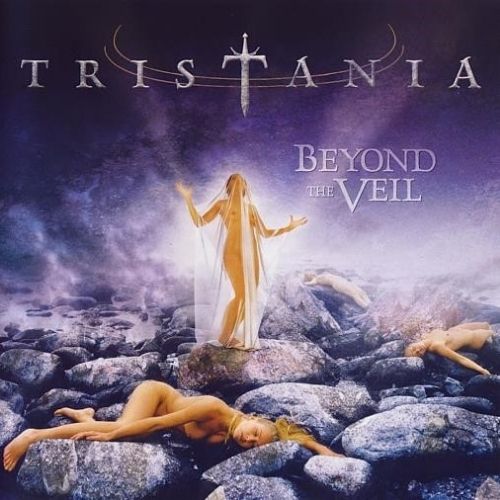
The cover of “Beyond the Veil” also carries the album’s musical logic.
Featuring a photograph by Petter Hegre and a design by Tor Søreide Design, the cover depicts a central figure dressed in white amid a rocky, dark landscape, surrounded by naked bodies lying on the ground and a bruised-looking sky.
Viewed from today, the image may seem to contain every cliché of 1990s Gothic Metal aesthetics: naked bodies, death, fog, mysticism, a white dress, a purple sky.
But when we consider the cover alongside the album’s content, a more meaningful structure emerges.
The central figure is not moving. The bodies around her do not convey any sense of life either. While one side seems to represent life and the other death, there is no clear boundary between the two.
Just like the album itself.
Beauty is not outside decay. It is inside it. For this reason, the cover goes beyond being “a gothic cover for a gothic album” and visualizes the album’s central idea: the two sides of the veil are not completely separate from one another.
Why Was It So Important in 1999?
The answer lies not only in the music, but in the timing.
By the late 1990s, Gothic Metal had not yet become standardized in the way it is understood today. THEATRE OF TRAGEDY’s “Beauty and the Beast” approach had established a strong point of reference, but TRISTANIA took it somewhere more extreme, more symphonic, and more theatrical. Contemporary reviews immediately recognized this.
A 1999 review by metal.de noted that the band had moved away from the THEATRE OF TRAGEDY echoes of “Widow’s Weeds,” using more vocal forms, larger choirs, more violin, and more modern arrangements. The album was consequently awarded 8/10.
A Chronicles of Chaos review published in early 2000, meanwhile, highlighted the combination of female vocals, male and female choirs, death and black metal vocals, clean male vocals, keyboards, and violin, giving the album a 9/10.
In later assessments, the album’s status continued to grow.
In 2008, a Sputnikmusic retrospective described it as one of Gothic Metal’s “crowning jewels,” while assessments on Metal Archives from the same period described the album as the genre’s “quintessence” and one of its high points. In 2014, another assessment directly interpreted the difference between “Widow’s Weeds” and “Beyond the Veil” through the connection between Gothic and Symphonic Metal. A 2021 AllMusic assessment likewise called the album TRISTANIA’s “crowning achievement” and regarded it as one of the strongest examples of the “Beauty and the Beast” tradition.
This historical look back matters.
Because the impact of “Beyond the Veil” was not visible only when it first appeared. The album’s real impact became clearer in the years that followed, as Gothic and Symphonic Metal increasingly moved toward larger orchestral, choral, and theatrical structures.
The Wave Created by Napalm Records
It would also be wrong to attribute the album’s rise to the music alone. Napalm Records supported “Beyond the Veil” heavily. Later archival sources indicate that the album attracted significant attention in Europe, that the band rose to headliner status, and that tours extending into North and South America became possible. In 2000, the band continued touring Europe as a headliner and also secured its first major overseas opportunities in Mexico and the United States.
More interestingly, a 2000 advertisement for Napalm Records America in the Billboard archive marketed TRISTANIA directly with the slogan “The world’s #1 Gothic Metal band.” This was, of course, not an objective ranking, but part of the record label’s advertising language at the time. And that is precisely why it matters: “Beyond the Veil” was no longer simply an album circulating through the European underground; it was being positioned at the center of the international Gothic Metal market.
TRISTANIA’s concert activity extending as far as Mexico and the United States in 2000 also demonstrates the practical result of this. And this is where the great irony in the album’s fate begins.
The Veil Closes
“Beyond the Veil” was the last full-length album TRISTANIA made with Morten Veland.
At the end of 2000, Veland and the rest of the band parted ways due to musical and personal differences. Veland would later form SIRENIA. TRISTANIA continued on with “World of Glass.”
Therefore, “Beyond the Veil” is not merely the creative peak of a band. It is a document marking the end of an era.
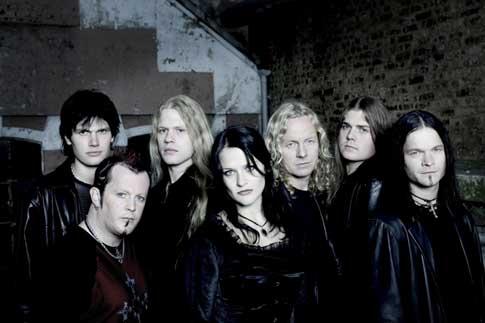
Veland’s weight in guitar, harsh vocals, songwriting, and lyric writing; Einar Moen’s role on keyboards and programming; Vibeke Stene’s soprano vocals; Østen Bergøy’s clean male vocals; Pete Johansen’s violin; and the extensive choir lineup came together in this particular creative equation only once.
Later TRISTANIA records would move in different directions. But the exact same formula found on “Beyond the Veil” would never appear again. Perhaps that is why the album’s impact feels stronger today.
Why Do Its Flaws Still Matter?
To sanctify a Holy Album should not mean declaring it flawless. “Beyond the Veil” can be too long at times. Some tracks repeat the same dramatic method again and again. The choral and keyboard layers occasionally become overly dense. Stene’s voice could have been used more in relation to the album’s potential. Some of the guitar passages are quite simple when considered on their own. Moreover, the album’s lyrics, particularly today, can sometimes be read as an attempt to produce gothic imagery rather than meaning.
A 2010 review also argued that the ideas in the album’s second half were not tied together as tightly as those in the first half. Another retrospective from 2023 noted that the same basic elements are repeatedly used across almost all of the album’s tracks, and that the diversity is not always handled flawlessly. But this is precisely where the historical value of “Beyond the Veil” needs to be separated from its aesthetic flaws. Because much of what sounds familiar today was not nearly as familiar in 1999. When an album uses a language that will later be imitated hundreds of times, some parts of that language may sound less surprising today. That is less the album’s fault than the result of its influence.
Why Should “Beyond the Veil” Still Be Heard Today?
Because when we look back through the lens of the huge orchestras, massive choirs, female vocals, male harsh vocals, and cinematic arrangements that Symphonic Metal possesses today, “Beyond the Veil” shows us what that language looked like before it grew up. There was not yet the budget for a real orchestra. There was not yet the immaculate digital cleanliness of modern metal productions. The genre’s formula had not yet fully settled into place commercially. But the idea was there. In abundance. The idea that a violin melody could work within the same composition as a death/black metal riff. The idea that a soprano vocal could be used not merely to beautify a chorus, but to become the atmosphere itself. The idea that a clean male vocalist could be not a rival to the harsh vocalist, but a third dramatic character. The idea that the choir could be more than decoration, as decisive as a riff. And most importantly, the idea that the darkness of Gothic Metal could be created not merely through slowness and melancholy, but through contrast, layers, and theatrical tension. That is where TRISTANIA’s real legacy lies.
Holy Album
Today, “Beyond the Veil” is not merely one of the good Gothic Metal albums of 1999. It is one of the clearest documents of the period when Gothic Metal began pushing beyond its own boundaries and expanding toward Symphonic Metal.
It walks through the door opened by THEATRE OF TRAGEDY, combining Norway’s extreme metal heritage, gothic romanticism, classical music influences, and the “Beauty and the Beast” vocal approach within a single structure. When larger, brighter, and more commercial versions of Symphonic Metal emerged in the years that followed, the dark and raw side of “Beyond the Veil” became even more valuable. Because the grandeur of this album is not sterile. It is not flawless. It is not always balanced. At times it is too theatrical, too long, too ornate. But that is precisely what makes it alive. Here is a band within a genre that, in 1999, no one yet knew exactly what it would become, testing just how far Gothic Metal could be taken.
And looking back from the Symphonic Metal explosion that would emerge a few years later, “Beyond the Veil” can no longer be heard merely as an album, but as a threshold.
Is there death behind the veil?
The album offers no definitive answer.
But the music proves something else:
Some albums disappear within their own era.
Others become more articulate about why they matter as the years pass.
“Beyond the Veil” belongs to the latter.
A Holy Album in every sense.
