
ALBUM REVIEW
A World Worth Burning – The Sky Was Colored as Hammered Lead
Exploring its post-metal, atmospheric sludge framework, instrumental structure, and genre positioning.
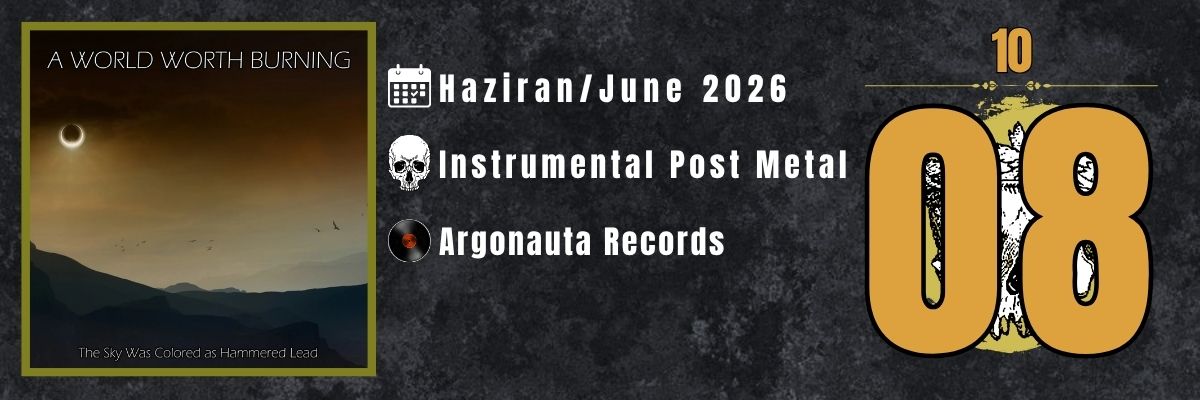
A World Worth Burning emerges as a US-based project operating within a post-metal framework, defined by an instrumental approach that constructs its narrative not through vocals but through layered guitar textures, low-frequency pressure, and slowly evolving compositions. Taking shape during the 2020 period, this structure centers itself around the idea of long-form composition, building a cohesive eight-part album. “The Sky Was Colored as Hammered Lead” stands out as the project’s first substantial statement, clearly outlining both its aesthetic direction and its search for positioning within the genre.
From its opening moments, the album presents itself less as a collection of individual tracks and more as a long-form flow structure, functioning as a unified eight-section composition. The reliance of the guitars on layered harmonic expansion rather than riff generation is the key factor defining this cohesion. Instead of introducing a clearly defined theme at the outset, the guitars gradually build slow intensification through mid-tempo pedal tones and repeating chord progressions; this shifts the narrative away from riff-driven progression toward a surface that accumulates tension. This approach, often seen within the post-metal tradition, is further expanded here through the delayed entry of rhythmic ruptures.
The drum writing functions less as a constant directional force and more as a stabilizing framework between sections. Rather than blast-driven passages or aggressive accelerations, the band opts for a groove logic that moves by shifting its center of gravity. This choice positions the drums as a supportive layer for the harmonic fields opened by the guitars rather than something that sharpens them. Especially in the mid-sections, the drums operate less as a driving force and more as an element that stabilizes the surface, which technically enables the album’s cinematic breadth while keeping its dramatic ruptures under controlled restraint.
The bass guitar emerges as one of the most distinctive elements of the production. Its growling, low-mid focused tone continuously pushes against the atmospheric space created by the guitars in the upper frequencies, generating a sense of weight that is not merely harmonic filling but often a central presence within the mix—at times even overshadowing the guitars themselves. This choice transforms the album’s claimed “catastrophic intensity” from an abstract idea into a tangible physical pressure. However, because this density is maintained at a relatively constant level throughout, it also introduces a certain homogeneity that limits sharper dynamic contrast.
The guitars, diverging from classical post-rock crescendo logic, operate through continuously evolving motifs rather than clearly defined riffs. Even as distortion layers increase, most riffs never reach a definitive point of resolution, resulting in a structure that keeps harmonic motion in a suspended state. While this suspension strengthens the album’s atmospheric dimension, it also introduces a sense of directional ambiguity in certain passages. Even in heavier sections, the preference for broad sonic surfaces over pinpointed impact keeps the material aligned with a sludge/post-metal axis while pushing expectations of death-doom-derived sharpness into the background.
One of the album’s most critical decisions is its claim to construct a vocal-less narrative. As noted in the label text, the instruments are positioned as the “narrative voice.” In practice, however, this narrative unfolds less through clear thematic articulation and more through repetition and shifts in intensity. Rather than producing a direct musical encoding of apocalyptic imagery, the result is a sustained sense of collapse. The narrative exists, but it is not built on specific events; instead, it is constructed through an ever-expanding atmosphere.
The production approach reinforces this atmosphere through a wide, reverb-heavy mix. Yet this spatial openness occasionally softens frequency separation in densely layered guitar sections, reducing the readability of certain motifs. This simultaneously strengthens the album’s cinematic ambition while pushing parts of its compositional detail beneath the surface.
One of the more intriguing aspects of the drum–guitar interaction is the predominantly cyclical rather than progressive nature of the rhythmic structures. This cyclicity aims to create a psychedelic, hypnotic effect; however, in certain sections the delayed transitions result in a static intensity rather than linear development. While this can be read as a deliberate aesthetic choice, not every compositional idea undergoes an equally meaningful transformation within this stasis.
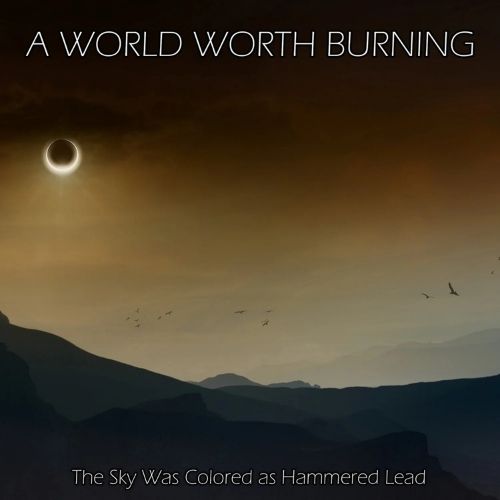
At the aesthetic level, the cover design and typographic choices do not fully match the discipline of the layered intensity the music constructs. The relatively plain and at times generic typographic treatment creates a lower conceptual pressure compared to the sonic density and dramatic scale inside the record. This introduces a subtle tension between the album’s external presentation and its internal architecture.
Ultimately, “The Sky Was Colored as Hammered Lead” positions itself within the triangle of post-metal, atmospheric sludge, and post-rock, prioritizing gradual accumulation and low-frequency pressure over riff-centered aggression. Its strongest moments emerge when guitars, bass, and drums lock into a single mass-like movement; its weakest lies in the fact that this mass does not always fragment and reshape itself with sufficient variation. For the listener, the record demands engagement as a sustained atmosphere rather than linear progression, yet because not every section delivers an equivalent degree of compositional transformation, the experience occasionally oscillates between intensity and stasis.
OZAN
https://www.facebook.com/A.World.Worth.Burning.Official
https://www.facebook.com/ArgonautaRecords