
ALBUM REVIEW
AMAROK - Overcome
Same compositions, ten different dark interpretations.
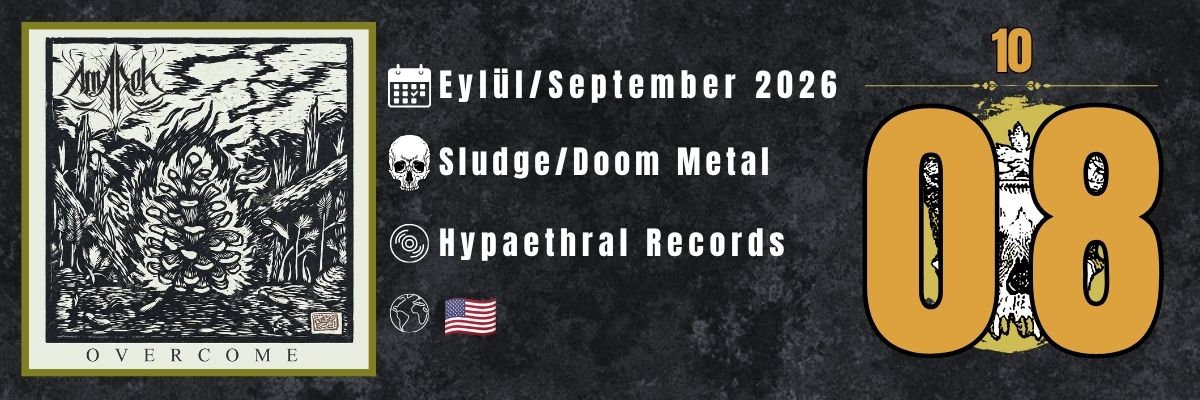
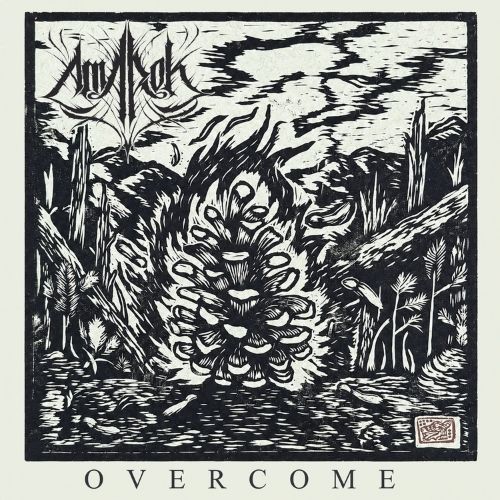
Treating AMAROK’s latest work, "Overcome", simply as a new album would mean overlooking the nature of the project itself. The five tracks from 2024’s "Resilience" are revisited here through ten separate interpretations; as a result, what emerges is less a collection of new compositions than a companion album that tests how far the same material can be transformed under different aesthetic approaches. Released by Hypaethral Records, this double album brings together artists from experimental and extreme metal circles, each pulling AMAROK’s already weighty, large-scale compositions into their own sonic worlds.
This approach becomes particularly meaningful when considering the musical structure of "Resilience". AMAROK combines the sustained weight of funeral doom with the melodic guitar layers and sharper intensity of black metal, but its songs are not constructed simply as sequences of slowed-down riffs. Guitar harmonies that linger within the same atmosphere for extended stretches, heavy bass movements, and slow drums establish the music’s physical weight, while the melodic lines give that framework a more fragile dimension tied to grief, loss, and spiritual searching. This is precisely where "Overcome" finds its central premise: the guest musicians are not tasked with reproducing finished songs, but with displacing the established centers of gravity within them.
Two distinct tendencies emerge as a result. Some interpretations preserve the melodic or emotional core of AMAROK’s compositions and make it visible through different instrumentation, while others almost dismantle the source material piece by piece. Leila Abdul-Rauf’s interpretation of "Penance" is one of the clearest examples of the former approach. By transforming the guitar melodies from the original into vocal lines and placing minimal synth drones beneath them, she rebuilds the composition not around its heavy doom foundation, but around melodic and vocal expression. The Eastern European folk influence added to this melodic transformation also shifts the song’s emotional center elsewhere. Most importantly, bringing the lyrics to the forefront demonstrates that the guitar harmonies in the original composition are not merely decorative elements, but a core that can be reinterpreted.
GRIDFAILURE’s treatment of the same song stands almost at the opposite end of the spectrum. Spanning roughly 18 minutes, the interpretation pulls the doom-heavy character of "Penance" toward a more experimental and darker black metal axis. Here, textural transformation takes precedence over the composition’s immediately traceable melodic backbone; the heavy and bleak source material takes on a noisier, more avant-garde, and more unsettled form. The difference between these two interpretations also explains why "Overcome" is more than simply a remix compilation: in different hands, the same composition is being reinterpreted not only through different sounds, but through different compositional approaches.
Andrew Black’s reworking of "Legacy", meanwhile, highlights another method. In AMAROK’s roughly 12-minute original, the solitude carried by the acoustic chords and the sense of grief intensified by the guitar harmonies unfold alongside the physical pressure of the bass and heavy drums. Black strips away much of that weight, giving the central melody a more ethereal and spiritual character. Organ tones, string-like textures, and the imperfect timbre of the piano preserve the song’s melodic core while moving it away from the physical weight of funeral doom and toward something more ceremonial. The fact that the piano carries the melody into the finale is particularly telling, demonstrating that the reworking is not merely a change in effects or production, but a reconsideration of the song’s dramatic progression itself.
A similar degree of freedom is present in the other interpretations. The inclusion of two different versions each of "Charred", "Ascension", and "Interlude" prevents the album from settling into a single reinterpretation aesthetic. Moving between experimental electronic textures, noise, industrial influences, and heavy atmospheres bordering on funeral doom, these versions make the already inaccessible nature of "Resilience" even more fragmented. This is also where the album’s most obvious problem emerges: as the freedom of reinterpretation increases, the recognizable musical identity of the source compositions recedes in some cases. Particularly on versions built around extended, dense textures, following the new idea itself can become more difficult than following the dramatic arc of AMAROK’s original composition.
Rather than making "Overcome" more accessible to a wider audience, this turns it into a work that demands a certain amount of patience from the listener. Yet that inaccessibility should not be viewed entirely as a flaw. The project’s purpose is not to make the melodies of "Resilience" easier to consume, but to test the material underlying those compositions through different sonic frameworks. One interpretation brings the main melody to the foreground, another places the emphasis on texture, while another centers the vocals or noise. From this perspective, the album’s cohesion comes not from the versions resembling one another, but from the openness of the same source material to different creative interventions.
Even so, "Overcome" cannot have its artistic value measured directly by the accessibility of each individual reinterpretation. What makes the album most interesting is the extent to which it reveals the flexibility of AMAROK’s songwriting. The broad territory "Resilience" establishes between doom, black metal, and post-metal is opened up even further by the guests’ interventions; yet that expansion does not always produce a stronger result. In some interpretations, the new approach brings a hidden aspect of the original song into view, while in others it pushes the source composition’s backbone too far into the background. There is therefore a constant tension here between novelty and function.
For that reason, "Overcome" is better understood as a second reading of "Resilience" than as an entirely new AMAROK release in its own right. What it asks of the listener is less the discovery of new songs than an examination of what five familiar compositions can become under different aesthetic interventions. Much like rereading a book through the experience gained from life since the first reading. In this respect, the album does more than expand AMAROK’s heavy music; it makes its boundaries visible. Not every reinterpretation is equally convincing, but the two markedly different approaches to "Penance" and "Legacy" clearly demonstrate how the same melodic and emotional core can produce radically different results. That is where "Overcome" leaves its lasting impression: rather than repeating "Resilience", it investigates which parts of it can be dismantled and rebuilt.

https://www.instagram.com/amarokdoom
https://www.facebook.com/amarokdoom
https://linktr.ee/hypaethralrecords
https://instagram.com/hypaethralrecords
https://www.facebook.com/hypaethralrecords
https://twitter.com/hypaethralrecs