
ALBUM REVIEW
Amberian Dawn – Temptation’s Gates
A Controlled Shift in Modern Symphonic Metal
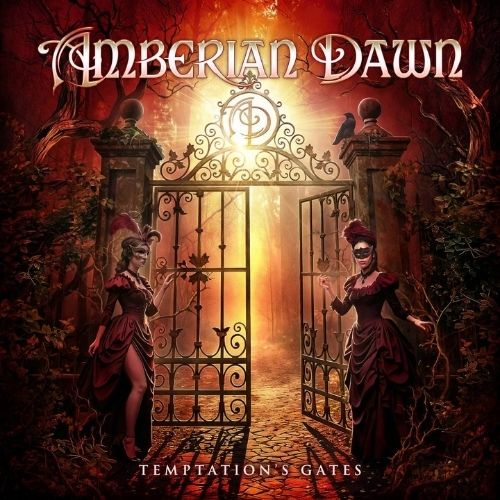
Finland-based Amberian Dawn occupies a distinctive position within the symphonic metal scene, blending melodic songwriting with the traditions of power metal. Led by Tuomas Seppälä, the band sits on the more accessible end of the genre spectrum, defined by its keyboard-driven atmospheric approach and clean, sharply articulated riff structures. “Temptation’s Gates” serves as an important threshold for examining how this aesthetic is reshaped through a new vocal era.
At first glance, the album operates within a framework that can be read as “modernized symphonic metal”; however, its true character emerges in the complex answer it gives to where this modernization actually takes hold and where it remains merely surface-level. Tuomas Seppälä’s guitar- and keyboard-centered writing pulls orchestral density into the background, constructing a riff–hook-driven skeleton. While this choice may sound like a deliberate simplification in response to the genre’s often over-layered production issues, it also establishes a framework that limits the compositions’ capacity for dramatic expansion. The riff structures are largely derived from power metal traditions, built on clear chordal centers and harmonically low-tension progressions, creating a continuous sense of melodic fluidity rather than unresolved harmonic pressure.
The drum writing supports this framework by maintaining a linear propulsion, particularly in mid-tempo passages, allowing the guitars to operate without forcing rhythmic variation while not actively pushing them forward either. In more aggressive moments such as “Moon,” blast beats are introduced, but this intensification remains in the realm of brief dynamic bursts rather than a parameter that reshapes the overall form of the track. This creates a gap between the album’s implied “heavier direction” and its actual compositional outcomes; heaviness functions more as a surface-layer intensity effect than a structural transformation.

Nicole Willerton’s vocal performance sits at the center of the album and directly defines the direction of its writing strategy. Clean vocals function not only as melodic carriers but also as a primary structural layer filling harmonic space. In tracks such as “Temptation’s Gates” and “The Vision of Dreaming,” vocal melodies operate as a secondary layer independent of the guitar riffs, reinforcing a vocal-led melodic hierarchy typical of symphonic metal. However, the growled vocals introduced in “Unchained” do not integrate as a fully embedded oppositional force within the system; instead, they function more as a tonal rupture, a color shift. This dual vocal approach is familiar enough to be read as part of a broader scene trend, yet it does not produce a compositional necessity that expands the genre’s boundaries.
Keyboard usage forms the aesthetic backbone of the album. Rather than intensifying orchestral layering, Seppälä relies on atmospheric pads and short melodic motifs, steering the production toward a “lightened symphonic” direction. This approach creates an openness that edges toward pop–power metal territory in tracks such as “Eternal Flame” and “Life is Art,” where keyboards act less as carriers of orchestral weight and more as the melodic engine of the song structure itself. While this deliberately steps back from the traditional symphonic metal expectation of epic escalation, it also introduces a sense of structural thinness in certain passages.
Guitar tones are rooted in a clean, sharply mid-focused modern production aesthetic. However, this clarity often flattens rather than strengthens the harmonic identity of the riffs. In tracks such as “Moon” and “Undying Colours,” the riff writing is functionally solid but leaves little lasting imprint due to a lack of rhythmic variation and harmonic deviation. In contrast, more hook-driven compositions like “The Vision of Dreaming” achieve greater cohesion through riff–vocal synchronization, where guitars function as a complementary rhythmic framework rather than competing with the keyboards.
One of the most notable structural decisions on the album is its deliberate avoidance of large-scale symphonic metal “epic” forms. Most tracks remain close to 3–4 minute pop-song structures, allowing each piece to function as an independent melodic unit. This approach has a dual consequence: it makes the album more accessible and compact on one hand, while limiting the genre’s characteristic potential for layered development on the other. As a result, the album moves within a consistent mid-level intensity rather than building dramatic peaks.
The production approach is generally clean and controlled, but this control also reduces micro-tensions between instruments, homogenizing the overall sonic density. In particular, the bass guitar remains confined to a supportive role that rarely extends beyond reinforcing the rhythmic foundation, staying passive beneath the guitar–drum interaction. This anchors the album’s rhythmic structure in a safe but risk-averse register.
Aesthetically, “Temptation’s Gates” does not fully break from the band’s ABBA-referencing previous era but instead re-codes that pop sensibility within a symphonic metal framework. While this pop-oriented approach enhances melodic accessibility in certain passages, it also acts as a filter that reduces the genre’s dramatic intensity. Consequently, the album’s aesthetic direction reads less as a radical repositioning and more as a controlled softening strategy.
In conclusion, “Temptation’s Gates” occupies a position within contemporary symphonic metal production trends defined by a cleaned-up, streamlined, and vocal-centric approach. The album avoids large-scale orchestral ambitions in favor of direct melodic writing, yet this choice does not consistently generate structural depth. The listening experience demands a continuous, fluid melodic surface rather than a layered dramatic architecture. For this reason, the album positions itself less as a boundary-pushing rupture and more as a controlled variation that refines existing symphonic metal aesthetics into a more accessible, pop-oriented form.
OZAN
https://amberiandawn.bandcamp.com/album/temptations-gates
https://www.facebook.com/amberiandawn