ALBUM REVIEW
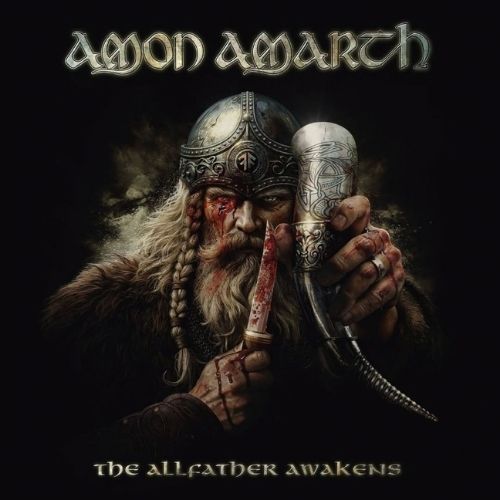
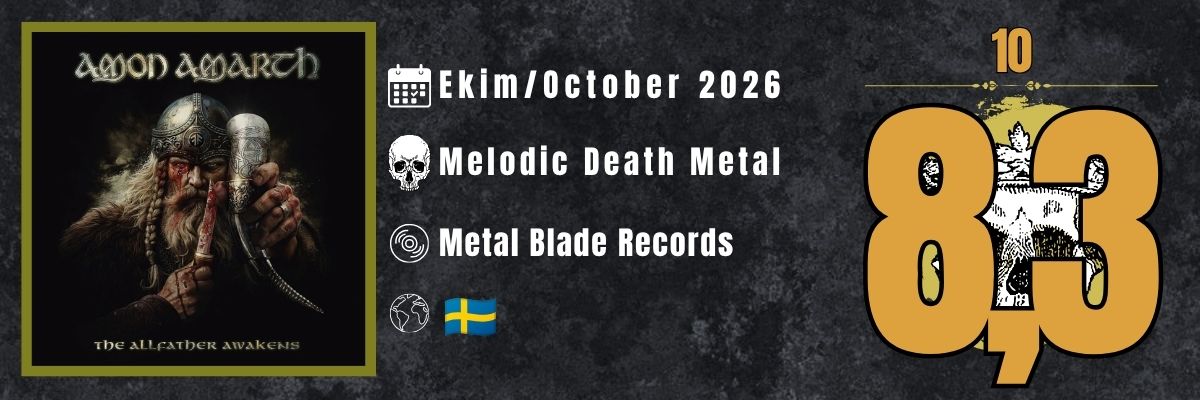
AMON AMARTH – The Allfather Awakens
AMON AMARTH makes its old formula work again.
Right now, I find myself at a point I had long hoped would never come. I think that, in recent years, writing an AMON AMARTH review would have ranked near the top of the list of things I least wanted to do. I don't want to because the band's new career trajectory, which began with "Jomsviking", has been genuinely painful for me after first discovering them through the "Sorrow Throughout the Nine Worlds" EP and following them ever since. For that reason, even though I hate doing it in a review, I will resort to more personal phrasing such as "I think" and "in my view" in many parts of this piece, because there is simply no other way around it. Of course, that does not mean I am going to set objectivity aside and turn this review into a personal grievance against the band. So let's first evaluate the album objectively, by the standards of today's mainstream metal. Toward the end of the review, I will share my thoughts less as a critic performing an autopsy on the album and more as a tired fan who has followed this band since the '90s.
In AMON AMARTH's career, "The Allfather Awakens" is less an attempt to change direction or open a new chapter than a record that tests how functional the musical language they have developed over the years still is. The band's connection to Viking mythology, tales of war, and melodic death metal is no longer merely a theme; it has become a self-contained universe that determines everything from the guitar melodies and vocal character to the crowd-participation-ready choruses and stage-oriented songwriting. Following the tired and occasionally forced feel of "The Great Heathen Army", the difference here is that the band has arrived at more vital songwriting while remaining within the same boundaries.
"Gjallarhorn" demonstrates within its opening minutes why this approach still works. The ceremonial vocals and guitar lines at the beginning quickly carry the song toward a broad, anthemic chorus; the aggression of melodic death metal meets the immediately accessible harmonic language of classic heavy metal. While Olavi Mikkonen and Johan Söderberg's guitars provide the album's primary field of movement, Johan Hegg's unmistakable harsh vocals place those melodies in a rougher, more martial framework. "Eight Legs Of Thunder", meanwhile, makes the band's heavy metal side more pronounced with its galloping guitars. The fact that removing Hegg's vocals from the equation would leave behind a fairly conventional heavy metal backbone also reveals just how much AMON AMARTH's melodic death metal identity depends on the contrast between guitar melodies and vocals.
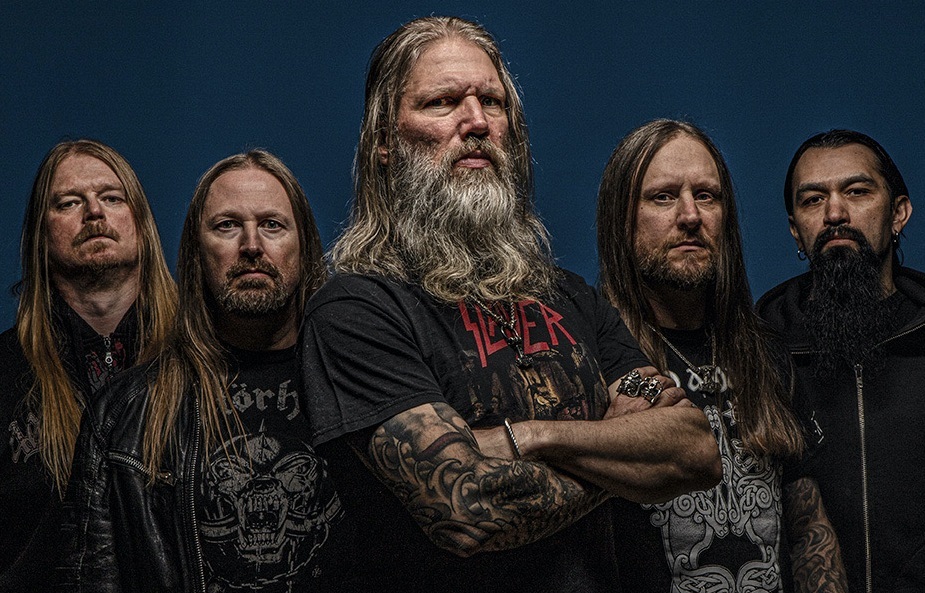
The improvement in the album's songwriting is particularly apparent in its choruses. "We Rule The Waves", "Raven God" and "The Allfather Awakes" rely on direct melodies that sound designed for the biggest stages, but that directness is not synonymous with simplicity. Mikkonen and Söderberg's twin-guitar harmonies prevent the songs from blurring completely into one another by reworking familiar patterns through different melodic variations. "Raven God" brings classic heavy metal-derived guitar work and a strong solo to the foreground, while "Kvasir's Blood" builds tension with a heavier, darker opening. The brief industrial touch in the middle also provides a small but functional deviation from the band's established formula.
For the most part, the rhythm section does its job with enough directness to carry this melodic framework. The double-kick work, marching rhythms and crushing mid-tempo passages on tracks such as "Die With A War Cry", "Raven God" and "The Allfather Awakes" provide the musical equivalent of the album's tales of war. At the same time, this is where the album's most obvious limitation emerges: its tempos and rhythmic dynamics largely remain within the safety of a mid-paced range. The individual songs have enough movement of their own, but the album as a whole could have benefited from more pronounced tempo shifts or sharper rhythmic contrasts, which might have given such a familiar formula greater dramatic impact.
"The Allfather Awakens" truly opens up a different space with "Upphaf". Being the first entirely acoustic song in AMON AMARTH's history can be considered an innovation in itself, but what really matters is how naturally it has been integrated without disrupting the album's identity. The narrative character of the lines taken from Völuspá combines with Hegg's more restrained vocal delivery here. As the music pulls back the walls of guitars and brings its acoustic textures to the forefront, the song's Scandinavian character remains intact. More importantly, this passage provides a genuine contrast with the darker, more martial character of the immediately following "Die With A War Cry". "Upphaf" is therefore valuable not merely because it is the band's first acoustic song, but because it serves a real function within the album's dynamics.
This controlled variety continues through the rest of the album in smaller details. "The Allfather Awakes" places the band's classic guitar language within a more modern and crystalline production framework, while "Ascending Like An Eagle" opens up a broader melodic space in the finale through its extended form. Approaching the seven-minute mark, the track takes more time to develop its ideas than the album's more direct songs, making it an appropriate choice for the closing slot. "Oden's Hunt", meanwhile, is one of the less impressive tracks among the closing numbers, though it is not weak enough to disrupt the overall flow.
Production also plays an important role in this recalibrated AMON AMARTH identity. Jacob Hansen's approach keeps the guitars distinct, the drums active and Hegg's vocals central without allowing the instruments to overwhelm one another. The clean separation of the twin-guitar harmonies in particular makes the details of the band's songwriting easier to hear. The result is a sound that carries the sheen of modern metal without sterilizing the band's rough, martial character. In that sense, the production does more than provide a cleaner surface; it allows the material AMON AMARTH have been working with for years to function more clearly.
None of this makes "The Allfather Awakens" an innovative album. Apart from "Upphaf", there is little evidence that AMON AMARTH has moved substantially away from its established language. But the real issue here is less originality than the formula becoming functional again. The balance between the melodic death metal and classic heavy metal inherited from the band's past, the huge choruses and the Viking narratives are still at the center. The difference is that this time the songs bring those elements together with less strain. The formula that occasionally felt like a self-repeating machine on "The Great Heathen Army" flows more naturally and with greater vitality here.
For that reason, the success of "The Allfather Awakens" lies not in AMON AMARTH discovering a new identity, but in correctly identifying which parts of their own identity still have strength. The album only rarely reaches the level of the band's classic periods, and it could certainly have been bolder in terms of rhythmic variety. On the other hand, its compact running time of roughly 43–46 minutes, its refusal to overstay its welcome and the quality of its melodic material set it apart from the band's more cautious recent efforts. AMON AMARTH are not merely repeating their past here; they are reminding us which elements of that past can still work onstage, through headphones and in a chorus.
At precisely this point, if I am to say what I genuinely feel as someone who has been among the band's first-wave fans, expecting an AMON AMARTH album on the level of "Once Sent from the Golden Hall" would, of course, be naive. After all the difficult periods the band went through, the risks every member took at the expense of their own quality of life, and the tremendous success that followed "Versus the World", which they recorded almost as if they were challenging the world with a "This is the final move, all or nothing!" attitude, it is obvious that they were never going to return to a '90s sound simply out of a love for true metal once every door in the mainstream scene had been thrown wide open.
What bothers me as an old fan is not the change AMON AMARTH has undergone at the level it has reached. The band has been active since 1992 and has managed to reach several different generations over those 34 years. The members have grown older, and of course such a transformation was inevitable. What I cannot stand, however, is the abandonment of the distinctive riff-writing methods that were so clearly identifiable in AMON AMARTH's sound, including on "Twilight of the Thunder God". What bound many AMON AMARTH fans like me to the band was neither the synchronized headbanging, nor drinking mead from horns onstage, nor even the Viking touches that looked incredibly fantastical and were not something we were accustomed to seeing on the main stage at the time. It was that unique approach to riff writing that formed AMON AMARTH's original and core fanbase. This riff structure, which drew inspiration from countless metal legends ranging from BLACK SABBATH to VENOM and from IRON MAIDEN to ENTOMBED, yet managed to express all of those influences through a completely distinctive sonic language, was abandoned once the band accepted the rules of the mainstream metal scene. So were the solos capable of pulling you out of the reality you inhabited and the potential to produce hit songs on every album that would remain with you for years to come. That is precisely what hurts me. The change in the band's sound became brutally apparent with "Jomsviking". Although AMON AMARTH has received a positive response to this transformation, particularly from its newer fanbase, they seem to have lost their frequency with listeners like me.
I know I have said a lot of negative things about the band, but all of that is, of course, connected to the journey of my relationship with AMON AMARTH stretching all the way back to the '90s, and has nothing to do with the band's latest album, "The Allfather Awakens". But as someone who rarely talks about this subject, I wanted to mention it in this review as well. I know this has been a long piece. If I've bored you, please forgive me. However unsatisfied I may be with where AMON AMARTH have arrived sonically, it is still a great feeling to have witnessed their journey from the days when they released their first recording through a Singaporean label and played their first show at a youth club in Stockholm, with DISSECTION headlining, to the level they have reached today. Enjoy the new album.
