
ALBUM REVIEW
PARIUS – Alchestronomy
Intricate progressive metal meets extreme heaviness.
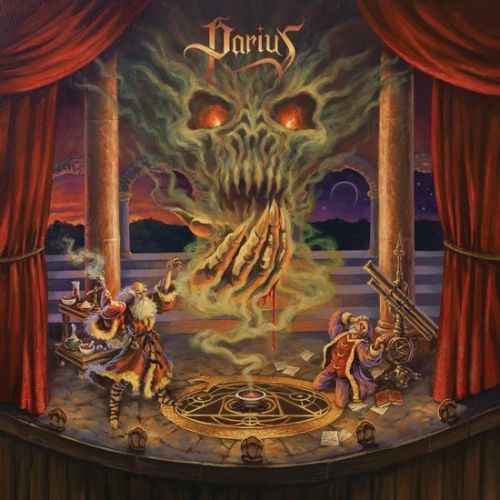
PARIUS, hailing from Philadelphia, take their approach of combining the intricate compositional language of progressive metal with the harsh vocals of death metal in search of a greater sense of cohesion on their fourth studio album, "Alchestronomy". Following 2022's "The Signal Heard Throughout Space", the new record is conceived as a single, seven-part suite spanning approximately 36 minutes. Its narrative framework revolves around an ideological clash between an alchemist and an astronomer, each seeking the secret of immortality. The connections to DREAM THEATER's "Six Degrees of Inner Turbulence" and THE MARS VOLTA's "Cassandra Gemini" help explain PARIUS's affinity for both the long-form compositional tradition of progressive metal and more theatrical, unpredictable modes of storytelling.
Opening track 'Alchemy' welcomes the listener with Hammond organ tones reminiscent of vintage progressive rock recordings. The character of the piece shifts shortly afterwards when the harsh vocals kick in, while the melodic passages featuring clean singing pull its intensity in a different direction. The transitions Louis Thierry makes between these two vocal approaches are one of the album's defining musical elements. His clean vocals occasionally recall the James LaBrie era of DREAM THEATER, but Thierry's performance cannot be judged solely on that resemblance. The shifting character of his harsh vocals and the variety the melodic passages bring to the narrative broaden the role of the voice within the compositions. Yet this diversity does not always translate into strong melodic cohesion. The vocal lines, in particular, are not consistently memorable enough, limiting the emotional impact of certain passages.
There is no question about PARIUS's musicianship. Ryan Rauch's guitar work moves between abrasive, angular riffs and more traditional progressive metal melodies, while his solos leave little doubt about his technical ability. Kenny Rentz's bass is more than just a foundation for the low end; at times, funk- and blues-inflected passages directly shape the rhythmic character of the compositions. The bass lines in 'Unbecoming of a Gentleman' and 'Equivalent Exchange' are particularly effective, balancing the density of the guitars and opening up a different kind of movement within the music. Dan Silver's drumming provides the backbone for compositions built around shifting time signatures and sudden transitions. Guest keyboardist Diego Tejeida, meanwhile, brings a range of colours from Hammond organ to piano, further emphasising the album's progressive rock side.
The way the seven sections connect makes it clear that "Alchestronomy" is more than a collection of tracks simply placed one after another. At the same time, its structure allows the individual sections to stand on their own, attempting to strike a balance between the suite concept and the traditional song format. 'Celestial Sea' represents the album's more aggressive side, with sudden time changes and bursts of harsh vocals, though the way melodic transitions are woven into these passages sometimes creates a stark contrast. 'Chrysopoeia', by comparison, has a distinct character of its own, packing lively bass-driven passages, effect-laden guitars and more playful melodic choices into a little over three minutes. Its occasional shift into a cheerful mood before returning to darker territory demonstrates how the band draws on the unpredictability of progressive music.
This diversity stretches further across 'Equivalent Exchange' and 'Blind Eyed Starlight'. The former begins with blues-influenced bass lines before gradually building through increasingly heavy guitars and powerful solo sections. 'Blind Eyed Starlight' takes a darker opening into rising melodies, harsh vocal shifts and a prominent guitar solo. The connection between these two sections is one of the suite's most effective structural moments. In the instrumental passages, the guitars and keyboards answer one another, and these exchanges do more than showcase the band's technical ability: they also heighten the emotional intensity of the compositions. On the other hand, the layers of riffs, melodies and rhythmic changes piled on top of one another in certain sections leave little room for the music to breathe. When a new idea appears at almost every turn, the sense of development can eventually begin to suffer.
This becomes particularly significant when considering the relationship between progressive metal and death metal. The framework PARIUS builds around clean vocals, melodic keyboards and complex instrumental passages takes on a heavier character with the addition of harsh vocals. However, the combination of these approaches does not always produce a natural sense of cohesion. In some transitions, the harsh vocals sound less like a continuation of the melodic atmosphere established beforehand and more like an element added to the composition after the fact. There is potential for a strong relationship between the complex rhythmic structures of technical death metal and the melodic, theatrical storytelling of progressive rock, yet "Alchestronomy" occasionally positions these two tendencies against each other. The failure of some vocal sections to develop sufficiently distinctive melodic hooks means the instrumental passages tend to leave a more lasting impression. The interplay between guitars and keyboards in 'Equivalent Exchange' and 'Blind Eyed Starlight' ranks among the album's strongest moments in this respect.
The production choices are also part of this discussion. PARIUS have stated that they avoided modern digital editing techniques such as quantization and pitch correction in favour of a more traditional recording approach. Finalised through Jamie King's mixing and mastering, the album makes this choice particularly apparent in the vocals. Thierry's performance retains a natural quality, free from the extensive digital correction often found in contemporary progressive metal productions. The trade-off is that vocal notes not delivered with absolute precision also become more noticeable. There are positive results from this approach elsewhere, however. The rhythmic flexibility is more apparent in the interplay between bass and drums at the beginning of 'Chrysopoeia', while the instruments maintain an interaction that preserves a sense of live performance throughout the record. Even so, it is difficult to regard this recording philosophy as an inherently innovative move. Its real significance lies in preserving the natural variations in the musicians' performances rather than striving for a perfected take.
The closing section, 'Astronomy', brings together the melodic and aggressive elements encountered throughout the preceding parts. After a more restrained opening, the track expands through piano and vocal arrangements, with a guitar solo and Thierry's shifting vocal styles setting up the suite's conclusion. The backing vocals moving between the stereo channels in the final section lend the track an additional sense of depth. The applause effect, evoking the end of a live performance, remains a curious choice after the musical finale, with its relationship to the album's overall aesthetic never fully explained.
"Alchestronomy" clearly demonstrates PARIUS's command of progressive metal's technical possibilities and their desire to bring different musical traditions together within a single composition. At 36 minutes, it offers a shorter, more concentrated alternative to the genre's increasingly lengthy album format, while its seven-part suite structure gives the record a distinct sense of cohesion. Nevertheless, the failure to fully develop its constantly shifting musical ideas, coupled with occasional disconnects between the harsh vocals and melodic passages, limits the album's potential. At their best, PARIUS bring together the melodic richness of progressive rock and the intensity of extreme metal with a natural ease; in less successful moments, complexity takes precedence over memorability. Rather than pushing the established boundaries of the genre beyond their limits, "Alchestronomy" demonstrates just how delicate a compositional balance is required to bring different approaches together within them. It is an album with plenty of strong moments, but also a number of unresolved issues.

https://www.facebook.com/pariusofficial
https://parius.bandcamp.com/album/alchestronomy