
ALBUM REVIEW
APOGEAN - Waste Where Life Begins
Heavy, Dark, Controlled
APOGEAN are a band rooted in Canada’s modern technical death metal scene, shaping their musical approach not only through a high level of instrumental proficiency but also through an attempt to merge different extreme metal influences. Following their 2024 debut album "Cyberstrictive", which brought the band considerable attention, their second full-length "Waste Where Life Begins" reshapes their technical intensity through heavier grooves, darker atmospheres, and melodic touches. However, this stylistic shift creates a certain tension between APOGEAN’s potential and the album’s compositional cohesion, resulting in a listening experience that remains open to debate.
At a time when modern technical death metal continues to explore the fusion of different stylistic directions, APOGEAN choose not to create a direct continuation of their debut with "Waste Where Life Begins", instead building an identity that is heavier, more atmospheric, and more groove-oriented. However, this transition does not fully balance the band’s desire to showcase their technical abilities with their new aesthetic goals. The album delivers strong moments through sharp guitar work, intense rhythmic accents, and a dark tonal palette, yet not all of these ideas are developed enough to achieve the same impact on a compositional level.
APOGEAN’s previous release, "Cyberstrictive", was an album that embraced the intricate riff structures, high-speed drumming, and memorable melodic frameworks associated more directly with modern technical death metal. "Waste Where Life Begins", on the other hand, pulls back from that approach, moving toward deathcore-influenced heavy grooves, black metal-derived tremolo passages, and a broader use of atmosphere. This shift becomes especially apparent on tracks such as 'Waste Where Life Begins' and 'Lie in Cinder'. Here, the guitars are built less around technical density and more around low-tuned, staccato chug patterns and mechanical rhythmic repetition. However, these choices do not always create a new expressive space; in some sections, they move uncomfortably close to established modern deathcore formulas.
This is where the album’s central issue emerges: APOGEAN’s technical background has not disappeared completely, but this technical approach has been pushed away from its role as the primary driving force of the songs and instead appears as an occasional embellishment. The repeated guitar patterns, recurring rhythmic accents, and similar aggressive transitions used heavily throughout the first half occasionally weaken the distinction between tracks. Despite its relatively short runtime, "Waste Where Life Begins" sometimes feels less like a collection of ideas naturally developing and more like a repeated exploration of a specific sonic aesthetic.
That said, APOGEAN’s new direction cannot be considered an outright failure. The emphasis on atmosphere and melody opens a different creative space compared to the band’s earlier work. 'Daughter of the Oak' establishes the album’s aesthetic blueprint within its opening moments: Gojira-influenced rhythmic structures, black metal-inspired tremolo melodies, powerful growls, and Laura Bates’ violin contributions all merge within the same framework. However, the violin remains more of a supporting color that enhances the existing atmosphere rather than a central element capable of altering the album’s compositional logic. Similarly, the choral textures and ambient passages expand the sonic palette but do not fundamentally reshape the songwriting dynamics.
At this point, APOGEAN’s experimental approach separates them from the more radical examples found within today’s technical death metal landscape. While many bands associated with The Artisan Era, Willowtip, or Transcending Obscurity develop technical intensity not only through virtuosity but also through compositional complexity and unexpected structural shifts, "Waste Where Life Begins" follows a more controlled and accessible path. Although the band incorporates elements of black metal, neofolk, and classical music, these influences mostly orbit around the existing death metal foundation rather than transforming it. The experiments support the album’s character, but they do not become elements that redefine it.
One of the album’s strongest aspects emerges within the rhythm section. Doug Noel’s drumming significantly reduces the risk of the material becoming monotonous. On tracks such as 'Nassaru' and the album closer 'Black Smoke, Bleeding Earth', Noel’s use of blast beats, sharp transitions, and varied cymbal work allows the songs to move with greater dynamism. Particularly within the more complex riff structures, the drums do not simply follow the guitars but take an active role in shaping the direction of the compositions.
Mac Smith’s vocals are another clear strength of the album. Smith moves between deep guttural vocals, high-pitched screams, rasped tones, and pig squeal techniques, adding multiple layers to the material. The vocal production is also balanced in a way that supports this range; rather than disappearing behind the wall of guitars, the vocals maintain a clear presence above the rhythmic foundation. However, the strength of the vocal performance occasionally overshadows the musical foundation, especially in moments where certain tracks fail to establish equally compelling riff identities.
The album’s strongest moments generally appear when the band moves away from its heavier structures and develops more fluid melodic ideas. 'White Trees, Black Leaves' builds a more dynamic rhythmic framework through black metal-rooted melodic lines, while the guitar solos in the second half of the track provide one of the album’s most effective moments. 'Nassaru' offers a more balanced composition, with shifting riff structures, Laura Bates’ violin contributions, and Joshua Ward’s spoken-word passages giving the track a more defined narrative character. The closing track 'Black Smoke, Bleeding Earth' similarly brings together the band’s atmospheric and melodic sides in a more successful manner.
From a production perspective, "Waste Where Life Begins" possesses a thick and controlled sound that aligns with modern extreme metal standards. The guitar tones create a powerful low-end weight, while the drums maintain the necessary physical impact, particularly during the groove-oriented sections. However, this dense digital clarity occasionally increases the music’s mechanical feel. Although APOGEAN’s modern mixing approach supports the aggression of the material, it sometimes limits the space where a more organic sense of dynamics could develop.
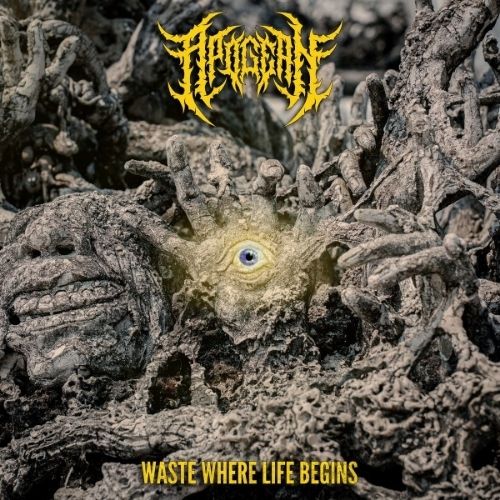
On the visual side, the artwork created by Dexter Forbes combines the album’s cosmic, biological, and dark themes through All-Seeing Eye symbolism and fossil-like imagery. While this approach aligns with the band’s science-fiction and dystopian aesthetic background, it does not significantly move beyond the symbolic vocabulary frequently used within extreme metal’s visual language. The cover complements the atmosphere of the music, but it does not become an element that independently strengthens the album’s unique identity.
"Waste Where Life Begins" is not an album that fails due to a lack of ability from APOGEAN; on the contrary, the band’s musical capabilities remain clearly evident throughout the record. The issue is that many of their ideas remain centered around the same point of gravity, with different influences often existing on the surface rather than transforming the songwriting itself. Instead of pushing the current boundaries of technical death metal, the album explores how the genre can be rearranged through black metal atmospheres, deathcore weight, and melodic elements.
Ultimately, "Waste Where Life Begins" is a record that asks listeners to focus less on constant technical complexity and more on the details of heavier riffs, atmospheric transitions, and controlled structural shifts. APOGEAN expand their sonic territory here, but this expansion has not yet reached the point of completely redefining the band’s identity. The album presents ideas that strengthen their position within the contemporary extreme metal scene; however, the band’s true potential appears to lie in their ability to carry these ideas forward through bolder compositional decisions in the future.
OZAN