
EP REVIEW
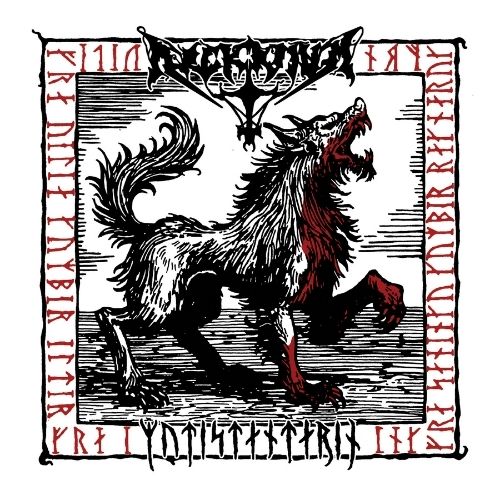
Arckanum – Motestandarin
The silence broken by "Motestandarin"
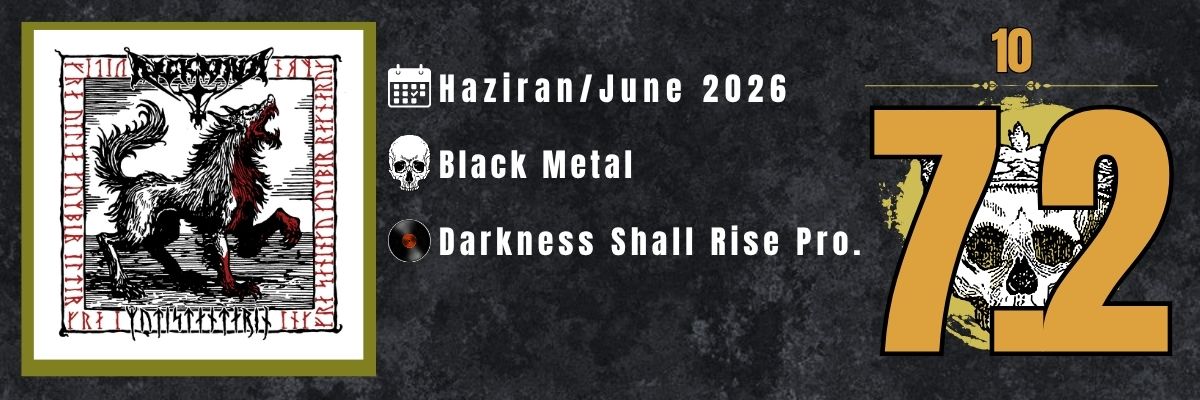
Arckanum, one of the longest-running one-man projects of the Swedish black metal scene, has persisted through a ritualistic and occult musical language shaped by Shamaatae since the early 1990s. The project represents a more chaotic and ceremonial interpretation of early Swedish black metal aesthetics, defined by tremolo riff cycles, the use of vocals as a rhythmic instrument, and a deliberately blurred atmospheric approach. The Motestandarin EP is positioned within this extensive discography as a short but critical transitional threshold that demonstrates how Arckanum’s existing language is being reorganized.
At first glance, the EP appears to lean on a return narrative, yet its two-track structure instead presents an attempt at repositioning that operates within a narrower framework. At its core, the material still relies on Shamaatae’s long-established tremolo riff cycles, mid-tempo, blast-driven transitions, and the use of vocals as a rhythmic instrument; however, these structures are now left more exposed, with a stripped-down mix approach and fewer layers.
The guitars remain faithful to the classic Arckanum vocabulary, built on continuously repeating riff blocks with minimal modulation and a more drone-like flow. Compared to earlier releases, however, the dirty harmonic overlays and chaotic secondary guitar lines have been pulled further back. This results in a more linear overall motion; while riff changes remain evident, the reduced friction between layers keeps tension at a more controlled level. Particularly in more melodic passages such as Anskoti, the riffs are allowed to approach an epic sense of elevation, yet arrangement decisions repeatedly interrupt this progression, deliberately leaving the structure “unresolved.
The drum writing is the clearest reflection of this minimalization. Blast beats have not been entirely abandoned, but they now function more as transitional devices, while the primary rhythmic foundation leans toward a mid-tempo emphasis. This approach pushes Arckanum’s early “ritualistic chaos” into the background and makes the structures more legible. However, this legibility also comes at the expense of rhythmic flow: the drums shift from intensifying the harmonic tension of the guitar riffs to stabilizing them within a more fixed framework.
The vocal performance remains the most constant element of the project. Shamaatae’s characteristic throat-driven delivery, which prioritizes rhythmic emphasis over articulation, still sits prominently in the mix and functions as a secondary percussive layer cutting through the guitar texture. Yet whereas this vocal approach previously collided with more chaotic instrumentation, it now operates over a more orderly foundation, resulting in a more controlled presence that destabilizes the compositions to a lesser degree.
On the production side, a sense of “cleanliness” is clearly present. The lo-fi aesthetic has not been completely abandoned, but the frequency spectrum is more clearly separated; in particular, the overlap between guitars and vocals in the midrange has been reduced. This shifts Arckanum’s traditional blurred atmosphere slightly into the background while increasing the individual readability of the riffs. At the same time, this choice weakens the historically central sense of a “blurred ritual space,” as the mix clarifies the musical structure while reducing the natural friction of atmospheric density.
The references to a “third phase” and the “reawakening of the anti-cosmic current” in the accompanying material do not translate into a direct or dramatic expansion within the music itself. Rather than inventing a new language, the compositions rewrite the existing Arckanum lexicon in a more controlled manner. In this sense, the claim of “rebirth” reads less as a radical rupture on a musical level and more as a refined presentation strategy. Riff writing, vocal technique, and rhythmic structure remain anchored in the same core, with changes occurring primarily through density and layering.
Motestandarin thus functions less as an expansion point in Arckanum’s discography and more as a zone of compression. The compositional ideas remain recognizably strong, yet the reduction of chaotic space around them results in tracks that are more controlled while also less unpredictable. This is where the EP’s position becomes clear: rather than opening a new aesthetic direction, it establishes a more structured transitional surface for the forthcoming full-length material.
Ultimately, Motestandarin preserves Arckanum’s core riff and vocal architecture while shifting it toward a more legible production model. This approach at times makes melodic developments more apparent, but it also partially pushes back the irregular ritual tension that has long defined the project. The EP therefore positions itself not as a radical transformation, but as a controlled reconfiguration of an existing language, demanding from the listener not the familiar chaotic density, but a more linear and structured reading of Arckanum.
OZAN
darknessshallrise.de
facebook.com/darknessshallriseproductions
darknessshallriseproductions.bandcamp.com