Album Review
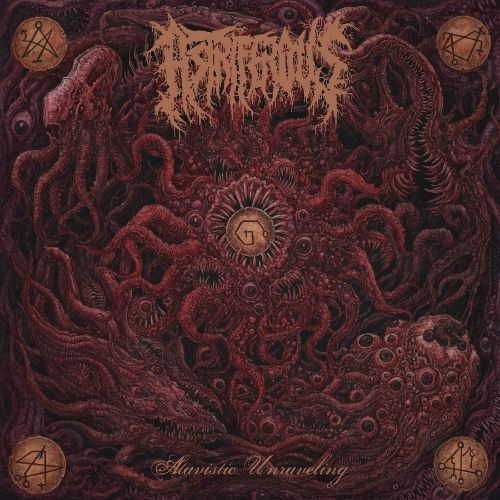
Astriferous - Atavistic Unraveling
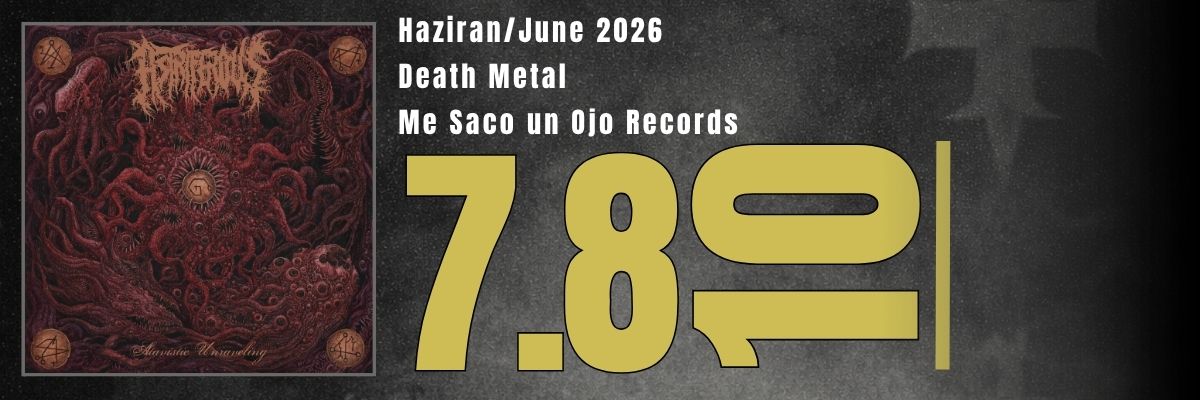
Astriferous stands out as one of the bands attempting to establish a distinct compositional discipline within the increasingly saturated output of the modern old school death metal scene. Atavistic Unraveling, as the second full-length in this trajectory, re-engages the genre’s early references through a far tighter structural organization. Rather than functioning as a purely aesthetic throwback, the album aims to deliver a controlled death metal narrative shaped through riff architecture, tempo transitions, and production choices.
With the opening track “Carriers of the Curse,” the album immediately projects its intended tension at full intensity. The guitars employ the classic “old school death metal” reference not merely as a tonal callback, but as a constantly evolving compositional system. Transitions between tremolo-driven passages and more open, angular riff cells generate a structure that is continuously fractured and reassembled, rather than following a single fluid line of brutality. Within this fragile framework, the low-tuned guitars are embedded into the mid-to-low frequency range in a way that prevents the riffs from resolving into a clear point of stability, keeping the music suspended in an ongoing state of unresolved tension.
The bass guitar functions here as more than harmonic support. Its dirty, “raunchy” character introduces a parallel layer of friction beneath the guitar riffs. This layer becomes particularly pronounced in slower, doom-paced sections, maintaining a persistent sense of decay even when the guitars open up dynamically. The drums operate as the most dynamic component of the album: sections that begin with blast beat intensity suddenly evolve into mid-tempo, weight-centered collapses or near-ceremonial slowdowns. These transitions are not arbitrary; they follow a compositional logic that continuously redistributes internal tension within the tracks, within the limits allowed by the riff structures.
The vocals are embedded within the mix with a brutal articulation reminiscent of Morbid Angel’s lineage. Rather than occupying a leading position, they function as an instrument in their own right, adding an additional layer of organic degradation to the chaotic guitar web. What stands out is less the vocal character itself and more its placement in the mix: it never overtakes the riffs, instead acting as a textural thickening agent that reinforces their overall cohesion.
One of the album’s most critical structural decisions is the juxtaposition of atmospheric tremolo sections with more technical, angular riff passages. There is no sharp rupture between these two approaches; transitions are generally achieved through shifts in melodic contour rather than rhythmic breaks. This prevents Astriferous’ sound from being reduced to a simple “brutal + atmospheric” dichotomy, instead constructing a continuously mutating compositional field. The angular riff language, occasionally reminiscent of Demilich, is used not as technical display but as a structural device that redirects the flow of the compositions.
On the production side, a clear decision is evident: while a dirty, organic foundation is preserved, there is a noticeably cleaner separation compared to earlier work. This clarity makes the riffs more legible, but simultaneously softens the absolute intensity of the decay-driven aesthetic. What remains unresolved is whether this production choice ultimately benefits or undermines the album. The increased clarity reveals the internal mechanics of the composition, particularly in technical transitions, yet it also pushes the chaotic blur of old school death metal somewhat into the background.
Another notable element is the use of synth layers in the background. These elements risk functioning as a superficial “atmosphere enhancer,” but Astriferous does not position them as structural agents that reshape the riff architecture. Instead, they are layered as a subtle form of sonic distortion over the existing texture. As such, they do not alter the compositional core of the album; rather, they operate as a surface layer that amplifies the sense of ritualistic emptiness in slower sections. This leaves open the question of whether this apparent experimentation represents structural expansion or merely decorative augmentation, with the latter being the more accurate interpretation.
Astriferous’ reference set is relatively clear: a line drawn between the early ’90s Finnish death metal intensity and the raw, uncontrolled aggression of South American traditions, supplemented by Morbid Angel’s technical angularity and Demilich-like rhythmic compression. However, Atavistic Unraveling does not redefine these references so much as it places them under a tighter performance discipline. The emphasis on “tightness” is evident: the band operates from a more controlled, calculated, and structurally refined position. Yet this refinement also limits the potential for a clearly differentiated identity within the increasingly dense old school death metal landscape.
At this point, the central question becomes whether increased technical clarity and compositional discipline expand Astriferous’ identity or merely present their existing form in a more effective manner. The answer is dual. On one hand, the sharper riff writing and controlled tempo shifts indicate a more deliberate compositional maturity compared to the debut. On the other, this progression remains confined within the existing vocabulary of death metal, articulating more precise sentences rather than opening a new aesthetic space.
In its current form, Atavistic Unraveling occupies a space within a scene that is expanding yet simultaneously drifting toward standardization. The album maintains a balanced relationship between technical precision and atmospheric density, but this balance often settles into a relatively safe middle ground. While the riff variations and directional shifts keep the listener engaged, they rarely escalate into genuinely unexpected compositional ruptures.
Ultimately, what emerges is a structure that demands a certain level of familiarity from the listener. For those already fluent in the language of death metal, the album delivers clear organization, controlled chaos, and carefully calibrated aggression. However, within the broader context of the genre’s current overproduction, these elements position Astriferous less as a disruptive force and more as a band refining an established aesthetic trajectory. In this sense, Atavistic Unraveling is a coherent and technically strong work, but its primary impact lies not in opening new directions, but in tightening the boundaries of the existing ones.
OZAN
astriferous.bandcamp.com
mesacounojo.com