ALBUM REVIEW
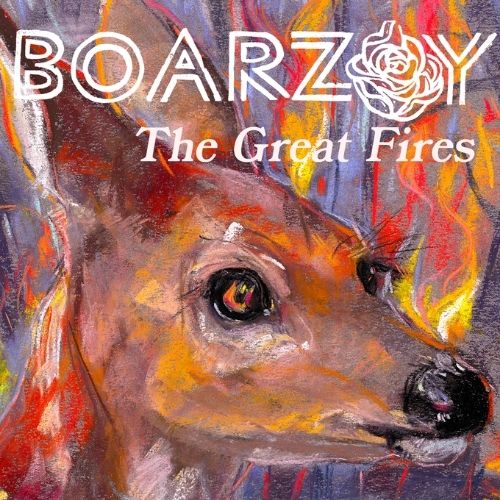
Boarzoy – The Great Fires
The Chaotic Edge of Sludge/Groove Metal
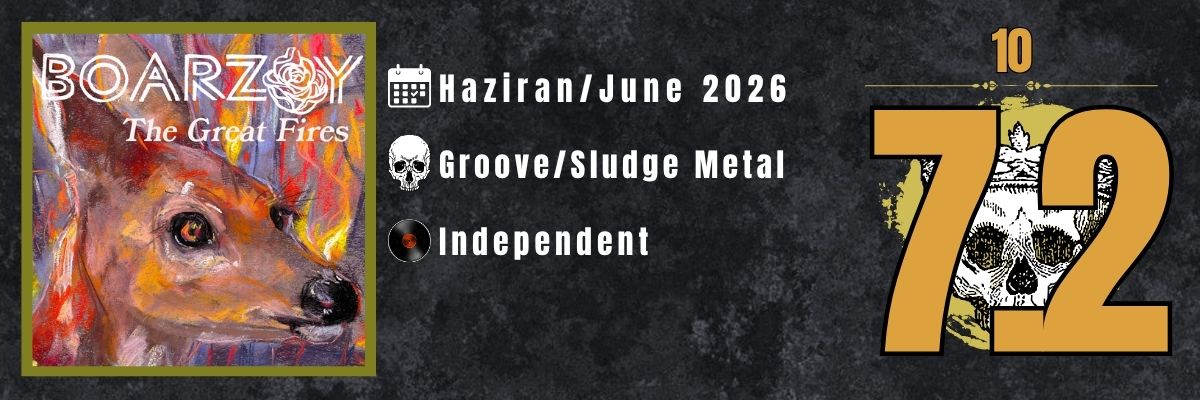
Boarzoy is a Boston-based band that has been drawing attention with an eclectic approach rooted in groove/sludge metal, which they themselves describe as “boar metal.” With high-energy live performances and a compositional language open to cross-genre shifts, they position themselves in the liminal zones of modern extreme metal. The Great Fires stands out as their second album, expanding this approach onto a broader scale while centering the tension between stylistic diversity and structural instability.
On The Great Fires, riff writing retains the “heavy and cyclical” backbone of traditional sludge/groove metal, yet this backbone operates through a continuously fragmented structural logic. Guitars rarely remain fixed to a single tonal center; instead, they shift between different articulations within the same riff, with palm-muted grooves suddenly giving way to open-chord dissonance or unexpected melodic extensions. These transitions point less to a “progressive” ambition and more to a compositional habit in which the riff itself refuses to remain stable. While mid-tempo sludge marches evoke the influence of Mastodon and early Machine Head, Boarzoy use these references not to create a linear sense of groove, but to destabilize it.
In the rhythm section, the relationship between bass and drums unfolds through constant micro-deviations rather than classical groove metal synchronization. The bass guitar often avoids strictly following the guitar riffs, instead thickening the harmonic foundation by generating independent low-frequency micro-motifs. This approach ensures that, particularly in more chaotic passages, the sense of “heaviness” is derived not from a fixed pulse but from layered density. On the drum side, there is a dual structure: on one hand, sharp, propulsive double-kick work and accented snare usage reminiscent of Lamb of God; on the other, a fractured metric sensibility and unexpected pauses that evoke The Mars Volta and Tool. This duality prevents the tracks from ever fully settling; the rhythmic center is constantly being redefined.
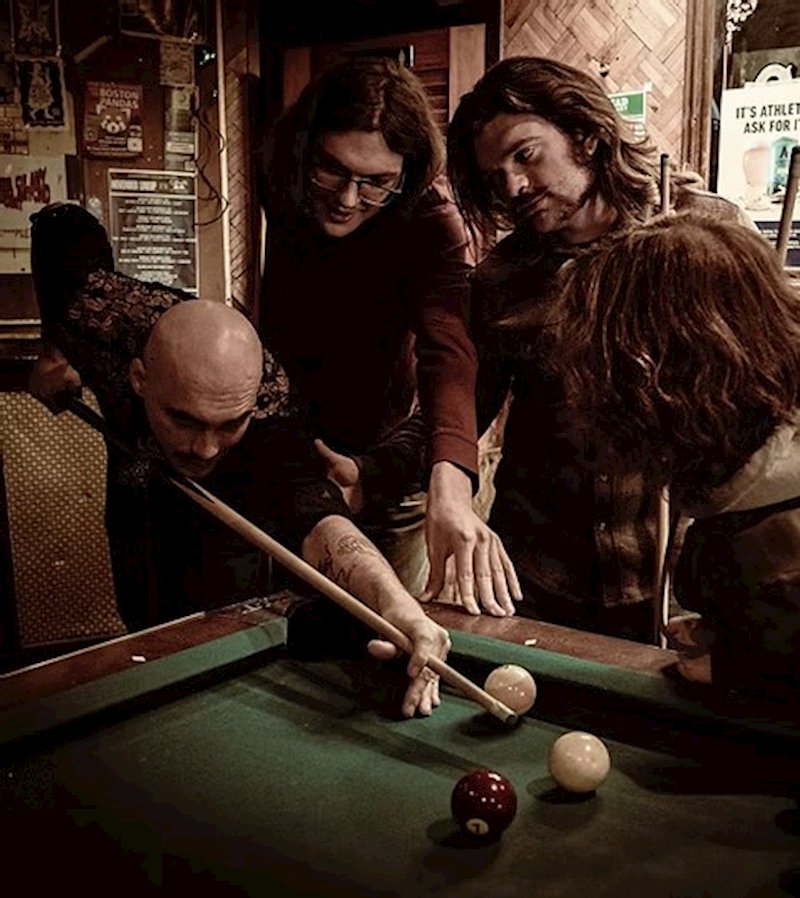
The vocal performance operates within this structure as both a binding and destabilizing element. Rennie Boyd’s vocal approach is not limited to a single technique; it moves between hardcore shouts, sludge growls, and semi-declamatory passages that at times feel almost spoken. In certain tracks, the vocals can be heard not locking rhythmically into the instrumental framework, but instead sitting atop it as a layer of friction. In line with the album’s overall character, this keeps the music in a constant state of dissolution. Sudden vocal ruptures reminiscent of System of a Down, or more subdued, semi-melodic passages influenced by Deftones, function not as elements of dramatic variety but as forces that feed structural instability.
One of the album’s most defining aspects lies in its sense of form. While a “classic” verse–chorus logic often appears on the surface, the real flow is built on a segmented, collage-like structure. The tracks consist of sections that are thematically connected yet continuously reconfigured in harmonic and rhythmic terms. This becomes particularly evident on tracks such as “Even in the Rain” and “Wartime Softshoe”: riff repetitions do not create fixed hooks but are reinterpreted with small variations on each return. This approach makes the album unpredictable for the listener, while also creating the impression that in some transitions the dramatic flow is being deliberately interrupted.
On the production side, the recording aesthetic does not fully abandon its DIY character, but it establishes this not through rawness, but through controlled density. Guitar tones create a compressed low-midrange field, while maintaining aggressive sharpness in the upper frequencies. This reduces the “muddy” character of sludge-oriented material, resulting in a more articulated form of aggression. The drums are not pushed into the background of the mix; on the contrary, their transient emphasis is highly defined, making even the album’s chaotic moments readable. However, this clarity also introduces, in some sections, a sense of mechanical assembly rather than organic flow.
Perhaps the most contentious yet defining aspect of the album is its dense eclecticism. The heavy riff aesthetics of Melvins, Devin Townsend’s layered production approach, Primus’s rhythmic deviations, and The Mars Volta’s fragmented compositional language are all being filtered into the same melting pot. However, these references often coexist side by side rather than transforming one another. For instance, jazz-inflected groove passages, when linked to heavier sludge sections, operate through contrast rather than generating a new synthesis. This pushes the album’s identity closer to a “multi-part” structure rather than a truly hybrid one.
The aesthetic approach defined as “boar metal” becomes more legible here primarily through visual and stage-energy associations. The album’s musical structure does not fully abstract this DIY/anarchic identity, but neither does it directly translate it into a compositional method. As such, the passages described as “chaotic” are not entirely uncontrolled; rather, they are fractures placed according to a specific structural logic. The issue is that these fractures do not always open new directions, but instead restart the existing one. This results in certain tracks producing a sense of cyclical expansion rather than forward movement.
The use of quieter passages is one of the album’s most functional dimensions. These subdued sections are used not only to create dynamic contrast, but also to generate suspended tension. In these moments, more open guitar chord voicings and the vocal retreat create a Tool-reminiscent sense of waiting. However, this state of suspension is often cut short by sudden returns to high-intensity passages rather than evolving into long-form dramatic resolution. This keeps the album’s dramatic arc deliberately “unfinished.”
The Great Fires constructs a framework in which genre transitions are not treated as points of fusion, but as continuously colliding layers. As a result, rather than expanding the current boundaries of sludge/groove metal, the album creates a constantly shifting field of movement within those boundaries. For the listener, this demands a continuously readjusted perception rather than a fixed focal point. The eclecticism it embraces sometimes translates into structural variety, while at other times remaining a matter of intensity variation alone.
Ultimately, Boarzoy’s work occupies a position that generates constant tension between compositional boldness and structural coherence. While the album contains strong ideas on the level of individual riffs or tracks, it does not always sustain the ambition of transforming these ideas into a larger architectural framework. This positions The Great Fires as a work that strongly reflects scene energy and stylistic diversity, but does not consistently translate that diversity into a compositional language that fully redefines itself. The listening experience requires a controlled instability rather than a clear sense of direction; a condition that ultimately stems from the album’s adoption of this imbalance as a permanent aesthetic choice.
OZAN