
EP REVIEW
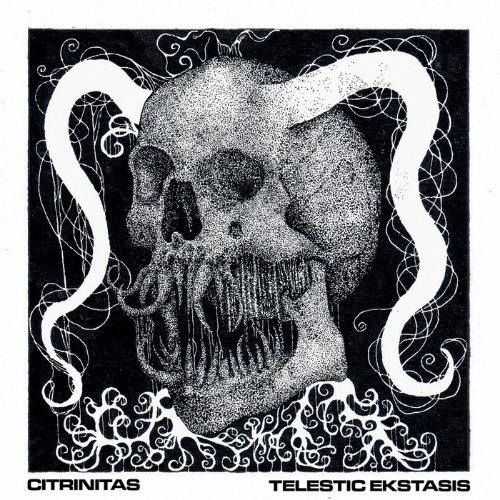
Citrinitas – Telestic Ekstasis
A Blurred Space Between Doom, Black Metal and Noise

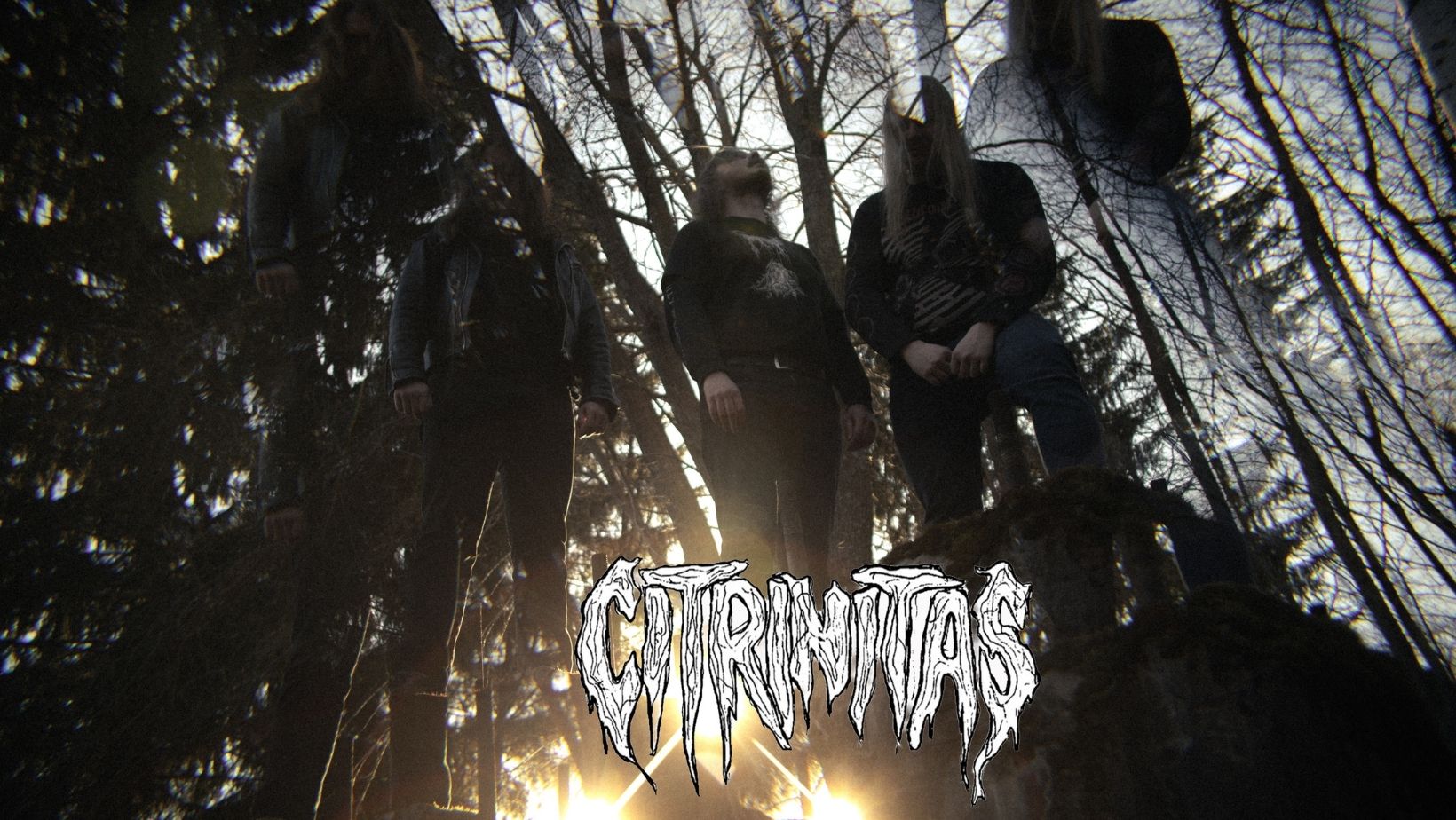
Finnish outfit Citrinitas construct a blurred sonic field on their latest EP “Telestic Ekstasis,” drifting between doom, black metal, and noise. Released via Caligari Records, the three-track recording maintains its ambition of generating dense atmosphere despite its brief runtime. However, this density raises the question of whether it stems from genuine compositional expansion or an aesthetic choice that operates within the limits of repetition.
From its opening moments, the EP builds its riff architecture not around the idea of “progression,” but around a sense of cyclical compression. Rather than offering clear thematic development, the guitars operate through repetitive figures that oscillate between mid-tempo doom and black metal; these figures often restart themselves before reaching any definitive cadential resolution. This approach shifts the pieces away from traditional notions of “composition” and toward an ever-expanding field with restricted internal dynamics. The fact that the three tracks can easily feel like a single extended form leaves open the question of whether this uniformity is a deliberate compositional decision or a limitation in conceptual density.
The drum writing does not sit at the center of this structure, functioning instead as a stabilizing surface layer. Rather than blast-driven intensity or technical complexity, it establishes a steady rhythmic ground that frames the looping riff cycles. This reduces any sense of forward momentum while reinforcing the suspended, hanging quality of the material. Yet this suspension does not always generate dramatic tension; in several passages, rhythmic and harmonic repetition begins to neutralize itself rather than build mutual reinforcement.
The vocal layer is deliberately pushed back in the mix. It is often perceived as dissolving into the guitar surface and the surrounding reverb field, shifting the voice away from a narrative function and toward a textural noise element. While black metal remains a reference point at the level of articulation, the vocal technique does not drive the composition, instead dissolving into the overall blur as one more layer within the mix.
Production choices define the EP’s core identity. Although it leans toward a lo-fi aesthetic, it is not a fully raw recording; the reverb-heavy “garage” character emphasized in the label notes significantly softens the edges of the guitars. This blurring reduces the clarity of the riffs while simultaneously creating a sense of spatial depth. However, this space rarely functions as compositional expansion; instead, it becomes a reflective chamber in which the same motifs are repeated from different perceived distances. In this sense, production acts less as an opening mechanism and more as a filter that continually folds the music back into itself.
Sections such as “Stella Signata” introduce a more melodic surface, at times approaching dungeon synth-like textures, marking one of the EP’s most noticeable deviations. However, this shift does not reorganize the underlying riff logic; it remains an atmospheric layer placed atop the existing cyclical structure. In other words, there is aesthetic widening, but not a transformation of compositional behavior. Similarly, the dissonant noise eruptions in the closing track function less as structural ruptures and more as a dissolution effect appended to the doom/black metal framework.
At this point, Citrinitas establish a compelling tension: while the music strives to generate a continuous sense of atmospheric density and alienation, the tools used to achieve this effect—riff repetition, steady rhythmic frameworks, low variation structures—simultaneously narrow the compositional risk space. The atmosphere is undeniably strong, yet the structural decisions that generate it rarely produce the kind of dramatic inflection that would propel it forward.
“Telestic Ekstasis” thus aligns itself with a growing strand of doom/black metal that prioritizes texture over linear narrative, treating the riff as a surface generator rather than a vehicle for articulation. However, the EP’s limitations emerge precisely here: the texture is effective, but the compositional events unfolding within it remain restricted. As a result, the record builds its impact on continuity of intensity rather than transformation.
Ultimately, Citrinitas demand a listening approach that accepts suspension within a fixed sonic field rather than expecting linear song progression. Yet the ideas contained within that field do not always expand into a broad enough compositional space to continually redefine one another, resulting in a work that persists through repetition of its aesthetic core at varying degrees of intensity. This positions the EP as a transitional form with strong atmospheric capability, but limited compositional extension.
OZAN
caligarirecords.com
caligarirecords.bandcamp.com
facebook.com/caligarirecords