
ALBUM REVIEW
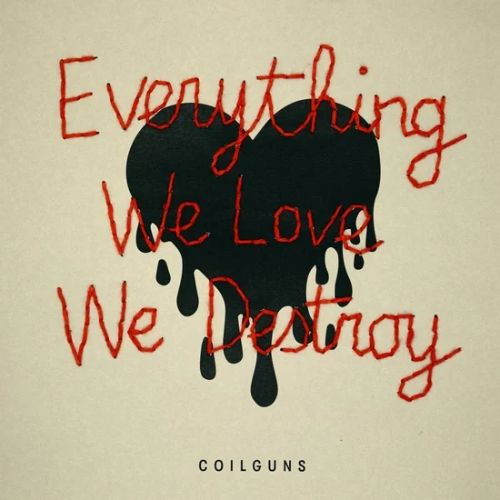
COILGUNS – Everything We Love, We Destroy
Melodic noise rock meets experimental post-hardcore.

COILGUNS have always embraced noise, chaos and a degree of unpredictability in their music. The Swiss quartet's evolution from its DIY hardcore roots towards a more melodic and experimental approach shaped around Noise Rock took a significant step forward with 2024's "Odd Love". Having played more than 85 shows worldwide in the wake of that album, the band now returns with its fifth studio full-length, "Everything We Love, We Destroy", opting for a more direct lyrical approach and a creative process that allows contrasting musical textures to coexist.
The album's title alone offers a fairly clear indication of the issues COILGUNS intend to address. The ongoing environmental destruction despite the tenth anniversary of the Paris Climate Agreement, Switzerland's immigration policies, the increasingly dysfunctional state of the internet, gender inequality and the difficulties inherent in human relationships are among the subjects explored from different angles throughout the record. Rather than concealing these concerns behind elaborate metaphors, Louis Jucker addresses them in unambiguous terms. 'Peace Trader' confronts the contradiction between Switzerland's international image as a peaceful nation and its immigration policies, while 'Platform Decay' turns its attention to the deteriorating state of the digital world and the internet activists fighting against it. 'Teach Ourselves', meanwhile, reminds men that they must confront their own responsibilities when it comes to gender equality. This directness is reflected in the album's musical character, too. Rather than wrapping their message in a complicated conceptual framework, COILGUNS communicate through the shifting structures of the songs and the steadily intensifying emotional delivery of the vocals.

Musically, the most immediate change is the way the pronounced Noise Rock aggression of the band's previous work is balanced by a more measured approach to the guitars. That does not mean COILGUNS have abandoned their ferocity. Distortion and dissonance remain essential components of the compositions, but melodic guitar passages, piano accents and keyboards broaden the music's expressive range. Crucially, these elements never feel like decorative additions pasted onto the songs after the fact. Instead of simply filling the gaps between noisier passages, they become integral tools for redirecting the compositions and allowing tension to develop in different ways.
The title track, which opens the album, is a fine example of this approach. Beginning with Luc Hess's commanding drumming, the song quickly moves beyond its initially compressed rhythmic framework into a more expansive instrumental arrangement. Melancholic piano chords and a melodic vocal line contrast with the abrasive guitar work, while Kevin Galland's bass lines make a significant contribution to the song's overall cohesion. The repeated chorus, in particular, leaves a lasting impression of the frustration expressed in the lyrics. Rather than merely providing an immediately memorable hook, its repetition conveys the sense of entrapment created by broken promises and responsibilities that are continually postponed.
'Peace Trader' represents the album's more abrasive side, with heavier guitar tuning and an increasingly forceful rhythmic structure. Following its melodic opening, the guitars gradually intensify, heightening the song's emotional tension. Here, the relationship COILGUNS establish between Noise Rock and Post-Hardcore becomes particularly apparent. The harsher passages and quieter transitions do not function as two separate musical identities; they connect as different intensities within the same compositional approach. 'Replication Crisis' explores this volatility from another angle. Built around a cyclical bass line, the track gradually transforms from an acoustic rumination into something considerably more aggressive. Its ability to regain momentum after passages that feel as though they have already brought the song to a close also pushes its four-minute runtime beyond conventional verse-and-chorus structures. These unexpected restarts translate the track's underlying mental unrest into musical form.
With its more restless and unpredictable structure, 'Platform Decay' brings the album's experimental side to the forefront. The electronic and keyboard textures developed with Ben Chisholm's contributions add a different colour to the noisy foundation created by the guitars. These elements never overwhelm the music, however, instead reinforcing the track's rhythmic momentum and atmosphere. 'Punisher Disclaimer', meanwhile, is one of the album's more direct applications of dissonance and rhythmic aggression. Its sharp guitar transitions and danceable rhythmic accents recall COILGUNS' Hardcore roots without entirely abandoning their increasingly melodic approach.
It is also significant that this is the first album on which Kevin Galland has been involved with the bass from the very beginning of the songwriting process. The musical framework previously defined largely by the relationship between guitars and drums now gives the bass considerably more room to operate independently. The cyclical bass approach in 'Replication Crisis' is one of the clearest examples. Rather than simply reinforcing the low end beneath the guitars, the bass becomes an instrument that helps determine the melodic and rhythmic direction of the songs. This contribution is one of the key factors behind the album's more intricate musical construction.
'Days Before the War' stands out particularly against the record's generally abrasive backdrop. At approximately a minute and a half, the song makes no attempt to develop the kind of dense instrumental arrangement found elsewhere on the album, instead bringing Jucker's quieter, more vulnerable vocal performance to the forefront. This brief passage, which edges towards a Singer/Songwriter sensibility, demonstrates that COILGUNS cannot be defined solely through noise and aggression. 'Teach Ourselves', by contrast, adopts a more unsettled character through its fragmented structure, with the guitar and bass repeatedly cutting each other off before falling back into motion. The rhythmic interplay towards the end is another reminder of the band's continued willingness to disrupt conventional song structures.
'Carbon Magic' is one of the album's more immediately physical tracks, driven by its dirty groove and energetic chorus. Addressing the carbon offsetting industry, the song combines the rhythmic force of the guitars with an accessible melodic approach. 'Forever Chemicals' takes a different route. Opening with piano, it establishes a calm and restrained atmosphere before gradually acquiring a more forceful character as the instrumentation grows heavier. Because the melodic framework remains intact, the rhythmically driven, guitar-led climax feels like more than a simple increase in volume; it becomes the natural culmination of the tension accumulated throughout the song.
Closing track 'Perfect Fit Content' is the album's most contentious moment, demonstrating just how far COILGUNS are willing to push the boundaries of their established songwriting approach. Built from fragmented riff ideas, contrasting rhythmic concepts and unconventional transitions, this extended composition moves noticeably away from the melodic accessibility of the other songs. At its conclusion, Anna Sauter-McDowell calmly delivers a critical statement about art being considered incomprehensible and irrelevant, creating an ironic finale that turns the scrutiny back on the band's own artistic output. This decision directly connects the album's political and social criticism with COILGUNS' own artistic existence. Nevertheless, the track's fragmented structure may not work equally well for everyone. Although its experimental approach represents a deliberate departure from the album's melodic cohesion, some of the transitions between sections are less convincing than those found elsewhere on the record.
Scott Evans's contribution to the recording process, Tom Dalgety's mixing and Ben Chisholm's additional production work are also important in understanding this musical shift. Recorded in the warehouse-studio space at Humus Records in La Chaux-de-Fonds, the sessions allowed the band to make use of the various instruments and sound sources available in its own working environment. The resulting production retains the rough-edged character essential to Noise Rock while ensuring that melodic details and the interplay between instruments remain clearly audible. The more prominent presence of piano, keyboards and bass guitar does more than simply give the album a softer sound; it also contributes to a broader musical vocabulary.
The real question when assessing "Everything We Love, We Destroy" is not whether its melodic approach weakens COILGUNS' abrasive musical identity, but how effectively these two elements complement one another. The album combines the traditional noise aesthetic of Noise Rock and Post-Hardcore with more accessible melodies, while also incorporating passages that lean towards Indie Rock and Post-Punk. These choices do not place the band outside the boundaries of its established genres. On the contrary, they offer a broader expressive vocabulary that challenges the tendency to judge Hardcore-derived music solely in terms of physical aggression. The melodic direction that became more pronounced on "Odd Love" is taken further here, while COILGUNS retain the restless and unpredictable compositional approach that defines their music.
Ultimately, "Everything We Love, We Destroy" is one of the most balanced entries in COILGUNS' discography in terms of the relationship between musical accessibility and experimentation. Although the fragmented structures in certain passages, particularly the length of the closing track, remain open to debate, the album's ability to bring different musical approaches together within a coherent aesthetic framework is a significant achievement. Vulnerability here does not function as the opposite of aggression, but as an expressive quality that gives it greater meaning. Rather than reducing their anger to noise alone, COILGUNS channel it through melodies, rhythmic disruptions and uncompromising lyrics, giving it a much broader scope. This latest release from a band continuing to develop its own voice within the contemporary Noise Rock and Post-Hardcore scenes is a thoroughly rewarding listen for anyone who values the emotional and intellectual depth that heavy music can offer.

https://hummus-records.com
https://www.facebook.com/hummusrecordsofficial
https://www.instagram.com/humusrecords