ALBUM REVIEW
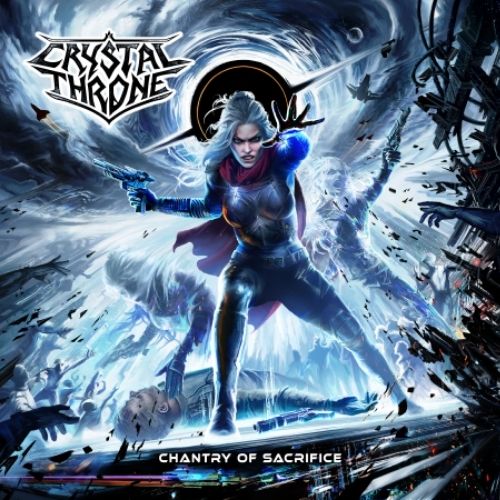
CRYSTAL THRONE - Chantry Of Sacrifice
Strong melodies, technical writing, limited originality.

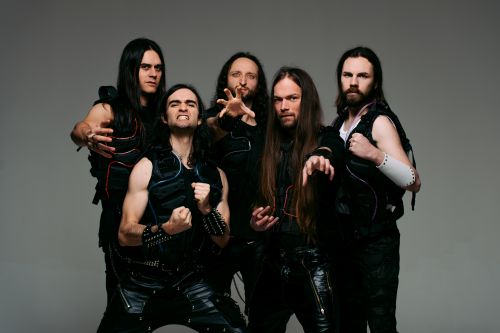
Hailing from Metz, CRYSTAL THRONE’s second album, “Chantry Of Sacrifice,” is built around a science-fiction concept set in the year 5150, following Hÿldr, the last surviving representative of humanity, as she travels back in time to uncover the reason behind Earth’s mysterious disappearance. Formed in 2019, the band expanded its lineup following their 2021 debut with Will Ram on drums and John Lemoine on second guitar, creating considerably more room to maneuver, particularly in the guitar arrangements. The fact that almost all nine tracks run beyond the five-minute mark also has a direct impact on the musical realization of the narrative.
This long-form approach becomes the most distinctive compositional choice on “Chantry Of Sacrifice.” While ‘Children Of The Ruins’ and ‘Tides Of Ages’ build on a fast Power Metal foundation enriched with Progressive and occasional Speed Metal elements, the twin-guitar harmonies constantly push the melodies forward. CRYSTAL THRONE openly embrace the 1980s American Progressive/Power Metal tradition here, particularly the lineage of QUEENSRŸCHE, CRIMSON GLORY and SYMPHONY X. The spoken, futuristic introduction of ‘A Hero’s Call’ makes that reference even more apparent; at this point, however, it needs to be stated clearly that from the very first riff, this record goes well beyond the instinct to simply revive an old formula. Through sharp-edged riffing, high-register vocals and the melodic interplay between the guitars, it takes concrete steps toward establishing its own sound while preserving the classic Heavy Metal backbone of its songs.
Terry DeFire’s clean, wide-ranging vocals sit at the center of this approach. Particularly when he reaches the higher end of his register, there is a character reminiscent of the American Metal vocal tradition of the 1980s and 1990s. That said, not every vocal melody is equally memorable. As the compositions develop, the vocal lines are skillfully woven into increasingly intricate structures, yet some choruses fail to leave a sufficiently strong imprint once the song has ended. This is less a question of the album’s technical proficiency than of melodic memorability.
‘Electrical Savior’ pulls the tempo back somewhat, allowing the melodic side to come further forward. ‘Walls Of Silent Mourn,’ meanwhile, broadens the album’s atmosphere through its mid-tempo structure, constantly moving guitars and more somber harmonic character. Here, the narrative rises and falls of the concept are reflected in the music: the songs do not simply move between fast and showy passages, but alter their tempo and intensity in accordance with the dramatic flow of the story. ‘Antagonists,’ by contrast, moves forward as a high-energy piece; the addition of a female guest vocalist and Max Waynn’s solo, which follows the melodic line, expand the song’s palette.
Waynn’s guitar work is one of the album’s strongest aspects. Rather than pushing the music aside for the sake of technical display, the solos generally function as extensions of the melodic structure, while the harmonies created by the two guitars are among the elements that make CRYSTAL THRONE’s classic Heavy Metal heritage more apparent than its Progressive leanings. Jefferson Brand’s bass also provides a solid foundation beneath this guitar-centered approach, particularly through its prominent presence in the lower frequencies. The clear consensus among the sources regarding the band’s technical ability is no coincidence: the issue here is not playing skill, but how economically that skill can be employed within the compositions.
Because the fundamental weakness of “Chantry Of Sacrifice” lies less in a lack of ideas than in the failure to arrange those ideas tightly enough. Long tracks such as ‘Antagonists’ and especially ‘Insurgent Outcry’ contain numerous tempo changes, transitions and distinct sections, yet that movement does not always produce a corresponding dramatic effect. Keeping almost all nine tracks on the longer side supports the album’s narrative scope, but it also heightens the sense of repetition in certain passages. The concept-album format therefore becomes both an advantage and a limitation: it allows the story to unfold across a broad canvas, but it also requires each section to establish a sufficiently strong musical identity of its own.
That is why ‘Sleeping In The Void’ is particularly significant. Beginning slowly and progressing through choral vocals and a weighty rhythmic structure, the closing track introduces symphonic textures and a faster section as it develops, revealing possibilities that had been used more sparingly earlier in the album. Its dramatic conclusion also demonstrates that CRYSTAL THRONE are not necessarily bound to simply follow the legacy of QUEENSRŸCHE and American Progressive/Power Metal. The real question is why this degree of courage is not employed to the same extent earlier in the album.
In its current form, “Chantry Of Sacrifice” is a technically accomplished and melodically serious work from a band well versed in the traditions of its genre. But establishing a more distinct identity is not simply a matter of combining references such as QUEENSRŸCHE, CRIMSON GLORY and IRON MAIDEN in different ways; it also requires being more ruthless about deciding which ideas genuinely need to remain in these long compositions. CRYSTAL THRONE’s potential is particularly evident in the guitar work and in their effort to connect the narrative with the music. My expectations for the band’s next recording are already very high. If they receive better mixing and mastering support—which I hope will become possible once they have access to a more comfortable budget—then everything could start moving forward in a much more positive direction for the band. “Chantry Of Sacrifice,” meanwhile, is an album in which that potential has not yet been fully unleashed, but which nevertheless represents a very serious step toward defining where CRYSTAL THRONE are headed.
