ALBUM REVIEW
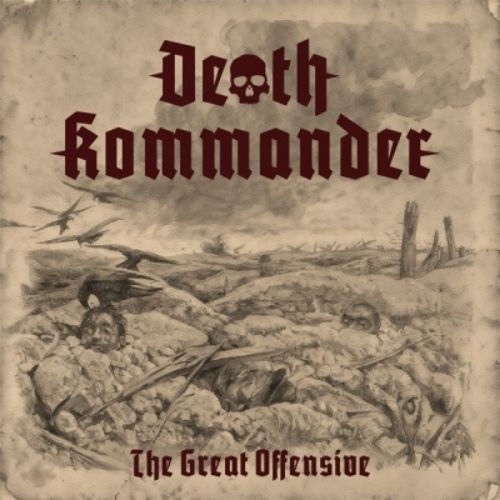
DEATH KOMMANDER - The Great Offensive
Death Metal forged in BOLT THROWER’s shadow.
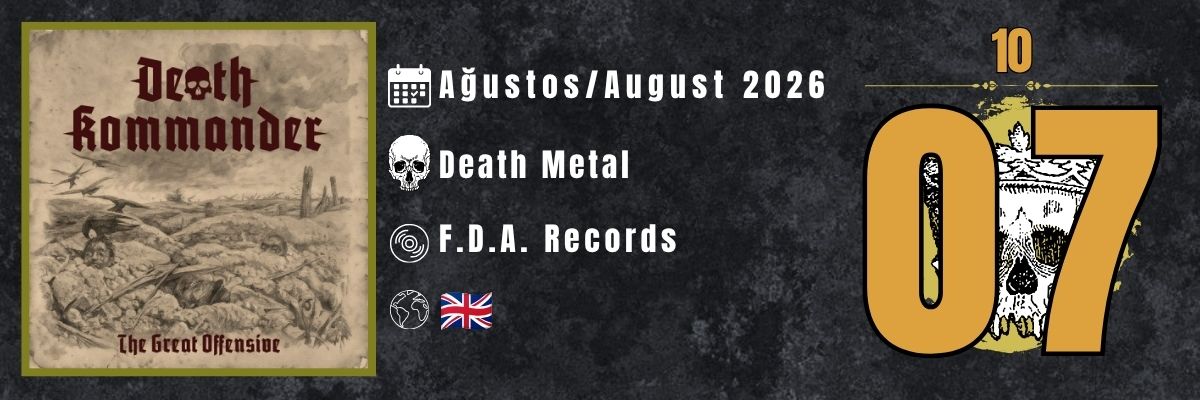
Founded in Edinburgh in 2018, DEATH KOMMANDER operate within the war-themed, slow-marching strain of Death Metal, shaping their approach around the legacy of BOLT THROWER. Rather than high speed or technical showmanship, their music emphasizes the weight carried by downtuned guitars, the mechanical forward motion of mid-tempo riffs, and an arrangement style that translates the atmosphere of war directly into the music. This EP, “The Great Offensive”, revisits this early approach through new recordings of the band’s 2018 debut demo and two tracks from 2021’s “Pro Patria Mori”, presenting them with a more contemporary production.
The band’s fundamental approach on record is built around reshaping existing material with a heavier, tighter and more defined production rather than attempting to establish a new compositional language. The four tracks from the Edinburgh-based band’s 2018 demo “Summer Offensive ’18” have been re-recorded with the post-2024 lineup, while 'Flamethrower' and 'The March' from 2021’s “Pro Patria Mori” have undergone the same treatment. The result is a roughly 25-minute, war-themed Death Metal release that sits unmistakably within the BOLT THROWER tradition; but before considering how effective this approach is musically, the more fundamental question is whether these songs actually needed to be re-recorded in the first place.
DEATH KOMMANDER make no attempt to conceal their musical point of reference. Ben’s rhythm guitars directly follow the BOLT THROWER formula of heavily downtuned, churning riffs that move predominantly at mid-tempo, particularly the way that band turned the atmosphere of war into something physically weighty. Much of the riffing is built not around complex structures but repetition, weight and a sense of forward momentum. The strength lies not in technical display, but in turning a handful of fundamental guitar ideas into a sufficiently tight march alongside the drums and bass. As a result, the songs remain short, direct and easy to follow.
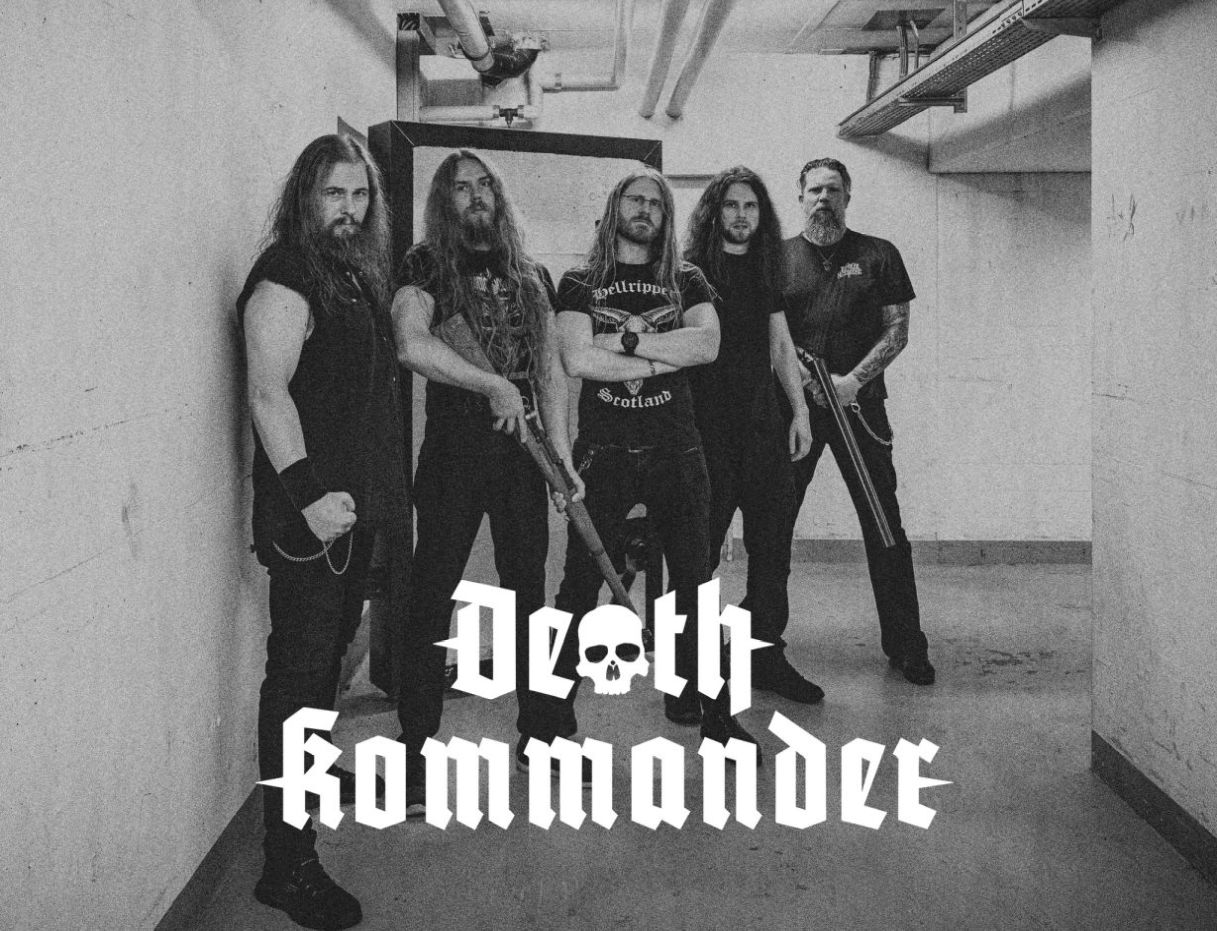
That simplicity also constitutes the band’s most obvious limitation. Although many of the riffs are effective, DEATH KOMMANDER do not transform them enough to establish a more distinctive compositional identity of their own. Even in some of the melodic ideas, the BOLT THROWER legacy is felt not merely as a general reference but directly within the compositions themselves. HAIL OF BULLETS and, at times, early ASPHYX influences can also be heard around this framework, but the band’s core remains unchanged: heavy guitars, controlled tempos, a sense of military marching, and the mechanical momentum carried by the riffs.
That said, “The Great Offensive” demonstrates that DEATH KOMMANDER’s approach to revisiting their material does offer a certain advantage. Although the rawer character of the original demo is particularly apparent in the drums, these reworked versions bring the performances under greater control without completely eliminating their old-school underground feel. Matt’s drumming functions as a fundamental element in carrying the weight of the songs; the rhythms are mostly unshowy, yet clear enough to support the guitars’ forward movement without interruption. Hardy’s bass, meanwhile, tends to sit beneath the guitar wall in the production, but still reinforces the physical weight of the low end.
There is an interesting duality on the guitar side, however. Bringing Ben’s rhythm guitars further forward could have provided the fullness the material needs. The current mix preserves the aggression of the riffs, but in places leaves the guitar texture more exposed than necessary. Oli’s lead guitars, by contrast, do not turn the arrangements into a technical showcase; his melodic touches remain secondary layers supporting the war-themed Death Metal aesthetic rather than overtaking the core riffing. While this choice is consistent with the band’s musical simplicity, it also narrows the space in which the EP could distinguish itself from its contemporary counterparts.
Kruxator’s vocals are one of the weaker aspects of the recording. Although the vocal performance fits the aggressive framework, its character does not always match the weight carried by the guitars. Particularly within such direct, repetition-based riff structures, greater rhythmic and tonal variation in the vocals could have helped differentiate the songs from one another. Instead, the performance largely maintains the same mode of attack throughout. This does not contradict the band’s overall aesthetic, but it further limits the compositional variety of the roughly 25-minute release.
The war theme is not merely an ornament placed outside the music; the band connects it directly to the EP’s visual and lyrical language. Titles such as 'Operation Eisenfaust', 'Flamethrower' and 'The March', together with imagery of trench warfare, tanks and the First World War, draw upon one of the most recognizable aspects of BOLT THROWER’s legacy. The monochromatic artwork reinforces this approach as well. Here, however, the visual identity confirms rather than expands the aesthetic framework already established by the music. In other words, there is no disconnect between the artwork and the sound; neither makes any particular effort to move beyond the same field of reference.
At this point, the central problem with “The Great Offensive” is less its musical quality than its function. The re-recordings provide a technically stronger presentation; the tighter performances of early tracks such as 'Shellshock' and 'Onwards' suggest that the band’s simple but functional early riff writing actually produces more direct results than some of their later work. Yet this does not automatically justify the existence of a new release. With the original demo still available and its songs not even a decade old, re-recording this material feels less like a creative necessity than a repackaging of the existing catalogue.
Moreover, DEATH KOMMANDER’s approach is already largely rooted in a “worship” aesthetic. Within such a formula, a re-recording only truly makes sense if it goes beyond correcting the production of older material and reinterprets the compositional potential of the songs themselves. “The Great Offensive” does this only to a limited extent. The performances are tighter, the guitar tone is stronger and the overall recording standard is more professional; but the fundamental logic of the songs remains largely where it was. The re-recording therefore improves the presentation of the musical ideas more than the ideas themselves.
That does not mean the EP is without purpose. DEATH KOMMANDER’s highly direct approach to the BOLT THROWER legacy represents a form of fidelity that has become relatively uncommon in contemporary Death Metal. The issue is not that the band uses this reference point, but how much of their own compositional understanding they add to it. In the case of “The Great Offensive”, the answer remains limited. Yet the fact that the band’s earliest riffs can function within such a stripped-down framework also reveals that DEATH KOMMANDER’s greatest strength lies not in pursuing an elaborate identity, but in executing simple riffs with sufficient weight and a strong sense of tempo.
Ultimately, “The Great Offensive” is an EP that presents DEATH KOMMANDER’s sound in a cleaner and tighter form, but derives its significance more from revising their early material than from advancing the band’s artistic direction. It does not demand any particular effort from the listener to decipher the songs; on the contrary, the directness of the riffs and their mid-tempo marches make the material immediately accessible. Yet that very directness weakens the creative justification behind the decision to re-record it. The real question for DEATH KOMMANDER’s next step is not how effectively they can reproduce the language of BOLT THROWER, but how far they can establish a riffing language of their own within it.

https://deathkommander.bandcamp.com/