ALBUM REVIEW
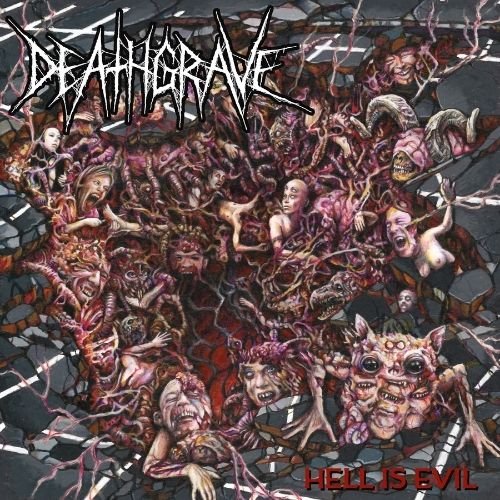
DEATHGRAVE - Hell Is Evil
Controlled, dark, feral.
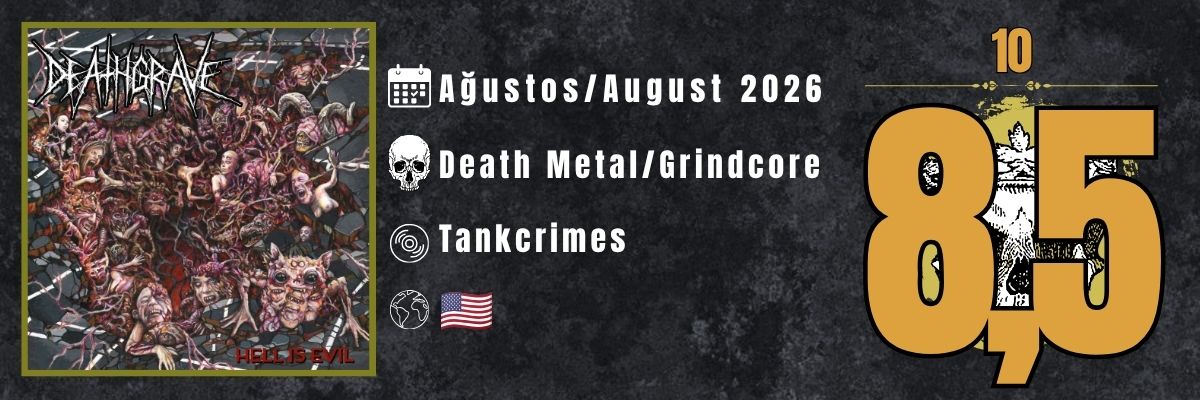
DEATHGRAVE, hailing from San Jose, California, have developed a distinctive sound that combines the punk-rooted aggression of grindcore with different strains of extreme metal, including death metal, doom, sludge, and thrash. Active in the underground scene since 2013, the band expand their riffs and song structures on "Hell Is Evil" by adding a more pronounced compositional approach to the feral energy of their previous work. For that reason, the album deserves to be judged less by DEATHGRAVE's desire to move between genres than by how successfully they integrate these different musical elements into a single compositional language.
The most defining characteristic of DEATHGRAVE's "Hell Is Evil" is the way they loosen the reflexive structure of extreme music, traditionally built around speed and aggression, in favor of songwriting. Compared with the previous album, "It's Only Midnight," the riffs here are no longer merely short bursts used to propel the music toward the next explosion. Songs stretching to around three minutes give ideas room to develop without crushing one another. This does not mean DEATHGRAVE are moving away from their grindcore roots; rather, they place grindcore's punk-driven impulsiveness within a more controlled compositional framework alongside death metal, thrash, doom, sludge, d-beat, noise rock, and industrial textures. The result is a record in which speed remains a fundamental source of energy, but is no longer the whole point.
The opening track, "Hell Is Evil," functions almost as a direct manifesto for this approach. While the riffs take on a more defined shape, the production gives the band's aggression more room to breathe without diluting it. The expansion into three-minute songs is particularly important because DEATHGRAVE are allowing their riffs to carry their own weight rather than relying solely on short, sharp bursts of violence. As a result, the variety heard across the first half of the album does not stem from arbitrary genre shifts, but from reorganizing the same fundamental aggression around different rhythmic and tonal centers of gravity.

"Hard To Swallow" reveals the darker side of this transformation. Greg Wilkinson's heavy, doomy guitar riff pulls the song's punk/death metal momentum downward, creating a denser low-end space. The band's members' connection to the Graves at Sea lineage can be felt in the doom/sludge sensibility that directly informs the song's central riff logic. It therefore functions as more than a decorative atmospheric layer; it determines the song's tempo and physical weight. Vocally, Andre Cornejo's forceful, forward-thrusting shouts operate along the same aggressive axis as the riffs rather than sitting on top of them as a separate layer. The presence of Chris Reifert on guest vocals also makes DEATHGRAVE's connection to their death metal lineage more apparent.
With "I Am Here," the band accelerates again, pushing death metal fury through grindcore's more clipped rhythmic logic. What matters here, however, is not simply the tempo but the way the punk character remains embedded in the behavior of the riffs. This is precisely one of the qualities that distinguishes DEATHGRAVE within contemporary extreme metal. Rather than allowing their death metal riffs to conform to a conventional death metal aesthetic, they continually grind them against punk's directness and grindcore's compressed approach to song form.
"Born From Death" comes closest to the most stripped-down expression of this approach. While the song largely allows aggression to take control, dissonant punk guitar figures emerging in the background deliberately disrupt that intensity. These small interventions matter because DEATHGRAVE's songwriting is not simply about producing harder riffs. By introducing a counter-element capable of disrupting the riff's own momentum, they keep the internal tension of the song alive. The real-life event behind the track also adds weight to the album's political and human context, demonstrating that its lyrics are not merely an abstract darkness designed to serve an extreme metal aesthetic.
One of the album's strongest compositions, "Smaller And Smaller," demonstrates just how effective the band's decision to slow down can be. At nearly four minutes, the track is precisely the kind of example that explains why DEATHGRAVE have begun moving toward longer structures. While sludge-oriented riffs pull the guitars' center of gravity downward, the occasional blast beats prevent that density from becoming a completely uniform crawl. Speed and weight are not alternatives here; they are two distinct modes of movement that define one another within the same song. This is why the album's darker side becomes more pronounced in its slower passages. This is also where DEATHGRAVE most clearly reject the notion that their heaviest moments necessarily have to be their fastest.
"Yaws 3D" uses the band's transitions between punk and death metal more directly. While this combination recalls the punk/death metal intersection historically carried by grindcore, DEATHGRAVE's approach is not simply a matter of reproducing a traditional formula. The movement between genres across individual tracks becomes part of the album's broader compositional logic. "It's Only Midnight," with its more pronounced thrash influence, similarly gives the vocals a more functional role, particularly in the chorus. Here, the vocals do more than generate aggression; they contribute to the song's structural memorability. It is a small but significant distinction, and one that demonstrates why songwriting has become a greater priority for the band on this new album.
"Your Pain Is Ready," and especially "Won't See You In Heaven," turn the album back toward physical weight. On the latter, Fern Alberts' dense bass tone does more than support the aggressive texture created by the guitars; it pulls the song's center of gravity downward. As the tempo drops, the weight of the bass becomes more pronounced, creating a different kind of crushing impact from the sharpness of DEATHGRAVE's faster passages. This is one of the album's relatively rare but effective moments in which the bass functions as more than a rhythmic complement. When low-tempo density replaces the chaotic movement of the faster passages, the darkness inherent in the band's sound becomes much more apparent.
Clint Zane's drumming also makes the transitions between these two extremes possible. While blast beats and high-tempo sections keep the band's grindcore pulse alive, the refusal to use rhythm solely as a means of determining speed gives the heavier passages room to breathe. In this sense, the rhythm section forms a flexible backbone that allows the songs to move between weight and velocity rather than imposing a fixed template beneath the guitars.
The variety in the vocal approach runs parallel to this expanding compositional outlook. Andre Cornejo's ability to move from high-pitched, blackened shrieks to death metal gurgles and snarling vocals of varying degrees of harshness prevents the songs from becoming buried beneath a single vocal color. Yet the fundamental character of the vocals remains unchanged: the purpose of the performance is not to create melodic contrast, but to establish different levels of intensity suited to the guitars' varying rhythmic and tonal behavior. The more pronounced use of vocals in the chorus of "It's Only Midnight" is therefore particularly significant; here, the band places the aggressive vocal performance at the center of the composition, strengthening the song's structural identity.
The album's production supports this approach as well. DEATHGRAVE's sound has taken on a more controlled and defined shape without drifting toward the sterile sheen of modern metal production. The mixing and mastering carried out by Wilkinson at Earhammer Studio preserve the thickness of the guitars and the physical weight of the bass while preventing the different genres from masking one another. In this respect, the more refined sound of "Hell Is Evil" does not amount to a studio polish that blunts the band's feral character. Instead, it makes the different ideas within the arrangements easier to perceive, bringing the band's growing compositional ambition into sharper focus.
This places DEATHGRAVE in an interesting position within the contemporary grindcore scene. The band still possess punk-rooted directness, death metal brutality, and grindcore's instinct for speed, but rather than keeping these elements within the boundaries of a single genre, they bring them into the same compositional space as doom/sludge weight, thrash's momentum, noise rock's roughness, and industrial music's mechanical harshness. The achievement lies not in the number of influences involved, but in how many of them are embedded directly into the riffs and tempo decisions. The sludge approach in "Smaller And Smaller" or the bass-driven slowdown in "Won't See You In Heaven" do not feel like passages added to demonstrate the album's stylistic variety; they genuinely alter how the songs function.
For that reason, defining "Hell Is Evil" simply as a more mature form of grindcore would be insufficient. The album's central concern is preserving the aggression of extreme music while breaking that aggression's dominance over the composition. DEATHGRAVE write longer riffs, lower the tempos, use repetition, make the choruses more pronounced, and allow the bass and drums to shift the center of gravity within the songs. Yet the music remains raw, punk-rooted, and abrasive. The band's expansion therefore does not take the form of an identity shift, but of opening up more possibilities within an existing language.
"Hell Is Evil" is less a rapidly consumed extreme metal record than a work that demands attention to why a riff is held at a particular tempo and why a song slows down at precisely the point it does. DEATHGRAVE are not inventing new genres; they are stopping grindcore's constantly forward-driving mechanism and rearranging the same materials in heavier, more structured, and more varied forms. That is ultimately where the album finds its position: DEATHGRAVE expand the center of gravity of their sound by forcing genre boundaries into friction with one another, without sacrificing the dirty, oppositional spirit of underground extreme metal.

http://deathgrave.bandcamp.com
http://www.instagram.com/deathgrave408
http://www.tankcrimes.com
http://www.facebook.com/tankcrimes
http://www.instagram.com/tankcrimes