ALBUM REVIEW
Demonic Manifestation - Grimshrine
A Faithful Tribute to Swedish Old School Death Metal
Hey folks, and everyone who's still young at heart—how's it going? Every time people say summer and sunshine should be struck from the climate's playlist, the weather seems to take it personally and hits back even harder... Thank God for music and air conditioning, or I'd have a much harder time finding anything positive about life these days. Yeah, yeah, I can already hear you: "Nice one, genius—you crank up the AC and make the climate cry even harder." Fair enough, don't shoot me. We've already got something that crawled straight out of the grave in front of us; no need to bury me just yet. At least wait until I've finished writing about DEMONIC MANIFESTATION's Grimshrine.
Anyway, let's get to it. My man Ozan—the review junkie himself—came to me and said, "Dude, I found another one that's right up your alley," and tossed this one straight into my lap.
I genuinely enjoyed listening to Demonic Manifestation, but every now and then one thought kept creeping into my head: "This riff is great... but I know I've heard it before."
Playing old-school death metal is no easy task. The bar is ridiculously high. Entombed, Dismember, Grave, and Unleashed left behind such an overwhelming legacy that every new band speaking the same musical language is inevitably measured against them.
First things first: Demonic Manifestation is one of those bands that has spent years in the underground while remaining genuinely devoted to old-school death metal. They carved out a respectable place for themselves with World of Horror in 2015 and Necrokult in 2017. After a long silence, Grimshrine arrived, and even its earliest promotional material described it as "a lost Swedish death metal album from 1992."
To me, the album's greatest strength is that it leans into nostalgia without becoming enslaved by it. Musically, it's built on those HM-2-powered, chainsaw-toned guitars straight out of the Entombed, Dismember, and Grave school. It's riff-driven songwriting, memorable riffs instead of technical showboating, melodic guitar harmonies that never try to sound "pretty." The melodies are there—but they always smell like a graveyard. Moss-covered tombstones, damp abandoned buildings, crumbling stone walls—that's the atmosphere running through the entire record.
Another thing I really appreciate is that it avoids the sterile perfection of modern production. Every instrument is clearly audible, yet the recording still feels grimy. As a result, the music never sounds sanitized; it feels alive and threatening. The drums stay relentlessly aggressive while still giving the riffs room to breathe. That classic balance found in old Swedish death metal remains intact.
I don't think Demonic Manifestation's problem is a lack of technical ability. Quite the opposite—they know this style inside and out. The real issue is the lack of surprise. I kept catching myself thinking, "I could've heard this on a Dismember recording from 1993." But there's an interesting balance here. Sometimes that's exactly what I want. Not every album has to redefine its genre. Sometimes you just want to crank up those chainsaw guitars and spend forty minutes breathing in the scent of the graveyard.
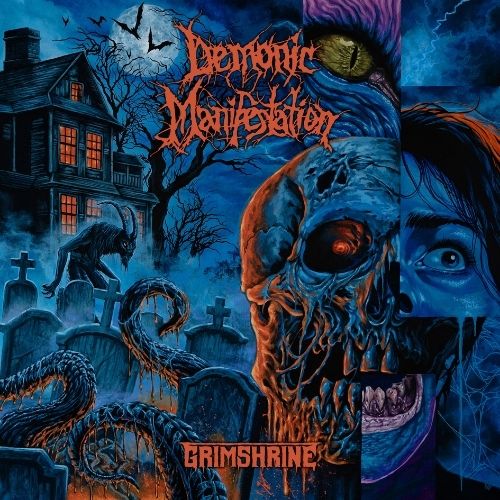
In fact, I think one of the album's biggest successes is how its artwork, production, and riff writing all speak the same language. The cover is retro, the guitar tone is retro, the songwriting is retro... Nothing suddenly sticks out and says, "Hey, I'm from 2026." One glance at the cover and you instantly think, "This is going to be all filthy, mud-soaked guitar tones."
To me, Grimshrine's artwork perfectly captures the spirit of '80s and '90s VHS horror films. That cold palette where purple, blue, and orange bleed into one another, the fog-drenched graveyard atmosphere, the composition reminiscent of classic horror posters... It feels like you're staring at a Lucio Fulci or early John Carpenter movie poster. Even before hearing a single note, it tells you one thing: decay lives here.
These days, a lot of death metal album covers feel overly digital and overloaded with detail. Grimshrine, on the other hand, is readable. There's one central scene, and it reflects the album's atmosphere directly. It's the same philosophy you find on classic Dismember and Entombed records—the cover is an extension of the music. It's not trying to scream, "Look how brutal we are." It's designed to pull the listener through the cemetery gates at first glance.
The thing that impressed me most about Demonic Manifestation's Grimshrine is its sincerity. There are countless "old-school death metal" bands today, but some of them give off the feeling that they're constantly saying, "Look, we play old-school death metal." That calculation simply isn't here. These guys sound as if they actually walked into a rehearsal room in 1991 and hit Record.
And then there are the riffs. That's where the album's biggest strength lies. The songs keep introducing new riffs without ever exhausting the listener. The influence of Dismember and Entombed is undeniable, but they stop short of becoming outright copies.
I also enjoyed the vocals. Instead of going for impossibly deep, cave-dwelling gutturals, they've chosen a tone that's more intelligible while remaining savage. As a result, the vocals never overpower the guitars or drums—they become part of them.
And the drums... Those transitions between classic Swedish d-beats and traditional death metal rhythms inject the album with tremendous momentum. Instead of hammering away with nonstop blast beats, they preserve the groove. That's exactly why it's so hard not to bang your head.
Another plus is the running time. It never overstays its welcome. The songs make their point and move on. Plenty of modern death metal albums run for an hour, yet half of it slips from your memory. Grimshrine operates on a hit-and-run philosophy.
And once again, that connection between the artwork and the music... To me, that's what defines this album's identity. You know exactly what you're about to hear the moment you see the cover, and once the first riff kicks in, you step directly into the world painted on it. That's always been one of my favorite qualities of classic death metal albums.
That said, if Demonic Manifestation wants to leave a lasting mark, they'll eventually need to develop a signature of their own. My favorite track on the album, "Ninth Flame Path," offers a glimpse of what that could look like. Its black metal touches and chaotic opening show that the band is capable of stepping outside the standard Swedish death metal formula. I only wish there had been more moments like that throughout the album.
"Ninth Flame Path" initially feels closer to the chaotic, sinister atmosphere of second-wave black metal than classic Swedish death metal. It never fully turns into a black metal song, though; the death metal backbone remains intact. The melodies in the opening section seem deliberately unwilling to flow smoothly. Instead of putting the listener at ease, they create discomfort. Then the HM-2 riffs kick in, and suddenly it's, "Alright, we're back in the graveyard."
There's another interesting aspect to it as well. While the album as a whole revolves around decay and graveyard imagery, "Ninth Flame Path" carries a more occult, ritualistic atmosphere. It feels as though torches are burning inside an abandoned temple and some ancient rite is about to begin.
What draws me in isn't just the heaviness. It's the way the music transports the listener somewhere else. And to me, that's exactly what good death metal should do. You shouldn't finish a song thinking only, "Nice riff." A world should come alive in your mind. "Ninth Flame Path" accomplishes exactly that. Close your eyes and you can genuinely picture damp stone walls, dying torches, and a lonely path disappearing into the darkness.
That's where the magic of old-school death metal really lies. It reminds me of a time in the early Swedish scene when death metal and black metal hadn't yet fully separated into distinct worlds. You could still hear the shared darkness between the two genres in certain riffs and melodies. "Ninth Flame Path" captures that spirit beautifully.
One more thing I especially appreciate: the band builds that atmosphere with guitars rather than keyboards or orchestral arrangements. Nowadays, plenty of bands stack effect upon effect in an attempt to sound dark. Here, the riffs and harmonies written for two guitars are more than enough. That gives the album a darkness that feels completely natural.
Anyway, I've rambled on long enough. :)
If you love "old-school" death metal but you're not looking for a carbon copy, this album probably won't have much to offer you. Take Death – Leprosy, for example—you love it because when it came out, it sounded like nothing else. You love Entombed because Left Hand Path introduced a guitar tone that changed everything. So if what you're really after is a band that's faithful to the spirit while still sounding unmistakably like itself, you've come to the wrong place.
That's why Demonic Manifestation leaves me with the feeling of being "a great band that never quite becomes a great one." It's an enjoyable listen with a strong atmosphere, but if someone asked me years from now to name the one album that best represents Swedish-style death metal in the 2020s, this probably wouldn't be the first title that came to mind.
Even so, I'll say this: I'm glad bands like this still exist. Because this music isn't a genre that's meant to survive only in museums. It's still breathing in rehearsal rooms, basement spaces, and in front of filthy amplifiers. And as long as that spirit lives on, we'll keep discovering new graveyards.
HÜS
demonicmanifestation.bandcamp.com
personal-records.com
personal-records.bandcamp.com
facebook.com/personalrecords666