
Album Review
DISSIMULATOR - Artifice Dissolves
Technicality, speed, and songwriting achieve perfect balance.
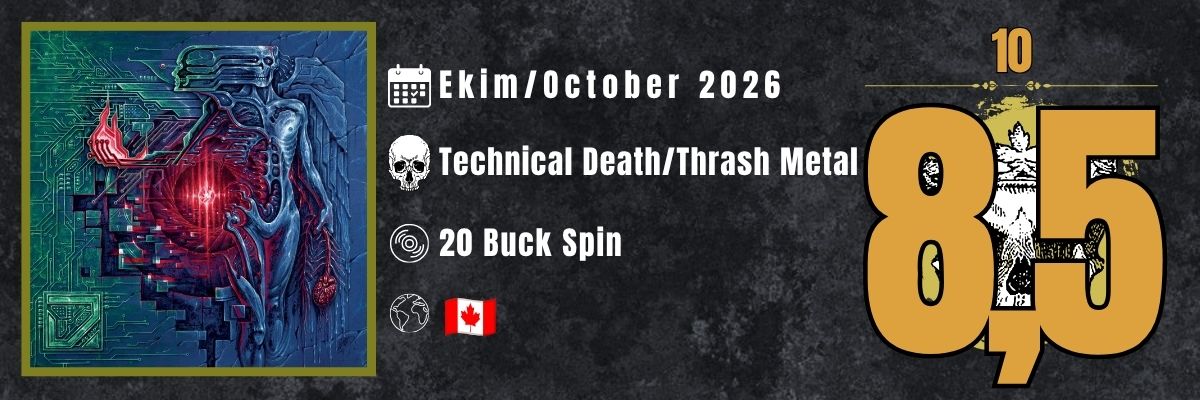
Montreal-based DISSIMULATOR’s second full-length, "Artifice Dissolves", is a record that serves as a reminder that the intersection of technical Death/Thrash cannot be defined solely through sheer instrumental prowess. While the approach that became evident on "Lower Form Resistance" is tightened further here, the complexity in the band’s music manages to move beyond being a showpiece added on top of the songs, becoming an integral part of the songwriting itself. As a result, there is a clear gap between the resistance the album creates on first listen and the detailed structures that begin to reveal themselves over subsequent spins.
DISSIMULATOR’s core strength lies in not treating technicality as something separate from speed. The riffs do not branch out merely for the sake of becoming as complex as possible; the sharp attacks of Thrash Metal, the heavier and more physical side of Death Metal, and progressive rhythmic breaks complement one another within the same compositions. Changes in riff density within a short passage, an unexpected pause or a shift in rhythmic direction no longer sound like isolated “tricks”. Particularly on songs approaching six or seven minutes, this approach prevents the constantly changing material from disrupting the overall coherence of the tracks.
From this perspective, the opening of "Artifice Dissolves" is particularly striking. 'Hungry Ghosts' offers no easy foothold in the album’s opening minutes, with its dissonances and unsettling shifts in direction. Even for listeners who felt that the band had placed the technical intensity of its previous album within a more accessible framework, this amounts to a small test. By contrast, as tracks such as 'Artifice Dissolves' and 'Alloyed' progress, it becomes increasingly clear how the riffs connect to one another. Beneath structures that initially seem complex lies a highly controlled approach to composition.

The rhythm section is an important part of that control. Philippe Boucher’s drums are kept sufficiently prominent in the mix without being pushed unnecessarily to the forefront; the physical weight of the blast beats and double-bass passages becomes even more palpable when working in tandem with the bass. Antoine Daigneault’s bass parts likewise remain more than a lower layer supporting the guitars. Although their movement in the faster passages is presented with enough balance to be easy to overlook at first, closer attention reveals how much of the rhythmic structure they carry. As a result, there is no unnecessary separation between the more showy side of the technical performance and the backbone of the songs.
On the guitar side, the band’s real mastery emerges less from the sheer number of riffs than from what those riffs do. Tracks such as 'Neon Metropolis' and 'Robostrobos' rely not on randomly stacking one idea after another, but on controlled shifts between different levels of intensity. The various Thrash and Death Metal associations in 'Proprioceptor' reveal another side of the same approach. The traces of VOIVOD, CYNIC, SADUS, ATHEIST and similar bands are certainly there, but DISSIMULATOR’s value lies not in lining up these references, but in absorbing them into its own technical Death/Thrash vocabulary.
The album’s accessibility becomes important at precisely this point. "Artifice Dissolves" is complex without constantly forcing the listener to focus on technical detail. Because the function of the riffs within the compositions remains clear, the technical passages never drift outside the music itself. This allows the band to avoid the problem Technical Death Metal sometimes falls into, where “what is being played becomes more important than how it is being played”. No matter how fast or complex DISSIMULATOR becomes, the Death/Thrash character of the songs never disappears.
The vocals reinforce this balance as well. Claude Leduc’s aggressive vocal character adds intensity to the music without becoming buried beneath the guitars in the mix. At the same time, the vocal treatment is not harsh enough to impose a second layer of pressure over the instrumental complexity. The additional vocals on 'Artifice Dissolves', 'Alloyed' and 'Proprioceptor' also contribute to this structure. The vocal therefore becomes less an independent element sitting above the technical musical framework and more a component that directs the aggression of the compositions.
The production choices are particularly well suited to the album’s character. Although the sound is clean and transparent, it avoids the excessively sterile or artificially enlarged aesthetic sometimes employed by modern Technical Death Metal. The natural character of the drums gives the music a physical sense of space without blunting the guitars’ harshness. This warmth also plays a role in making DISSIMULATOR’s complex compositions easier to follow. Rather than choosing a mix designed to make the technicality appear bigger, the production is geared towards making the details of the music audible.
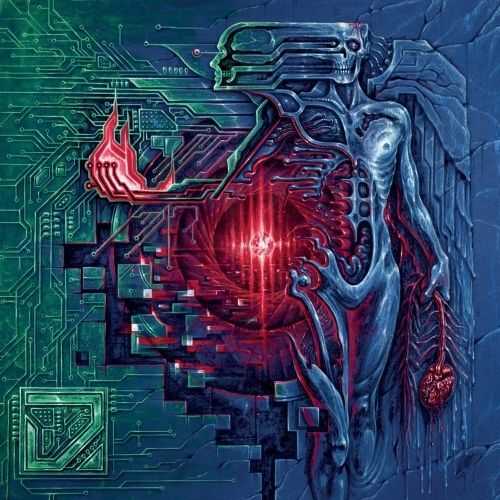
The science-fiction aesthetic also corresponds directly with this musical structure. The album’s mechanical and biomechanical visual world, together with the more melancholic and atmospheric interlude of 'Dusk', creates a brief space to breathe within the constantly forward-moving nature of the songs. 'Neon Metropolis' that follows and 'Robostrobos' at the end then raise the album’s technical intensity again. In particular, the riff in the later section of 'Robostrobos', which gives the impression of being rhythmically off-balance while retaining its internal control, shows that the band can build complexity not only through speed and precision, but also through physical sensation.
Still, "Artifice Dissolves" is not an album that opens up with effortless ease. The sharp transitions, dissonances and constantly shifting ideas in its early sections may leave listeners unfamiliar with Technical Death/Thrash on the outside. The fact that some riffs are remembered more through structural movement than through a strong melodic hook also makes the album harder to grasp immediately. Here, however, this is less the result of uncontrolled songwriting than of the mode of expression the band has chosen. The album demands time; in return, repeated listens begin to separate the details that blur together on the first pass.
The most important thing the band achieves on its second album is making the musical consequences of its technicality more visible without reducing that technicality. "Artifice Dissolves" therefore cannot be regarded simply as a faster, more complex or more savage follow-up. The relationship between riff, rhythm, vocals and production has been tightened, while the distance between technical showmanship and songwriting has been reduced as much as possible. Drawing from the traditions of the genre while combining them with a contemporary production approach, the album forms a strong point of intersection for listeners following the different currents of VOIVOD, ATHEIST, SADUS, CYNIC and Technical Death/Thrash. "Artifice Dissolves" does not hide its complexity, but neither does it present that complexity as a virtue separate from the music itself. This balance is precisely where DISSIMULATOR’s most distinctive identity lies today.

https://www.facebook.com/20buckspin
https://www.instagram.com/20buckspinlabel
https://20buckspin.bandcamp.com