
ALBUM REVIEW
TAUFPATIN - Les Malfaisances de la Taufpatin
Melodic, dark, and strangely enchanting.
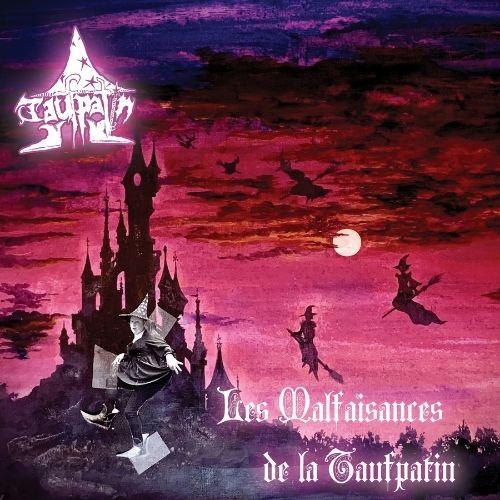
TAUFPATIN’s “Les Malfaisances de la Taufpatin” brings the lo-fi aesthetic of dungeon synth into the melodic, medieval-inflected strain of French underground black metal, resulting in a debut whose narrative world is every bit as clearly defined as its music. Released through Antiq, the record revolves around the return of La Taufpatin, a witch from 18th-century eastern France and Alsace who is said to have been burned at the stake for her misdeeds. Setting aside the humorous side of this French-language tale, the album’s musical backbone is surprisingly serious and cohesive.
The synths that open the record establish its aesthetic boundaries within the first few minutes. Dungeon synth and keller synth textures merge with the raw surface of the black metal guitars, incorporating the medieval feel into the compositions rather than using it merely as decoration. The guitars primarily move through melodic riffs, while the occasional leads and solos follow the same melodic approach. Technical showmanship takes a back seat to memorable motifs and unfolding melodic lines. Particularly in the slower passages, this approach allows the music to create its darkness not solely through distortion, but through melody itself.
The album’s overall pace is slow and measured. Rather than relying on blast beats or constant high-speed black metal, it opts for a more epic flow in which the riffs are given enough room to breathe. This has a direct impact on the atmosphere of “Les Malfaisances de la Taufpatin”. While the rhythm section supports the melodic character of the guitars, the songs follow one another not merely through changes in speed, but through melodic and atmospheric distinctions. As a result, the album’s relatively calm pace ceases to feel like a limitation and instead becomes one of the main tools through which its narrative unfolds.
The vocals bring a distinctly dirty and harsh black metal character to this framework. The screams reinforce the darker side of the songs by sitting firmly over the melodic foundation, while spoken-word passages and clean vocals emerge in places. These theatrical interventions draw the conceptual side of the French-language narrative into the music itself. Since the album’s story is less a conventional dark fantasy tale than an absurd story of revenge, this vocal variety becomes another element completing its world.
One of the most interesting aspects of TAUFPATIN is the contrast between the narrative and the music’s tonal character. La Taufpatin planning her revenge after being left out of a fairy party, eating chocolate, and preparing sinister spells for the good fairies makes for a decidedly strange story. The music, however, never turns that story into a comedic parody. The structure that begins with ‘L’Affront’ grows noticeably grander in moments such as ‘Opération Vengeance’, where it approaches a more majestic, almost martial character. These melodic rises expand the character’s personal anger onto a musical scale. The distance between the absurdity of the concept and the seriousness of the music is an important part of the album’s identity.
The use of dungeon synth is equally functional for this reason. The synths do not attempt to create orchestral grandeur; instead, they build the medieval atmosphere with sounds that can be deliberately simple, old-fashioned, and slightly strange. One important consequence of this choice is that it prevents the album from turning into an artificial epic metal production. Taken together, the raw texture of the guitars, the relatively primitive character of the synths, and the dark production keep the recording deliberately distant from a clean, modern studio aesthetic. Even so, the instruments never collapse into an indistinct mass of noise; the melodies and arrangements remain sufficiently defined.
This is where the comparison to BLUT AUS NORD’s “Memoria Vetusta” era also begins to make sense. The melodic riffs that create a psychedelic feel, the hypnotic atmosphere combined with the raw production, and the slow-moving structures all evoke a similar aesthetic proximity. TAUFPATIN, however, does not disappear completely into that reference point. As the album progresses, tracks that move toward more traditional black metal songwriting interrupt this psychedelic tendency. On one hand, this gives the record some variety; on the other, it creates a slight sense of imbalance across the album as a whole. When the expected atmospheric development gives way to a more conventional black metal approach, the shift becomes more apparent when the individual tracks are considered on their own.
Still, this inconsistency does not seriously damage the album’s overall flow. On the contrary, thanks to its relatively restrained pace and the melodic distinctions between the songs, the record leaves a more balanced impression when experienced as a whole. ‘Opération Vengeance’ is a particularly important example in this respect: while bringing out the album’s more majestic side, it brings the melodic structure and the story’s idea of revenge together at the same point. ‘Je reste la plus belle’, meanwhile, completes the album’s theatrical world by maintaining the narrative’s vain and uncompromising character. The record’s strongest moments emerge in passages like these, where the concept and the music begin to illuminate one another.
The album’s visual and conceptual dimensions cannot be considered separately from its musical approach either. Antiq’s philosophy of treating sound, visual identity, video, attitude, and physical objects as parts of the same whole is particularly well suited to TAUFPATIN’s world. La Taufpatin’s witch persona carried from the 18th century into the present, the French-language narrative, and the old-technology feel of dungeon synth all meet within the same aesthetic framework. This coherence shows that the album’s originality should not be sought solely in its riffs.
“Les Malfaisances de la Taufpatin” is not a flawless display of songwriting. Some tracks meet the expectations created by the album’s more psychedelic and atmospheric side with more conventional black metal solutions, and those transitions do not always feel organic. That said, this does not erase the overall character created by its melodic writing, slow tempos, and raw production. TAUFPATIN’s real achievement lies in refusing to turn the absurdity of its concept into a joke that would undermine the seriousness of the music. Instead, it supports the strangeness of its witch tale with a dark, melodic black metal language steeped in a medieval atmosphere.
For this reason, “Les Malfaisances de la Taufpatin” is more than simply a stylistic intersection between atmospheric black metal and dungeon synth. It combines the familiar tools of traditional melodic black metal with a narrative and visual world built around a clearly defined character. Uneven in places, but easily identifiable in personality when viewed as a whole, it is a melodically strong debut that consciously preserves its underground aesthetic. TAUFPATIN’s most important achievement here is its reliance not on musical showmanship to build its own world, but on the balance between atmosphere, melody, and narrative.

antiqrecords.com
facebook.com/antiq.label
antiqofficial.bandcamp.com