ALBUM REVIEW
DUIR – Catarsi
Structural Tension Between Atmospheric Black Metal and Folk Elements
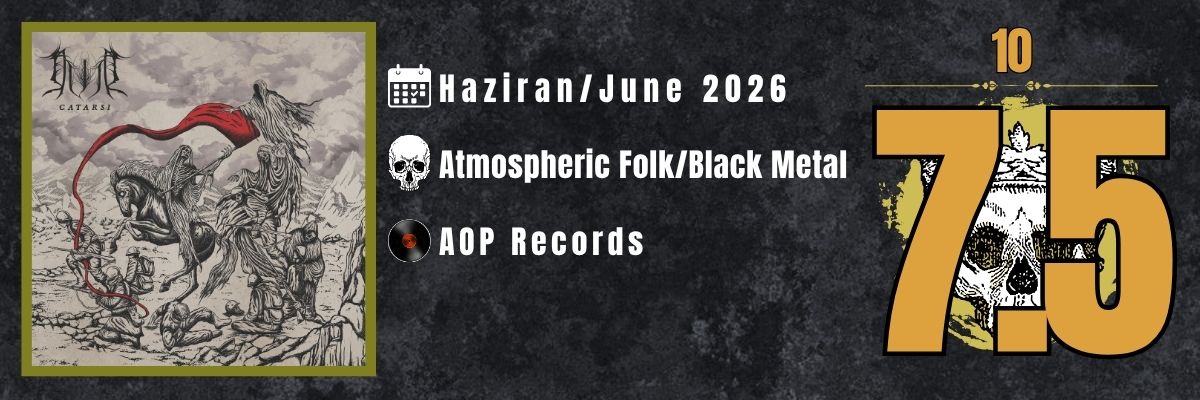
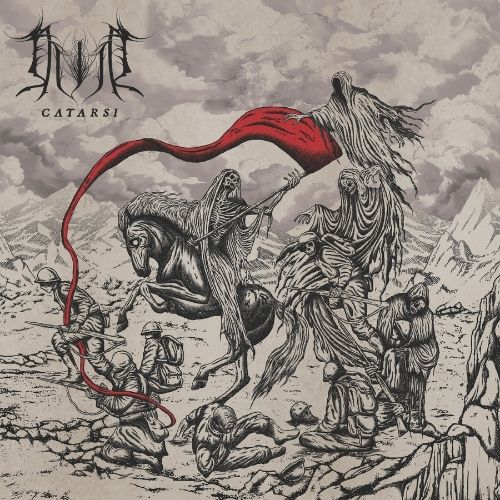
DUIR have been steadily carving out a more defined position within the scene as an Italian band that fuses atmospheric black metal with folk elements around a First World War-themed narrative. Following their 2022 debut, “Catarsı” stands out as their second full-length, presenting an ambitious attempt to expand the band’s compositional scope. Yet the album’s central concern is not merely thematic density, but the extent to which that density is actually reflected within the musical architecture itself.
While the album appears to build its balance between black metal and folk elements through a “war narrative” framework, the decisive factor lies in the internal architecture of the compositions: long-form tracks, interlocking sections, and riff cycles that progress through constant modulation. The core guitar language operates on tremolo-heavy, cold-toned riffs locked into a low-mid register; a choice that prioritizes the creation of a sustained field of tension over clearly articulated melodic lines. However, this tension does not always resolve into dramatic rupture; more often, riff blocks revolving around the same tonal center anchor the internal dynamics of the tracks into a horizontal flow.
The drum writing follows a dual-character approach designed to support this structure: clear transitions between blast beat eruptions and mid-tempo, forward-moving rhythmic passages. Yet these shifts are frequently driven more by layering and de-layering than by riff transformation, meaning the dramatic curve of the compositions does not consistently generate a strong sense of escalation. In tracks such as “Impeto” and “Di Nessuno” in particular, this structure produces a forward-driving energy while simultaneously reinforcing the impression of similarly constructed segments.
The folk instrumentation — flute, bagpipes, and hurdy-gurdy — represents both the album’s most crucial and most contested layer. Rather than functioning as elements that reshape the riff architecture, these instruments more often behave as melodic ornamentation placed atop an already established harmonic field. In “Manifest” and the closing track “Oltre l’Alba,” for instance, flute and bagpipes expand the atmosphere; however, this expansion does not alter compositional decisions, remaining instead at the level of surface embellishment. This highlights a clear gap between DUIR and approaches seen in bands such as SAOR or early WINTERFYLLETH, where folk melody actively guides structural development.
The vocal performance relies on high-register scream techniques that maintain constant pressure throughout. However, as the vocal layer is positioned above the guitar wall within the mix, it contributes less as a rhythmic or melodic counterforce and more as an additional layer of homogeneous intensity. This becomes particularly evident in shorter, more instrumental-oriented tracks such as “Della Notte,” where even in the absence of vocals, the guitar writing maintains a similar density level.
One of the album’s most evident structural issues emerges in its distribution of tempo and intensity. Along the trajectory from “Impeto” to “Della Notte,” the consistently high level of aggression limits dynamic contrast to a more micro-scale. As a result, several tracks begin to share a comparable sense of pacing; tonal and rhythmic differentiation across the midsection is not always sharply defined.
By contrast, sections such as “Del Giorno” introduce doom-influenced slowdowns and more open chord structures, briefly providing the album with moments of structural relief. Yet even these passages function less as directional shifts and more as transitional stations before a return to black metal intensity. The closing track, “Oltre l’Alba,” establishes a more dramatic frame with sea sounds and funeral-tinged bagpipe lines at the outset; however, this frame is quickly neutralized by the return of aggressive structures in the second half. What emerges is not a full convergence between concept and musical realization, but rather two parallel layers coexisting without fully intersecting.
The production approach is generally raw and sharp in character. The “sawing” tone of the guitars and the pronounced upper-frequency presence of the drums prevent the album from slipping into a sterile soundscape. However, the mix often places folk instruments further back, reducing their role within the compositional structure to that of an aesthetic addition rather than an integral voice.
Overall, “Catarsı” remains faithful to the long-form tradition of atmospheric black metal, but rather than redefining that framework, it intensifies it within existing parameters. DUIR establish a solid narrative foundation through their use of the Italian language and the First World War concept, yet on the musical level, the translation of that narrative into structural terms is not always equally consistent. The album demands sustained intensity and linear attention from the listener, but the degree of compositional variation it offers does not fully support that demand over its duration. As such, Catarsı remains a release that points to a stable position within the second tier of its scene, while still carrying untapped potential for broader compositional expansion.
OZAN
facebook.com/duirofficial
duir.bandcamp.com
aoprecords.de
facebook.com/aoprecs
artofpropaganda.bandcamp.com