
Album Review
Enevelde / Gjendød - Elegier fra avgrunnen
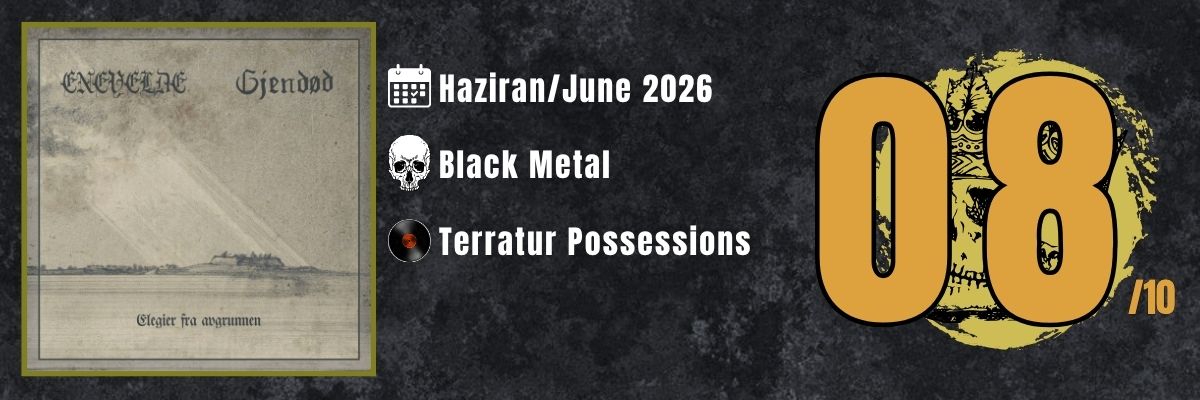
Placing two distinct veins of the Norwegian black metal tradition side by side, Elegier fra avgrunnen actually avoids one of the common pitfalls of the split format: rather than feeling like a fragmented compilation, it sets two separate compositional logics against each other within the same atmospheric framework. The contrast between Enevelde’s introspective, layered approach and Gjendød’s more band-driven, direct and forceful structure defines the album’s dramatic backbone.
Enevelde’s side immediately sets aside black metal’s classic “raw assault” reflex through cleanly executed passages and choral or hymn-like introductory motifs heard at the outset. This choice frames the entry of riffs not as an explosion, but as a gradual intensification. Even when tremolo guitars come in, the structure is not purely speed-driven; riffs expand as melodic cells and are frequently interrupted by mid-tempo transitions.
Drum usage is decisive here: while blast beats define moments of speed, they do not generate constant aggression, instead leaving “withdrawn spaces” within the tracks. As a result, Enevelde’s section leans into the atmospheric strain of 2000s Norwegian black metal, shaped through a mix that deliberately avoids the sterile sheen of modern production. The guitar tone is concentrated in the low-mid frequencies, emphasizing the mass of the riffs rather than their clarity.
The vocal approach spans a broader spectrum than a purely one-dimensional scream; the occasional addition of growl-like layers turns the vocals into not only a rhythmic attack but also a tonal element of tension. This renders Enevelde’s side more “internal” in structure: the progression of riffs builds a closing-in atmosphere rather than outward-facing energy.
The synth textures and melodic lead guitars embedded within the tracks mostly serve to layer rather than open up this structure. In particular, the synth usage toward the closing passages functions less as an expansion of harmonic space and more as a background element that thickens the existing darkness. This indicates that the experimental elements remain largely confined to “thickening the existing form” rather than transforming the composition itself.
The transition to Gjendød markedly shifts the album’s energy vector. Here, the guitars exhibit sharper riff articulation; tremolo passages are used to generate shorter, more percussive motifs rather than melodic expansion. This approach makes the tracks more “band-driven” compared to Enevelde’s side.
The drum performance is correspondingly more forward-driving: blast beats are deployed not to construct atmosphere, but to sustain riff momentum. Mid-tempo sections in Gjendød’s material function not merely as transitions but as the structural backbone carrying the weight of the riffs.
The vocal technique is positioned within a more classic high-register black metal scream register, anchoring the music more directly to mid-90s Norwegian aesthetics. The key point, however, is that Gjendød does not merely reproduce this reference; by introducing a sense of groove, they ground the riff flow in a more physical framework. This groove element occasionally produces brief deviations reminiscent of Carpathian Forest-like fragmented energy, though it never pushes the structure into a fully experimental domain.
Synth usage is more subdued compared to Enevelde and appears in shorter, more incidental interventions. Acoustic guitar passages, meanwhile, function less as expansion devices and more as textural bridges that soften otherwise abrupt transitions. In this respect, Gjendød’s experimental elements can be described as “structurally secondary rather than decorative.”
The production approach is the key unifying factor between both sides. The record deliberately avoids the purified standards of modern black metal; guitars carry “density” rather than sharpness, and the drums are recorded with a natural spatial feel stripped of artificial trigger-like processing. In line with the Terratur Possessions aesthetic, this positions the sound physically rather than technically.
The dramaturgy of the split is reinforced by this production language. Enevelde’s more inward-collapsing, ritualistic structure creates a form of “internal dissolution,” while Gjendød completes this space with a more outward-facing, rhythmic response. This transition does not operate as a contrast, but as two distinct modes of movement within the same tonal universe.
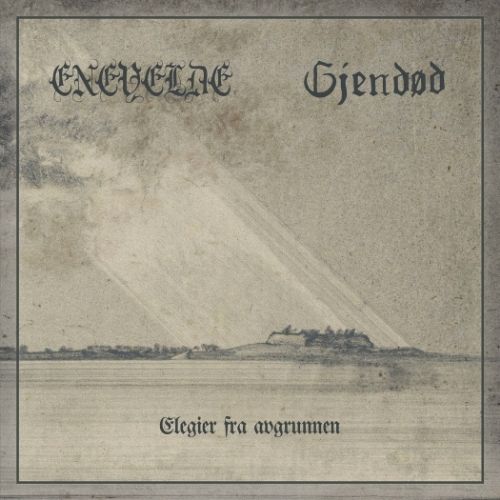
The muted, low-contrast natural imagery on the cover directly aligns with the musical approach. The notion of an “indistinct landscape” mirrors the way riffs are treated as atmospheric mass rather than sharply defined contours. The avoidance of overtly symbolic black metal iconography reinforces the idea that the album is not a theatrical “dark spectacle,” but rather a recorded atmosphere.
Elegier fra avgrunnen presents two interpretations of riff-based thinking rather than technical variety. Enevelde’s side pulls the structure inward, elongates time, and dissolves riffs into atmosphere, while Gjendød builds a more direct, rhythmic, and band-centered framework.
The listening approach the album demands becomes clear here: rather than rapid consumption, it requires following two different organizations of the same tonal world. Certain experimental textures (synths, acoustic guitars, melodic leads) at times remain on the surface rather than transforming the composition; however, this does not weaken the album’s intent, it merely defines its boundaries.
This split is positioned not through claims of “innovation,” but through the reactivation of established Norwegian black metal riff and production logic via two distinct internal systems. What emerges is not an expanding aesthetic statement, but two different distributions of weight across the same ground.
OZAN