ALBUM REVIEW
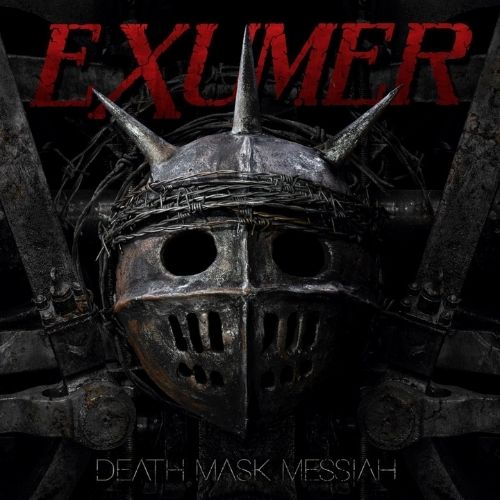
EXUMER - Death Mask Messiah
Modern Teutonic Thrash strengthened by traditional roots.
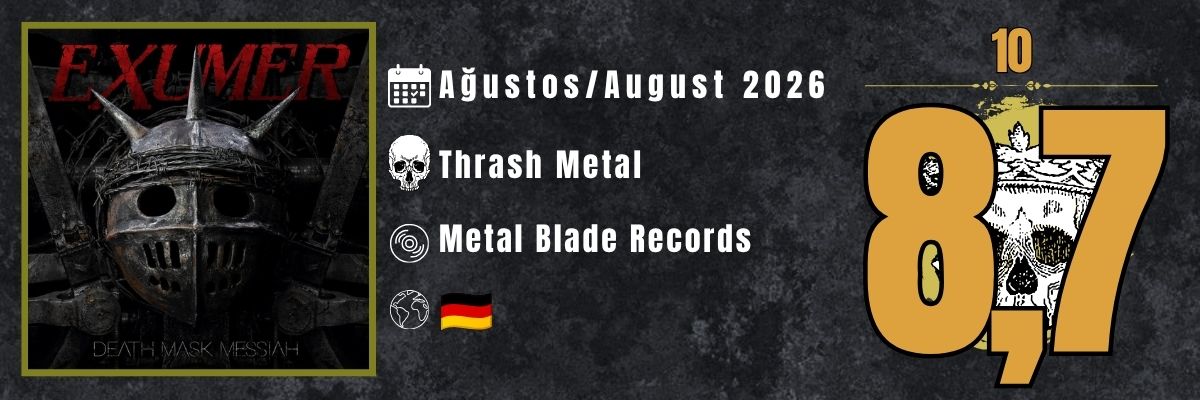
One of the most important bands the German thrash metal scene has given to the world, EXUMER breaks nearly seven years of silence with its sixth full-length album, “Death Mask Messiah.” The first detail that immediately stands out is that the album derives its sense of speed not simply from BPM, but from the way its riffs shift direction. At the center of the album are the sharp guitars familiar from the band’s sound, high-tempo drums, prominent bass lines, and Mem V. Stein’s aggressive vocal character. Yet what truly sets “Death Mask Messiah” apart from a conventional thrash album is the method used to bring these elements together. EXUMER does more than keep the legacy of ’80s Teutonic Thrash alive; it combines the restless riffing sensibility of that era with a tighter, more physical production approach.
The guitars of Ray Mensh and Marc Bräutigam form the album’s compositional backbone in particular. Rather than moving in a straight line, the riffs often progress through brief shifts in direction, stops, and rhythmic breaks. This keeps the songs from simply charging forward at high speed. As the guitars constantly alter where the next hit lands, the drums do not merely stabilize this movement but give it additional momentum. As a result, the aggression of “Death Mask Messiah” comes less from constantly accelerating than from the transitions between tension and release.
This approach makes itself apparent within the first few minutes. After its short, tense intro, the title track moves directly into its main body, leaning on the hard-edged riffs of the classic German thrash tradition. Its riffing brings together KREATOR’s sharp aggression and EXODUS’s more mobile guitar phrasing. However, these reference points never overshadow the song’s own identity. The rhythmic accents of the main riff and the chorus’s immediately graspable melodic structure turn the track into not only a fast opener, but an effective one.
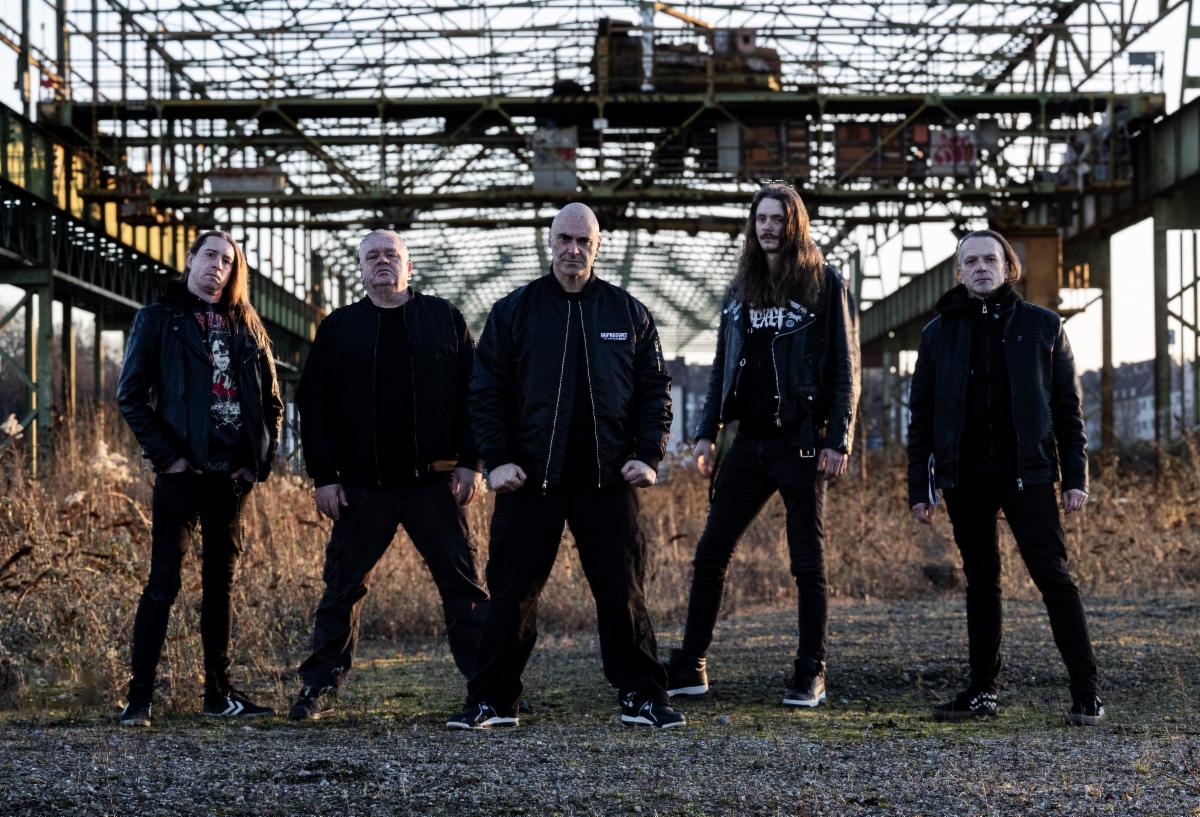
This is where one of EXUMER’s major strengths as a songwriter becomes apparent: they do not treat aggression and memorability as opposing qualities. Tracks such as “Blinding Skies” and “Sin Bleeder” combine sharp guitar work with high tempos while employing distinct melodic hooks in their choruses. In thrash metal, technical proficiency can often overshadow songwriting; EXUMER, however, uses riff complexity without compromising the songs’ memorability. As a result, the tracks are not merely effective in the moment they are performed; they are constructed so that certain guitar phrases and vocal passages linger in the memory.
“Eradication” shows another side of this formula. Rather than simply pushing the tempo upward, the song introduces variation through groove and rhythmic weight. Punk and crossover influences also become more pronounced here. Similarly, “Allocated Savagery” opens up a dirtier, more punk-oriented space within the traditional thrash framework. These touches do not transform EXUMER’s music into something belonging to another genre; instead, they demonstrate how the same riffing logic can be applied with different rhythmic weight.
Another strong element on the guitar side of the album is the solos. Mensh and Bräutigam do not use them as flashy sections tacked onto the songs after the fact. More often, they continue the aggression of the main riffs while maintaining the sense of speed and tension. Virtuosity, therefore, never takes precedence over songwriting. The guitar work on “Death Mask Messiah” is built more around momentum than showmanship.
The new rhythm section is another important part of this structure. Alex Voss’s bass playing does more than support the guitars’ lower frequencies; it adds to the physical weight of the songs. Keeping the bass audible in the production prevents the rhythmic body from disappearing beneath the dense layers of guitar riffs. Jerome Reil, meanwhile, brings a pronounced aggression to the drums. Particularly in the faster sections, the density of his hits locks directly into the guitars’ restless riffs, while his short rhythmic interventions during transitions prevent the songs from becoming mechanical displays of speed.
What makes Reil’s performance particularly noteworthy is not simply its power, but the way he emphasizes the music. Rather than copying every movement of the guitars, the drums support the riffs in some sections and give the songs an additional push in others. The rhythm section is therefore not a passive carrier sitting in the background of the album. Particularly in heavier passages such as “Fratricide,” the bass and drums significantly amplify the mass created by the guitars.
Mem V. Stein’s vocals are also one of the elements connecting the album’s past and present. The more wild and cutting vocal character heard on EXUMER’s early recordings has not disappeared entirely, but the delivery here is more controlled. Stein has a sharp thrash vocal character that could be placed somewhere between KREATOR’s Mille Petrozza and VIO-LENCE’s Sean Killian. Shouts, snarls, and hard-edged accents work together with the rhythmic structures of the songs. Moreover, keeping the vocal recordings clear and intelligible in the production prevents that aggression from getting lost beneath the dense guitar layers.
At this point, the production of “Death Mask Messiah” becomes particularly important. Dominic Paraskevopoulos’s recording approach modernizes the album without sterilizing EXUMER’s musical character. Arthur Rizk’s mixing and mastering, meanwhile, preserve the physical weight of the guitars, bass, and drums while preventing the frequencies from bleeding into one another. The result is a production that refuses to succumb to the excessively bright and over-compressed sound often encountered in contemporary thrash metal, while also avoiding a retreat far enough into the past to merely imitate the aesthetics of the ’80s.
This choice directly defines the album’s aesthetic position. “Death Mask Messiah” does not sound like an old album re-recorded with new technology. Instead, it frames a classic riffing language within today’s production standards. EXUMER’s traditional approach is therefore not used as a nostalgic backdrop here; it forms the foundation of the album’s songwriting and performance style.
From this perspective, the album’s claim to innovation should also be read differently. “Death Mask Messiah” is not trying to add a new word to the vocabulary of thrash metal. It does not alter its identity through experimental instrumentation, radical genre shifts, or unconventional production choices. Instead, EXUMER rearranges the fundamental tools of its genre through a tighter compositional approach. While originality in contemporary extreme metal is often defined by going beyond the boundaries of a genre, this album takes a different approach: writing better riffs within the same boundaries, building more effective transitions, and balancing aggression with melodic memorability.
In the album’s second half, “Serpent” and particularly “Fratricide” offer different levels of intensity within this approach, while “Scorcher” stands out as one of the tightest examples of the formula. Its compact structure, sharp riffs, and high tempo intensify the album’s core character without taking unnecessary detours. This is where EXUMER’s advantage as an experienced band becomes apparent: rather than knowing how much material a song can contain, they know which material is actually necessary.
The album’s thematic framework also aligns with this musical directness. The idea of the false messiah extending from David Koresh and the Waco incident through the “Death Mask Messiah” title expands across the album into themes of manipulation, political polarization, disinformation, and social division. These themes do not feel like a decorative concept placed on top of the music afterward; they share the same aesthetic language as the aggressive vocal delivery and the confrontational rhythmic structures of the songs. The idea of brothers becoming enemies in “Fratricide” likewise creates a fitting contrast with the album’s constantly forward-driving yet rhythmically fractured structure: there is movement, but that movement progresses toward conflict rather than resolution.
“Unchained Angel,” which arrives at the close, offers a more tangible expression of EXUMER’s relationship with its past. The choice of a NASTY SAVAGE song is not merely an ’80s cover; it is a direct reference to the two bands’ joint European tour in 1988. More importantly, while adapting the song to its own sound, EXUMER does not completely flatten its original character. Nasty Ronnie’s guest vocals therefore become more than a nostalgic appearance; they carry the cover’s historical context into the music itself. Here, nostalgia does not function as a bonus detached from the rest of the album, but as a deliberate closing choice that recalls EXUMER’s own position within the history of thrash.
The real point of “Death Mask Messiah,” then, is not to create a new EXUMER. The band rebuilds the riffing logic it carried from the ’80s through contemporary production, more controlled arrangements, and the physical power of its new rhythm section. The approach the album demands from the listener follows accordingly: those looking for an experimental record that challenges the fundamental rules of the genre will not find a different direction here; for those who pay attention to the function of riff architecture, rhythmic breaks, and chorus writing within thrash metal, however, there is more than enough material.
It is clear that “Death Mask Messiah” has particularly whetted the appetite of Turkish fans for the band ahead of Bosphorus Open Air. EXUMER’s current position becomes most apparent here. Rather than leaving the band in the shadow of its classic recordings, “Death Mask Messiah” positions EXUMER as a contemporary act demonstrating that traditional German thrash metal can still be a productive field for songwriting. Without requiring a radical change of direction, it builds a tighter and more physical album within its own aesthetic boundaries. This approach focuses less on seeking novelty than on how efficiently those boundaries can be used to reinforce the band’s identity. That is where the most significant critical weight of “Death Mask Messiah” lies.

https://www.facebook.com/exumerofficial
https://www.instagram.com/exumerofficial
https://www.facebook.com/metalbladerecords