
ALBUM REVIEW
Grimveil – Beneath the Veil of Silent Woods
Nature and Amospheric Black Metal

Grimveil emerge as a new formation centered on the nature-driven narrative tradition of atmospheric black metal, bringing together seasoned names from within the scene. Shaped by the collaboration between Simon Lindgren and Revenant, the project revisits the genre’s established aesthetic codes through a long-form and layered compositional approach. “Beneath the Veil of Silent Woods” stands as the first fully realized expression of this vision, offering a strikingly coherent introduction both conceptually and structurally.
Even for me, trying to focus on atmospheric black metal under Germany’s uncharacteristically sweltering 30-plus-degree heat, “Beneath the Veil of Silent Woods” manages to hold attention. Rather than simply reproducing the nature-centric narrative tradition of atmospheric black metal, the album constructs a framework that stabilizes it within a long-form compositional logic. Its backbone is not built on riff density or technical aggression in the traditional sense, but on layered guitar cycles unfolding in mid-to-slow tempos, continuously reframed through acoustic transitions.
From the opening tracks onward, the guitar language clearly leans on tremolo-based melodic lines, yet this tremolo writing avoids the genre’s typical sense of “continuous flow,” instead relying on the repetition of specific motifs at varying levels of intensity. Simon Lindgren’s compositional approach here is non-linear; he reinterprets the same melodic cell through both acoustic guitar and distorted layers, maintaining a steady internal tension within the tracks. This method, particularly in mid-tempo passages, weakens the sense of forward momentum in the riffs and instead generates a cyclical, suspended space.
The role of the rhythm section is critical at this point. The bass guitar is often confined to a foundational layer carrying the low-frequency weight of the guitar wall, stabilizing harmonic density rather than offering distinct melodic counterpoints. The drums, meanwhile, avoid blast beat-driven aggression and instead establish a walking, at times almost ceremonial rhythmic flow across much of the material. Even when acceleration occurs, these transitions avoid sharp ruptures, functioning instead as intensified continuations of preceding motifs. This positions the album’s sense of climax not in a linear arc, but in a more wave-like structure.
Acoustic guitar usage stands as one of the album’s most defining structural tools. These passages function less as “interludes” and more as alternative textural renderings of the same thematic material. Particularly in tracks such as “Into the Depths of Shrouded Pines” and “Where Beauty Breathes in Silence,” the acoustic layers do not create contrast when the distortion returns; instead, they sustain continuity with the preceding atmosphere. In other words, the transitions between heavy and soft are not aesthetic breaks, but different lighting conditions of the same composition.
Revenant’s vocal approach is deliberately integrated into this framework. His delivery relies less on technical variation and more on a single timbral identity: a fractured, constantly tense, and deliberately rough-edged scream. This choice pulls the vocals away from a narrative role and turns them into another layer of the atmosphere. However, a critical point emerges here: at times, the vocals become absorbed into the density of the guitars, losing some of their directional force and limiting dynamic differentiation, particularly in the mid-sections.
One of the album’s structural centers, “Only Trees Bear Witness,” provides the clearest example of this cyclical writing method. The track builds its long form not by introducing new material, but by expanding a single thematic core. While this approach maintains atmospheric consistency, it also creates the impression that certain repetitions function more as elongation than compositional necessity. A similar tendency appears in the second half of the album, where increases in intensity are achieved more through compression of existing material than through the introduction of new ideas.
The use of synths is notable yet deliberately kept in the background. Rather than creating a pronounced “symphonic expansion,” the layers are positioned as a faint ambient frequency behind the guitars. This restraint helps the album avoid drifting into exaggerated pastoral or folkloric dramatization, instead establishing a more neutral natural atmosphere.
On the other hand, the album’s production aesthetic also reveals certain limitations. Within the mix, guitars are clearly pushed to the foreground, while the micro-dynamic details of bass and drums are at times subdued. This reduces the perception of rhythmic nuance, especially in slower passages, and results in a texture that feels “layered yet flat” in its spatial articulation.
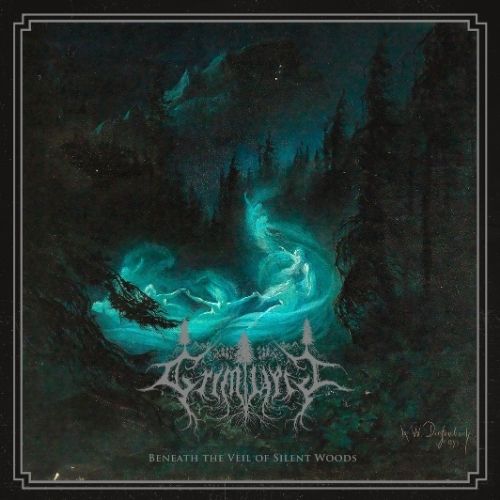
The visual and conceptual framework of the album—forest, mist, and the dissolution of the human within nature—largely aligns with its musical structure. However, this alignment operates primarily on an atmospheric level; compositionally, the idea of nature does not evolve into a genuine structural transformation, but rather remains a recurring aesthetic frame. In other words, the nature theme does not radically reshape the music’s architecture; it is layered onto an already cyclical writing method.
Toward the end, the album demonstrates more controlled intensity management on “As Fog Devours the Trail” and the closing instrumental piece. Here, particularly the more deliberate use of tempo shifts partially balances the occasionally repetitive structures of earlier tracks. Still, the overall form continues to favor continuity over major ruptures.
“Beneath the Veil of Silent Woods” proposes a long-form, layered, yet compositionally cautious framework within atmospheric black metal. Rather than expanding the genre’s nature-centric narrative language, Grimveil refine it into a more stable and cohesive listening environment. This approach ensures consistency and flow, while also revealing an aesthetic choice in which idea density is intentionally kept restrained in certain passages.
OZAN