ALBUM REVIEW
MEGASCAVENGER - Toxic Noxious Undeath
A forceful return to old-school Swedish death.
One of the more prolific names in Swedish death metal, Rogga Johansson continues to work the genre’s old-school vein under the MEGASCAVENGER banner, returning to it with characteristic persistence. “Toxic Noxious Undeath” deliberately distances itself from modern genre trends through short, tightly packed compositions that combine HM-2 guitar tones, sharp riffs, and a rotating cast of death metal vocalists within the same framework. Arriving after a six-year hiatus, the album is less concerned with pursuing originality than with asking just how effective classic Swedish death metal can still be as compositional material.
To put it in the most conventional terms, the album’s fundamental compositional idea is remarkably clear: short song forms, sharp Swedish death metal riffs, d-beat-driven momentum, and arrangements that work as directly as possible. With the guitars at the center, Rogga Johansson builds the songs around memorable riffs rather than technical showmanship. The dirty guitar texture of the HM-2 tradition is not used merely as a nostalgic effect here; by sharpening the edges of the riffs, it becomes one of the album’s primary production elements and a key carrier of its old-school character. Even so, the sound never gives in to the murkiness often found in productions that emulate the genre’s past. The dirty but controlled mix preserves the rhythmic backbone of the songs without burying Johan Berglund’s bass or Thomas Ohlsson’s drums beneath the wall of guitars.
This approach deliberately keeps “Toxic Noxious Undeath” away from modern death metal’s race toward technical complexity. MEGASCAVENGER is not trying to establish a new language here; instead, it takes the riff-centered songwriting approach of early Swedish death metal and runs it through the clarity afforded by contemporary production standards. The real question, therefore, is less about originality and more about how effectively extremely familiar material can be handled. On that front, the album’s answer is largely positive.
The opening track, 'Graveyard Dreams and Bonehouse Screams', immediately establishes the parameters of this approach through Kam Lee’s unmistakable vocals. Choppy, hard-hitting guitar strikes, constantly driving drums, and menacing lead guitars woven between the riffs keep the song moving without unnecessary detours. The strength of these riffs lies not in their complexity but in the placement of their rhythmic accents. The track draws almost directly from the basic vocabulary of Swedish death metal associated with ENTOMBED and DISMEMBER, but what keeps it from becoming a mere stylistic exercise is Rogga Johansson’s ability to continually reframe the main riffs through small rhythmic breaks and melodic touches.
'Corpses Below' makes the formula somewhat heavier. With Felix Stass providing deep vocals, the guitars become thicker and the bass more pronounced, allowing the track to broaden its rhythmic space without abandoning its momentum altogether. The death/doom influence becomes particularly apparent in the slower sections, where the weight carried by the rhythm guitars combines with the vocal character to emphasize the song’s suffocating side. It is significant that the bass ceases to function merely as low-end support and instead moves alongside the guitars. Johan Berglund’s lines are particularly free-flowing on 'Exploding Casket Syndrome', while Thomas Ohlsson’s drumming anchors that movement with direct, forceful hits.
Featuring Erik Rundqvist on vocals, 'Exploding Casket Syndrome' is one of the album’s quickest tracks to reveal its identity. Rather than constantly changing riffs within its brief running time, the arrangement sharpens the ideas already in place, establishing such an obvious connection to VOMITORY’s direct death metal aesthetic that the resemblance is hard to miss. That similarity is not a weakness; rather, it demonstrates how deliberately MEGASCAVENGER has drawn its aesthetic boundaries. Instead of adding “more technical elements,” the song opts to place several strong riffs one after another.
The album’s real field of variation, however, emerges through its vocals. Giving every track a different vocalist could easily have been an idea capable of disrupting the album’s cohesion. Indeed, ten distinct vocal personalities are the most obvious tool available for differentiating the songs on an album whose guitars largely draw from the same compositional center. MEGASCAVENGER, however, does not treat this variation as a random parade of guest appearances. Rogga Johansson’s guitar writing places each vocalist’s different techniques within a shared musical framework.
Dave Ingram’s heavy, authoritative performance on 'A World of Fire and Brimstone' naturally complements the track’s dark riffs. Michael H. Andersen’s more aggressive approach on 'Fleshburner Yearner', meanwhile, briefly pushes the album toward a blackened energy. 'Heading for the Furnace', featuring Max Otero, opens another avenue with death/thrash-inflected guitar movements and a sharper vocal approach, while Jan Bergmann Jepsen’s performance on 'As Purgatory Ascends' places the chainsaw tone of Swedish death metal against heavier, swamp-like passages. Dave Rotten’s brutal death metal-influenced vocals on 'Shallow Grave Overflow' further increase the track’s sheer mass.
At this point, the vocal diversity does not replace the album’s core compositional idea. On the contrary, it creates different surfaces within the same guitar-driven world. For that reason, the guest-vocalist concept on “Toxic Noxious Undeath” does not remain a decorative feature added simply to inflate the list of names. There is, however, a trade-off: while the vocals provide the album’s strongest source of variety, the individual riff identities of some tracks become less distinct. Particularly in the middle section, several songs, despite being well executed, do not stray far enough from the death metal patterns MEGASCAVENGER has used before.
'Toxic Noxious Undeath' is one of the album’s clearest distillations of this approach. Its prominent main riff, melodic touches, and more aggressive transitions bring together the strongest aspects of Rogga Johansson’s songwriting. The track is also direct enough to be one of the album’s most natural fits for the live setting. The technical touches here never overtake the composition; they sharpen the song’s character by reinforcing its main riff. This also highlights an important aspect of MEGASCAVENGER’s refusal to embrace a technical death metal aesthetic: technical elements are used not for display, but only insofar as they enhance the impact of the riff.
The rhythm section likewise supports the album’s stripped-down compositional philosophy. Thomas Ohlsson’s drumming does not constantly seek variation; instead, he maintains the songs’ center of gravity through d-beat propulsion, blastbeat transitions, and heavier strikes. Johan Berglund’s bass, meanwhile, becomes particularly prominent when the guitars grow rhythmically sparser or heavier, reinforcing the album’s lower register. As a result, bass and drums on MEGASCAVENGER are not passive support elements operating behind the guitars; they form a second layer that determines the physical weight of the riffs.
There is a similar balance on the production side. While the guitars retain the dirty, sharp tone that clearly preserves the aesthetic codes of old-school Swedish death metal, the separation between the instruments remains strong enough for contemporary listening conditions. This choice matters because “old-school” death metal can find itself caught between two extremes in recent years: an excessively retro approach that reproduces the recording character of the past almost verbatim, or an approach that neutralizes the old riff aesthetic through a modern, sterile production. “Toxic Noxious Undeath” avoids both. The sound is cleaned up without being sterilized; the grime remains, but the instruments are never allowed to collapse into one another.
The album’s most obvious limitation emerges precisely within these deliberate boundaries. Ten tracks and a running time of roughly 33 minutes are perfectly suited to MEGASCAVENGER’s strategy of directness. Keeping most songs around the two-to-three-minute mark prevents unnecessary repetition and stops the album from becoming weighed down like one extended composition. Yet there is also a sense in some tracks that the ideas could have been pushed further. Songs such as 'As Purgatory Ascends' and 'The Morbid Rides Again' offer solid riffs and strong performances, but structurally they leave room for greater risk-taking. The closing track in particular brings together the album’s core elements once again, but does not make a distinct compositional move that carries them beyond what the preceding songs have established.
This does not make “Toxic Noxious Undeath” unsuccessful; it simply makes MEGASCAVENGER’s intentions clearer. Rogga Johansson is not trying to expand the boundaries of the genre here. He is testing once again how effectively the established tools of death metal can be used. Considering how contemporary extreme metal increasingly favors brighter production, more conspicuous technical ability, and greater compositional complexity, this approach can be read as a deliberate counter-position. The album’s value, however, does not lie in its lack of innovation; it lies in its ability to build a functioning repertoire without needing to claim innovation.
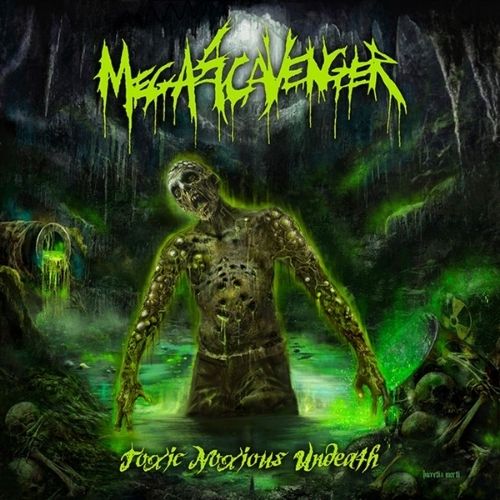
As the source material provides no detailed assessment of the album’s visual identity, there is not enough information to discuss its cover and design elements beyond the musical framework. The guest-vocalist concept, however, can be considered an integral part of the album’s aesthetic presentation: rather than centering the personal identity of a single vocalist, MEGASCAVENGER brings together different eras and voices from the European death metal scene under the same guitar framework. In that sense, the album draws not only on the musical conventions of classic death metal but also on its collective scene culture.
Ultimately, “Toxic Noxious Undeath” is less a reinvention of MEGASCAVENGER’s formula than a tightening of it. The directness of the riffs, the weight of the rhythm section, the dirty yet controlled production, and the rotating vocalists form the album’s core identity. With no experimental instrumentation or genre-spanning expansion, its ambition is not to redraw compositional boundaries, but to strip the well-established mechanism of Swedish death metal of unnecessary embellishment and put it back to work.
For that reason, “Toxic Noxious Undeath” is aimed less at listeners looking for additional layers than at those who value the direct impact of riffs, groove, vocal character, and concise song structures. The album’s position within the scene follows from the same principle: it does not use nostalgia merely to imitate the past, but neither does it deliberately push beyond the past’s boundaries. MEGASCAVENGER’s place in the present lies precisely in that tension — using the familiar tools of old-school death metal with enough discipline and energy to demonstrate that they still work.

https://www.facebook.com/megascavenger