ALBUM REVIEW
MISCREANCE - Reminiscence
Technical riffs merge with progressive experimentation.
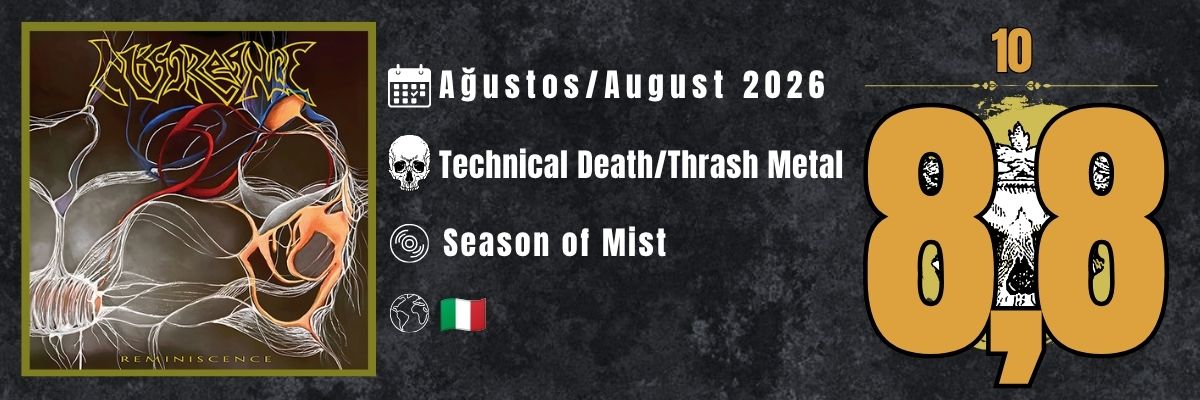
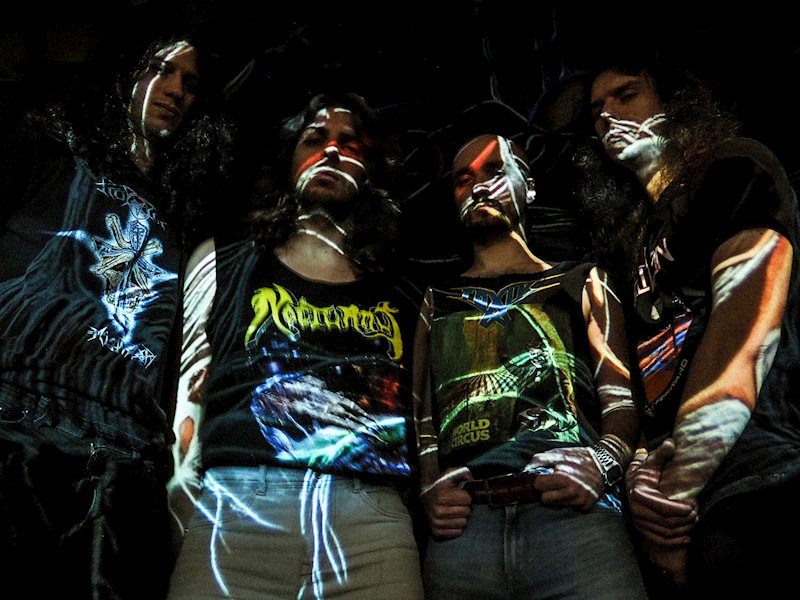
"Reminiscence", the second full-length album by one of the notable bands in the Italian thrash metal scene, MISCREANCE, was a record I had been eagerly anticipating for quite some time. I’ve finally had the chance to give it the attention it deserves, and the time has come to write about it. Rather than placing the speed and technical showmanship of technical death metal at the center, the band draws the record’s strength from the friction between its riffs. Andrea Granauro and Tommaso Cappelletti’s guitars do not simply take the late-’80s and early-’90s technical thrash/death legacy and copy it; instead, they reorganize its defining elements within constantly shifting structures. Andrea Feltrin’s drumming does more than merely follow these intricate guitar movements, becoming an active force in shaping each song’s architecture through sudden tempo changes, sharp transitions, and controlled disorder. Jean-Claude Rossignol’s prominent bass tone is another crucial part of this framework. Its position in the mix prevents the technical passages from turning into a guitar showcase confined to the upper frequencies, giving the music a persistent sense of weight.
This approach becomes apparent within the album’s opening minutes. "Trait d'Union" establishes its territory with percussion and more experimental textures rather than opening with a blast beat or a conventional death metal introduction. Clean vocal colors, technical riffs, thrash-based rhythms, and heavier mid-tempo sections then enter one after another. What matters here is not the individual presentation of these elements, but the way they are connected through the song’s constantly shifting compositional logic. The technical intensity of one section gives way to a groove-oriented passage, then to a solo or a freer transition. As a result, the song defines the virtuosity of technical death metal not directly through speed, but through structural density.
"Vision", meanwhile, opens more directly and brings the album’s thrash side to the forefront. Fast death metal riffs, prominent bass runs, and staccato rhythmic figures provide a more immediately accessible backbone. MISCREANCE does not maintain that accessibility for long, however. Breaks, dissonant guitar transitions, rhythmic ruptures, and sudden solo sections repeatedly interrupt the song’s linear progression. The result differs somewhat from technical death metal’s traditional notion of being "faster and more complex." Here, the complexity comes less from the number of notes than from compositional choices that prevent a riff from resolving in the way you expect it to.
"Scalp Ceremony" applies this formula within a shorter, denser framework. The thrash influence is more pronounced here, with mid-tempo groove sections creating breathing room between the technical guitar passages. Andrea Feltrin’s drumming is particularly important on this track because, rather than simply accelerating the complex rhythms, he distinguishes them through different attack and accent patterns. This keeps the technicality from stripping the song of its death metal identity. That is precisely where MISCREANCE maintains its central balance throughout the album: no matter how advanced their riff writing becomes, the band never allows the music to lose its physical weight.
A significant part of that weight comes from Rossignol’s bass work. The bass guitar on "Reminiscence" is not pushed into the nearly invisible supporting role it often occupies in many modern technical death metal productions. Instead, it comes to the front of the riff at certain moments, moves independently through some transitions, and balances the guitars’ dense upper frequencies with a darker low-end layer. Marino De Angeli’s production is crucial here as well. Following the recordings at Bridge Produzioni Audio, the mixing and mastering at Majestic Studio keep the instruments within the same physical space without allowing them to smother one another. That is not an easy balance to achieve in technical death metal, and it allows the sharpness of the guitars, the aggression of the drums, and the low-frequency weight of the bass to remain audible simultaneously.
"Synaptic Cortex Dissection" is one of the key tracks revealing the album’s more progressive side. Its chains of riffs move less according to a conventional verse/chorus logic than through a succession of musical events. Before one idea can fully settle, another rhythmic structure takes over; dissonant harmonies and sudden tempo changes become central to the song. Yet MISCREANCE’s success lies in ensuring that these transitions never feel entirely arbitrary. From the outside, the song’s structure may appear fragmented, but the rhythmic connections constantly rebuilt by the drums and bass keep the breaks between sections under control.
One of the album’s most interesting aspects is its use of instruments that extend beyond this technical framework. Leo Di Angilla’s contributions on percussion, didgeridoo, flute, and berimbau are particularly noticeable on "Scalp Ceremony", "Symbiosis", and the transitional sections. The important question here is whether the band is using these instruments merely as exotic decoration. For the most part, "Reminiscence" does not place them in the position of the main riff system; rather, they function as tools for expanding the rhythmic and atmospheric boundaries of the songs. These experiments therefore do not pull the album away from technical death metal. Even so, not every use carries the same structural significance. In some transitions, the percussion and world-music textures function more as connective layers supporting the concept, whereas on "Symbiosis" this approach becomes more organically integrated into the music itself.
"Symbiosis" is therefore one of the central tracks on "Reminiscence". Traditional technical death/thrash riffs, looser progressive passages, and tribal percussion meet within the same composition. The value of the experimental element here does not come merely from giving the track a different timbre; it also alters its rhythmic perception. By stepping outside the standard drum-guitar-bass triangle of a metal band, the percussion shifts the accents of the riffs onto a different foundation. For that reason, "Symbiosis" becomes one of the clearest examples of the album’s concept being tied directly to its musical structure.
Around "Oracle's Rift" and "The Moaning Hill", the album’s intensity shifts somewhat. "Oracle's Rift" in particular demonstrates both the strengths and limitations of MISCREANCE’s constantly shifting songwriting approach. While the sharp transitions between sections are technically impressive, maintaining the song’s momentum is not always easy. The problem is not a lack of technical ability; quite the opposite. It is the result of too many ideas being placed within the same composition without leaving one another enough room. Consequently, "Reminiscence" develops a more coherent character when considered as a whole rather than judged solely by the performances within individual tracks.
This also determines how the album should be heard. Its nine-track, approximately 39-minute structure can give the impression of a dense, uniform stream of technical death/thrash when heard superficially. But that resemblance does not come from monotony. There is no shortage of ideas, given the constant changes in riffs, broken tempos, and strategically placed solos. The issue is that these ideas do not always establish a clear hierarchy on the first listen. With closer attention, it becomes easier to recognize which sections function as rhythmic transitions, which serve as central motifs, and which act as atmospheric connections. For that reason, the compositional logic of "Reminiscence" works better within the album’s sequencing than through its individual songs in isolation.
This is also where MISCREANCE’s position within the genre becomes clearer. The influence of Death, Atheist, Pestilence, Sadus, Coroner, and the other foundational figures of early technical death metal is unmistakable, but the band does not turn those influences into a nostalgic revival project. Unlike the BPM- and mechanical-virtuosity-driven direction of modern technical death metal, MISCREANCE preserves an old-school riffing logic while making the compositions more complex. In that sense, "Reminiscence" functions as a bridge between early-’90s technical death metal and today’s more advanced approach to technical execution. Its novelty does not lie in inventing previously unheard techniques, but in rebuilding an old musical vocabulary through a contemporary approach to arrangement.
Andrea Feltrin’s vocals are also important in this context. His vocal tone is distinctly growled, harsh, and at times reminiscent of the Martin van Drunen tradition. This choice places the technical density of the guitars against the rougher, more physical character of the human voice. The use of spoken-word and effected vocals in certain sections also breaks with the standard death metal vocal approach. Particularly in passages dealing with the concept’s telepathic, primitive, and supernatural elements, this vocal variety does more than create atmosphere; it changes the musical presentation of the narrative itself. The placement of clean and ritualistic vocal textures between technical riffs is therefore not merely decorative, but one of the album’s functionally integrated experiments in arrangement.
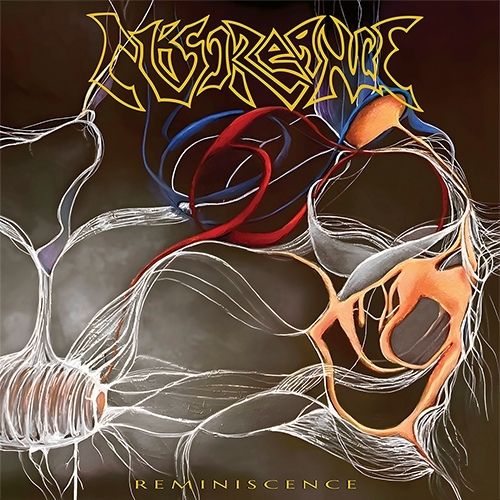
On the visual side, Mona Shiraz’s cover artwork also reinforces this approach. Bringing together neural connections, organic forms, and primitive/futuristic associations, the image visually completes the connection established in the music between old-school technical death metal and speculative science fiction. Rather than relying on the genre’s familiar grotesque or overtly violence-centered imagery, the cover represents the album’s "lost album" concept in a more abstract manner. As a result, the visual identity does not lag behind the music; particularly within a contemporary metal landscape increasingly populated by artificial and excessively sterile digital aesthetics, it offers a more organic counterpart.
That is where the real strength of "Reminiscence" lies. MISCREANCE does not expand the fundamental principles of old-school technical death/thrash merely by adding more technical passages. The weight of the bass in the mix, the structural role of the drums, the dissonant guitar transitions, the tribal percussion, and the vocal variety open up the album’s sonic world from several different directions. Yet not all of these elements are equally transformative; some experimental textures remain connective colors that support the concept, while on tracks such as "Symbiosis" they become direct components of the composition itself.
For that reason, "Reminiscence" offers an old-school response to the contemporary emphasis on technical death metal as spectacle without becoming fixated on the past. What MISCREANCE does is less about creating a new interpretation on top of the language established by bands such as Death, Atheist, Pestilence, and Coroner than demonstrating just how flexible that language still is. This is an album that does not surrender all of its details on the first listen, demanding attention to understand the function of its riffs, its rhythmic connections, and the reasons behind its experimental textures. In this respect, the band’s identity can no longer be contained by the description of "a young group that plays ’90s technical death metal well." MISCREANCE has reached a point where, while preserving the formal legacy of the old school, it is beginning to make its own compositional logic increasingly distinct.

Apple Music: https://music.apple.com/artist/miscreance/1502815524
Spotify: https://open.spotify.com/artist/2v4mzDLx1JSnxzq8CsYDzD
Bandcamp: https://miscreance.bandcamp.com/music
YouTube: https://www.youtube.com/channel/UC09Rq5Qo2p914wCf7PVFjqQ
Facebook: https://www.facebook.com/Miscreance/