
ALBUM REVIEW
One Day in Pain – Devouring the Gods
HM-2 Barrage of Fire
The Swedish death metal scene has, in recent years, become home to numerous projects that rework the classic HM-2 aesthetic while updating it through different strategies of intensity. One Day in Pain stands out within this lineage for an approach that places particular emphasis on low-end weight and groove-driven structure. “Devouring the Gods” positions itself as a clear statement of how the band interprets this aesthetic framework.
The first element defining the album’s character is not the structure of the guitars, but the inverted hierarchy between guitar and bass. Rather than remaining in its traditional role as a “low-end support,” the bass guitar is pushed prominently forward in the mix; at times it not only shares the harmonic body of the riffs with the guitars but also becomes a layer that directly reshapes the perception of distortion itself. This choice does not simply thicken the HM-2-like blurred wall of guitars, but instead creates an effect that expands the frequency spectrum downward.
The guitar writing is deliberately non-developmental and cyclical. The riffs are mostly built around short palm-muted cells and tremolo motifs; however, these motifs do not generate dramatic progression but instead produce intensity through internal repetition. In tracks such as “Let it Bleed” and “Be Dead,” this approach is clear: while riff blocks remain fixed, variation comes not from the guitars themselves but from shifting drum accents and small rhythmic deviations. This constructs the album around a sense of “continuous pressure” rather than narrative progression.
The drum performance does not break this static structure; on the contrary, it seals it in place. Even with double-time transitions or blast sections, the fundamental sensation is not speed but impact. The kick and snare relationship is highly mechanical; rather than creating rhythmic flexibility, this mechanization locks the riffs into a fixed grid. This choice aligns with the album’s aesthetic aim: not movement, but the production of weight.
The vocal approach is also integrated into this structure. The brutal vocals are positioned not as an independent narrative voice within the mix, but as part of the rhythmic framework. Following rather than interrupting the guitar rhythm, this approach does not create a dramatic contrast that would elevate the vocals to the foreground; instead, it confines all layers within the same block-like structure.
The album’s main point of differentiation lies in its use of the bass guitar. In particular, on tracks such as “Ferocious Consumption” and “Ashen Soul,” the bass is not merely audible but functions as a structural force guiding the composition. In “Ashen Soul,” the tempo slowdown does not arise from guitar harmony, but from the bass dragging the harmonic weight downward. This creates an atmosphere that edges toward death/doom; however, this expansion does not evolve into a continuous compositional transformation, remaining instead a temporary shift in intensity.
Guitar solos function not as developmental tools integrated into the structure, but rather as localized breaks in intensity. While technically functional, they operate less as a disruption of the existing riff cycle and more as short melodic layers placed atop it.
In genre terms, the album follows a groove-oriented Swedish death metal formula positioned between Bolt Thrower and classic Entombed. However, rather than expanding this formula, it stabilizes it. Tracks such as “Emptiness” occasionally introduce rhythmic variation or melodic deviation, but these do not alter the overall compositional language.
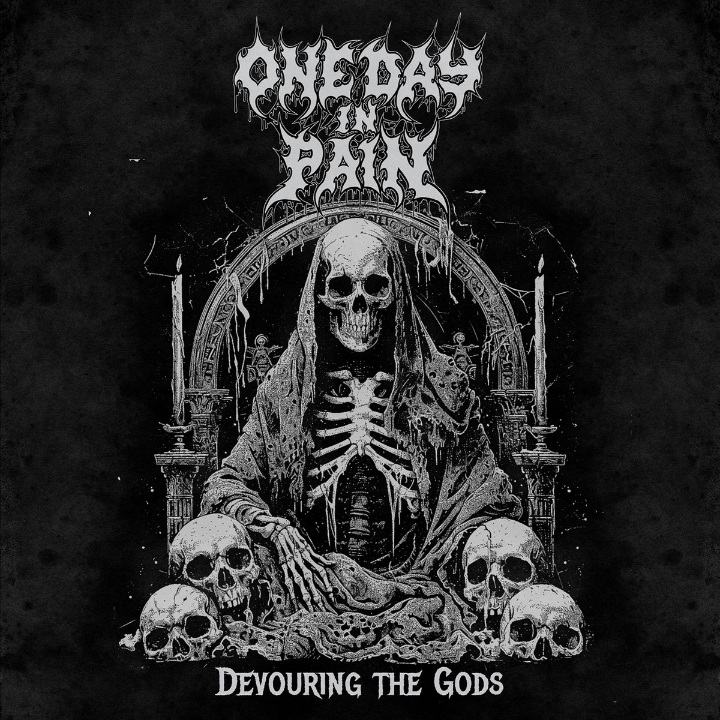
The cover artwork also continues the same aesthetic logic: a high-contrast, detail-heavy black-and-white composition that visually reinforces the idea of “intensity and decay” represented by the music. However, this reinforcement does not add a new layer of interpretation, but rather reiterates the existing aesthetic.
Ultimately, “Devouring the Gods” is a Swedish death metal album that operates more through weight and repetition than progression. Its strongest aspect is the structural prominence of the bass guitar within the mix, yet this idea functions less as a radical transformation of composition and more as a thickening of perception. The album works as a static field of pressure rather than a linear narrative, demanding from the listener not progression, but endurance within its sustained intensity.
OZAN
https://onedayinpain.bandcamp.com/
https://www.facebook.com/onedayinpain/