
ALBUM REVIEW
Orga Mecha – Humanity.exe
Synth-Driven Classic Metal Hybrid Under the Lens

Orga Mecha is positioned as a Los Angeles–based project attempting to merge the legacy of classic 80s heavy metal with synth and electronic textures on a shared structural foundation. Humanity.exe approaches this hybrid framework not merely as an aesthetic choice, but as a compositional idea that pushes against the boundaries of riff-centric metal writing. However, the album’s true focal point becomes increasingly defined by the question of how far these two worlds can actually be transformed into one another.
At first glance, the album may appear to be little more than a hybrid experiment seeking to carry the vocabulary of classic 80s heavy metal into the future. Yet the issue is not simply a “nostalgia + synth” formula. The real driving force of the record revolves around whether traditional riff-based heavy metal writing can coexist under the same roof as electronic layers, and to what extent these two languages are capable of transforming each other.
The core compositional backbone of the album is built on a classic heavy metal riff approach shaped through Raoul Rañoa’s guitar work. On opening tracks such as “Rise” and “Into the Fray,” the guitars move through pedal-point-driven progressions and melodic lead transitions that evoke the lineage of Judas Priest and Iron Maiden. The critical detail here is that the riffs often gravitate toward clear tonal targets; rather than operating within a continuously tense dissonant modern extreme metal framework, the material follows a more traditional harmonic logic that allows for resolution.
The synth and keytar layer placed atop this traditional structure mostly functions as a surface-level “shine” rather than altering the harmonic direction of the riffs. Melissa Pinion’s dual role as vocalist and synth player does not create a direct compositional integration between these domains, but instead produces a more layered arrangement sensibility. This establishes one of the album’s central tensions: electronic textures are clearly present, yet they rarely influence the decision-making core of the riff writing.

Richie “Captain Black” Brooks’ drumming acts as the primary engine setting the album’s tempo. On tracks such as “Into the Fray” and “Steel Mandible Swarm,” double-time passages and persistently forward-driving hi-hat work attempt to channel classic power metal energy into a cybernetic framework. However, the electronic references remain largely confined to the production layer; the drum writing itself does not structurally depart from an acoustic heavy metal logic.
This becomes particularly evident on more aggressive tracks like “Steel Mandible Swarm.” The track’s sense of “mechanical drift” is created less through genuine rhythmic transformation and more through glitch and textural effects embedded within the production. In other words, while the rhythmic identity may appear to shift, the core drum writing remains firmly rooted in an 80s metal template.
Melissa Pinion’s vocal performance is the most clearly defined component of the album. Her vocal approach avoids exaggerated operatic excess, instead relying on a controlled delivery that preserves melodic clarity across phrases. “May We Never Die” stands as the most balanced example of this approach; vocal lines do not sit above the riffs as detached layers, but instead follow a harmonic trajectory that aligns with the underlying progression.
However, a notable issue emerges here: despite carrying the album’s sci-fi thematic ambition, the vocal performance does not engage in a true compositional dialogue with the synth layers. In many cases, vocals and electronic textures function as two parallel lines moving independently of one another.
This is precisely where the album’s most important tension arises. Synths, keytar passages, and occasional glitch-like effects sit at the core of Orga Mecha’s identity claim. Yet on tracks such as “Idols and Gods” or “The Pestilent Age,” these elements primarily operate as an atmospheric frame surrounding the riffs rather than transforming their structure.
Even in more subdued moments such as “Lathe of Heaven,” the electronic elements appear to create a breathing space, but this space functions more as a softening of dynamics rather than a structural rupture. As a result, the electronic layer remains, in most cases, a tool of productional density management rather than compositional rewrite. This defines one of the album’s key limitations: Orga Mecha combines metal and electronic music on the same surface, but rarely translates these two languages into each other’s structural logic.
Across the album, song architecture adheres quite strictly to a “verse–pre-chorus–lead break” tradition. In tracks like “Swords Held High,” the classic metal build-up is clearly audible, while “Let This Be Your Final Battlefield” intensifies the formula with more aggressive lead guitar work. What is particularly notable is that this structure is never deliberately disrupted. Despite presenting a concept with experimental potential, the album keeps its compositional risks largely confined to arrangement-level variation. Harmonic and rhythmic frameworks remain stable, while variation occurs primarily on the surface layer.
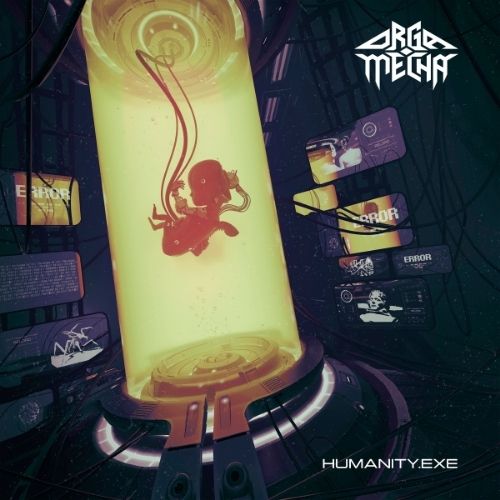
The fact that the album was recorded and mixed across multiple studios and engineers theoretically suggests a fragmented sonic identity. In practice, however, the result is a surprisingly unified production character. Guitars are placed forward, vocals sit centrally, and electronic layers are relegated to background texture. The cover art by Pavel Kurbanov reinforces this framing, establishing a retro-futuristic, dystopian, and technological visual language. Yet the relationship between visual and musical narratives remains one of thematic parallelism; the visual identity does not redefine the compositional structure of the music.
Humanity.exe positions itself as an album that expands the classic riff tradition of heavy metal through synth and electronic layers. However, this expansion often remains at the level of surface augmentation rather than structural transformation. The album’s strength lies in its clear melodic riff writing and the coherence of its vocal performance, which preserve the integrity of classic heavy metal language.
On the other hand, electronic elements function less as a redefinition of identity and more as an aesthetic update to an already established framework. For this reason, Humanity.exe does not fully reject its cross-genre ambition, but remains cautious in bringing that crossover into the core logic of its composition.
The album demands from the listener both a traditional heavy metal reading and an openness to electronic surface textures. Yet moments where these two layers genuinely reshape one another remain limited. Orga Mecha’s position ultimately becomes clear: not a boundary-breaking fusion, but a controlled coexistence within established limits.
OZAN