
ALBUM REVIEW
PETROSA - Roadburn Chronicles
PETROSA reshapes stoner doom through sheer grit.
PETROSA are a band capable of developing their own character by shifting the center of gravity within a familiar genre language at precisely the right moments. Built around low-tuned guitars and dense layers of fuzz, the songs embrace classic stoner/doom structures while occasionally opening their rhythmic framework to sludge’s lurching character and, at other times, the more aggressive accents of ’90s alternative metal.
Antonio Buonocore’s guitars are the defining element of PETROSA’s musical architecture. The riffs are largely built around spacious arrangements, repetition-driven hypnotic effects, and layers intensified by fuzz. Yet these repetitions are never static. “Turning Point” in particular reveals the album’s compositional approach more clearly through its pronounced contrast between quieter and louder sections. By setting its sludge-leaning heavy guitar textures against more open and dynamic passages, the track demonstrates that PETROSA are not relying solely on sheer tonal weight. The tension between silence and density shows how the arrangement itself can determine a song’s heaviness just as much as the riff.
Another side of this approach emerges on “I For An I.” Here, the sense of tempo becomes noticeably more animated, with punk rock energy settling over the stoner/doom foundation. With its fuzz guitars consistently pushed to the forefront, the arrangement moves the track into a dirtier space between classic heavy rock and doom. PETROSA do not abandon the genre’s traditional slow heaviness at this point; they simply alter the rhythmic emphasis, giving the same material a more propulsive momentum. This is an important choice throughout the album: rather than expanding the boundaries of the genre, they shift the distribution of weight within structures that already exist.

Giorgio Monza and Andrea Vignati’s rhythm section functions as the supporting framework for this approach. Rather than unnecessarily embellishing the riffs, the drums reinforce the guitars’ groove logic, while the bass support in the lower frequencies further thickens the guitars’ fuzz-heavy density. The result is not a sterile production in which the instruments are cleanly separated, but a sound built around a shared mass and a strong reliance on the low-mid frequencies. Carlo Altobelli’s production approach at Toxic Basement Studio fits this choice accordingly. The weight of “Roadburn Chronicles” is not built on a bright, hyper-separated modern mix, but on a dirty, dense surface that evokes an analogue feel.
Aldo Colciago’s vocals, meanwhile, never sound like a layer simply placed on top of this guitar-driven foundation. His gritty yet controlled delivery, particularly on tracks such as “S.U.R.E.,” “The Sinner,” and “Turning Point,” draws from the heavy/stoner vocal tradition associated with Fu Manchu and Orange Goblin. While the vocal melodies generally support the rhythmic movement of the riffs, the rawness of his delivery reinforces the underground aesthetic the band consciously preserves. What stands out here is PETROSA’s refusal to polish the vocals in an attempt to make the music more accessible; instead, they keep them on the same aesthetic plane as the guitars’ dirty texture.
“Rusty Blues,” one of the album’s strongest sections, shifts the center of gravity without stepping outside this formula. The tempo pulls back, the blues rock influence becomes more pronounced, and the arrangement reduces the dense fuzz pressure heard on the preceding tracks. The small pockets of Desert Rock melody within the song are important in showing that PETROSA are not simply a doom/stoner band built around a “weedian” aesthetic. More importantly, this simplification gives the album’s heavier sections greater meaning in retrospect: heaviness does not need to remain at maximum intensity to be effective.
A similar function appears on “Viper,” this time through a broader atmospheric approach. Its Desert Rock character and Post-Doom touches never move directly ahead of the guitar riffs; instead, they expand the space around them. For this reason, the cinematic atmospheres PETROSA employ do not come across as independent experimental elements within the album. They function as supporting tools that fill the spaces between the classic stoner/doom riffs. While this choice brings the band’s music closer to the territory of contemporary experimental doom, it is difficult to argue that these elements fundamentally alter the compositional logic. The experimentation remains less a structural rupture than an additional perspective on an established genre language.
This also defines PETROSA’s musical position. The legacy of bands such as KYUSS, DOZER, ORANGE GOBLIN, and MONSTER MAGNET is clearly present, but “Roadburn Chronicles” is not built merely around repackaging those influences. The grit of ’90s alternative metal, the momentum of punk rock, the stripped-down structures of blues rock, and the atmospheric side of Desert Rock are all incorporated into the same underlying doom/stoner framework. PETROSA’s individuality emerges precisely here: rather than simply adding elements from different genres, they establish their own center of gravity by deciding which of those elements should take prominence and when.
In the second half, tracks such as “Revenant” and “Dreamer’s Sunsets” bring the band’s heavier side back to the forefront, while the closing “An Old Van And A Couple Of Beers” places the album’s connection to the open road and underground rock culture directly within the music itself. This approach suggests that the band consciously distances itself from modern metal’s excessively sterile and flawless production aesthetic. The themes of “Roadburn Chronicles” follow the same line: concepts such as inner conflict, self-destruction, freedom, and recovery are supported by the music’s dirty tones and heavy riffs, but the album leaves them within the directness of the heavy rock tradition rather than turning them into a melodramatic narrative.
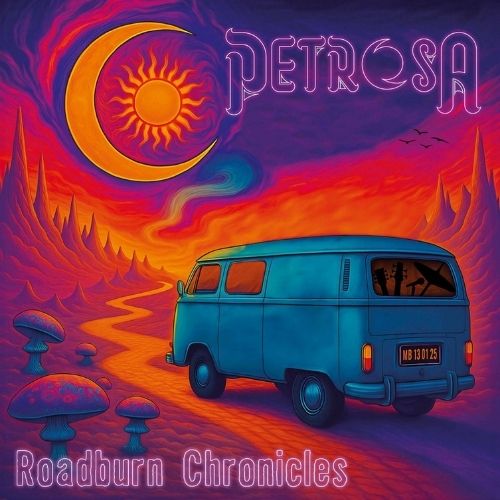
Since the available sources provide no detailed information about the visual identity, it is not possible to offer a separate assessment of how the artwork or typographic choices relate to the music. The album’s broader aesthetic framework, however, is sufficiently clear through its production and arrangement decisions: PETROSA are not attempting to break the genre’s historical visual and sonic codes; they are rearranging them within a dirtier, more alternative-rock-oriented, and occasionally more atmospheric sonic space.
“Roadburn Chronicles” therefore does not ask its listeners to discover a new doom/stoner vocabulary. What it demands instead is attention to the repetition of the riffs, the physical weight of the groove, the tonal density of the fuzz, and the tempo and dynamic shifts between tracks. PETROSA’s debut full-length does not position itself outside the contemporary scene; rather, it reinforces a more traditional approach by incorporating touches of alternative metal and Desert Rock, demonstrating why the genre still works today. The identity of “Roadburn Chronicles” emerges precisely from these choices in arrangement.
