
ALBUM REVIEW
PYLAR – Delyrio
Ritualistic cosmic metal

PYLAR is a Seville-based avant-garde metal collective that expands the boundaries of extreme music not through genre formulas, but through ritualistic intensity, experimental composition, and esoteric expression. Since 2012, the band has combined elements of doom, drone, psychedelic, industrial, and experimental metal into a singular sonic universe, continuously questioning the traditional modes of expression within metal with each release. “Delyrio” emerges as a new chapter where this approach is pushed into a darker, more fragmented, and less predictable territory, transforming PYLAR’s cosmic and metaphysical explorations into sound.
PYLAR’s sound is built around the idea of dismantling and reconstructing the familiar building blocks of extreme metal. “Delyrio” takes this method further, moving away from traditional riff-driven composition in favor of sound masses, rhythmic cycles, and ritualistic intensity. The guitars often cease to function as the primary force driving the songs in a conventional sense, instead creating fields of atmospheric pressure; layers of dense distortion, dissolving harmonies, and drifting feedback merge the weight of doom metal with the blurred perception of psychedelic rock. However, PYLAR’s approach is not simply rooted in drone aesthetics. The band keeps the music from becoming static by introducing subtle structural shifts that remain in constant motion within extended repetitions.
Across its four lengthy compositions, “Delyrio” deliberately stretches the perception of time. Rather than following a traditional introduction-development-conclusion structure, the tracks take shape as sonic architectures that transform between different levels of intensity. Opening track “Apoteosis” immediately reveals this philosophy: while the guitar tones carry a dark and abrasive character, the drums become the primary source of movement within the music. The rhythmic framework operates on a far more organic and fluid level than the slow, methodical marches associated with traditional doom metal. Gamaboz’s use of drums and percussion stands among the album’s defining elements; the beats are not merely there to establish tempo, but to alter the physical sensation of each composition.
At this point, PYLAR’s approach intersects with the ritualistic and experimental tendencies that have become increasingly visible within extreme metal in recent years. Echoes of Oranssi Pazuzu’s psychedelic dissolution, Teitanblood’s dense and threatening atmospheres, or the hypnotic repetition of Swans can occasionally be felt throughout “Delyrio,” yet the album does not directly imitate any of these influences. Instead, it absorbs the common ground between them: the understanding of music not merely as composition, but as a physical field of experience. PYLAR’s distinction lies in their attempt not to move between genres, but to dissolve the boundaries separating them simultaneously.
The album’s guitar work sits at the center of this approach. Riffs often function less as recognizable melodic motifs and more as movements of texture. At certain points, heavy guitar layers rooted in sludge and doom emerge, while elsewhere fragmented structures approach the territory of noise rock. “Enajenación” represents one of the most balanced examples of these two directions converging. The track initially establishes a more minimal and unsettling atmosphere before gradually intensifying into a more physical aggression, at times approaching the aesthetics of math metal and noise rock. These transitions are not random; beneath movements that appear chaotic, PYLAR maintains a controlled compositional logic.
The bass guitar also refuses to exist merely as a supporting element within this dense wall of sound. Mesagret’s bass lines maintain the center of gravity beneath the intensity created by the guitars, strengthening the album’s physical character particularly within the low-frequency spectrum. The production approach is equally significant here. “Delyrio” does not pursue the clean and separated mix often associated with extreme metal; instead, it creates an organic, blurred, and heavily resonant sound field. This choice stands in opposition to the clinical clarity frequently found in modern metal production. However, this is not a nostalgic pursuit of analog warmth; the uncertainty within the sound itself becomes a direct part of the album’s conceptual framework.
The vocals represent one of the strongest carriers of this atmosphere. The different vocal techniques employed by Ibb-ib’thu The Renegade and Linea Serpentinata extend beyond the traditional categories associated with extreme metal vocals. Moving between screams, narration, ritualistic repetition, and theatrical performance, the vocal approach follows the structural transformations of the compositions. Rather than occupying the role of a traditional “frontman” or “lead vocalist,” the voice functions like another instrument moving within the music. This choice reinforces the album’s ceremonial and experimental character.
PYLAR’s unconventional instrumentation choices also play a significant role in shaping the album’s identity. The violin, synthesizers, and various electronic textures are not used merely to add atmosphere; they function as tools that alter the spatial structure of the compositions. Lingua Alauda’s violin work, in particular, moves away from the traditional role of melodic ornamentation. It is used primarily to create tension, expand the sonic space, and shift the dense mass created by the guitars in different directions. However, not all of these experimental elements carry equal weight. While some electronic and atmospheric layers support the album’s overall structure, others remain closer to surface-level changes in color. PYLAR is at its strongest when these elements become fundamental parts of the composition rather than independent effects.
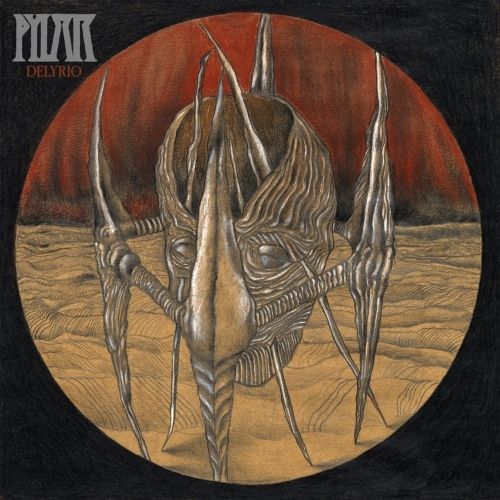
The visual identity of “Delyrio” also parallels the band’s musical approach. Gonzalo Santana’s artwork moves away from the direct darkness or horror imagery often found in extreme metal, adopting a more symbolic and abstract form of expression. This choice supports the album’s themes of uncertainty and fragmented perception within its sonic world. The visual side does not attempt to explain the music; instead, it occupies the same space of ambiguity.
One of the album’s most compelling aspects is that it does not use experimentation merely as a means of creating atmosphere. Throughout “Delyrio,” PYLAR attempts to reinterpret the fundamental concepts of metal — riff, rhythm, weight, and repetition. However, this approach does not achieve the same impact in every moment. In some sections, the density and abundance of ideas create a powerful compositional effect, while in others the album spends too much time wandering within its own abstract universe. This becomes both one of the work’s greatest strengths and one of the factors limiting its accessibility.
“Delyrio” occupies a distinctive position among contemporary extreme metal releases seeking to expand the boundaries of genre. Rather than inventing an entirely new form, PYLAR transforms the shared foundations of doom, psychedelic, drone, industrial, and avant-garde metal into a more extreme mode of expression. The album asks listeners not to focus on traditional song structures, but on how sound layers evolve, how rhythm shifts direction, and how atmosphere is constructed. Ultimately, “Delyrio” is not a repetition of PYLAR’s established aesthetic path; it is an extreme metal experience that demands patience and attention while carrying the band’s self-created experimental realm into a darker and more uncertain territory.
OZAN
https://www.pylar.bandcamp.com
https://www.facebook.com/PPYLARR
https://www.instagram.com/pylar_the_band
https://www.cycliclaw.com/cavsas
https://www.cycliclaw.bandcamp.com