
ALBUM REVIEW
SPACE CHASER - Razorblade Bay
SPACE CHASER sharpens its speed again.
Germany’s Thrash/Speed Metal scene has produced its fair share of ferocious acts, and SPACE CHASER are set to make a confident return to the metal scene in the first weeks of autumn with "Razorblade Bay", their fourth full-length after a five-year gap. The album’s ambition does not come from a fixation on speed and BPM-driven aggression, but from the sharpness of its riffs and the constant forward push of its rhythm section. At its core is the cutting guitar language of American eighties Thrash combined with the rougher, more direct character of German Thrash Metal; add the high-octane drive of Speed Metal and Punk’s angular energy, and the result draws its strength from the past while resolutely avoiding the swamp of nostalgia. The development that takes concrete shape with this album, and arguably makes it one of the most important milestones of the band’s career, is guitarist Leo Schacht taking over vocal duties alongside rhythm guitar following Siegfried Rudzynski’s departure. "Razorblade Bay" therefore also answers the question of whether the band can retain its identity under these circumstances.
The first four tracks provide a fairly clear answer. The title track, 'Razorblade Bay', launches straight into attack mode with sharp guitar runs that leave virtually no room for a warm-up. The cutting edge of the riffs rooted in the American Thrash tradition meets the rougher punch of the German school, but the song does not simply rely on reproducing the sounds of the past. The guitars’ complementary movements keep the track’s high velocity alive, while the drums drive the arrangement forward without resorting to unnecessary showmanship.
'Mind Melting Machine' makes the album’s guitar-centered approach even more pronounced. The riffs are not merely fast here; they are tightly interlocked enough to create a sense of mechanical repetition. Matthias Scheuerer’s drumming continually feeds the rhythmic framework established by the guitars, while Sebastian Kerlikowski’s bass does not simply remain in their shadow within the mix; it gives the low end the necessary weight and completes the track’s mechanical character. Martin Hochsattel and Leo Schacht’s guitars, meanwhile, put the physical impact of the riffs ahead of technical display.
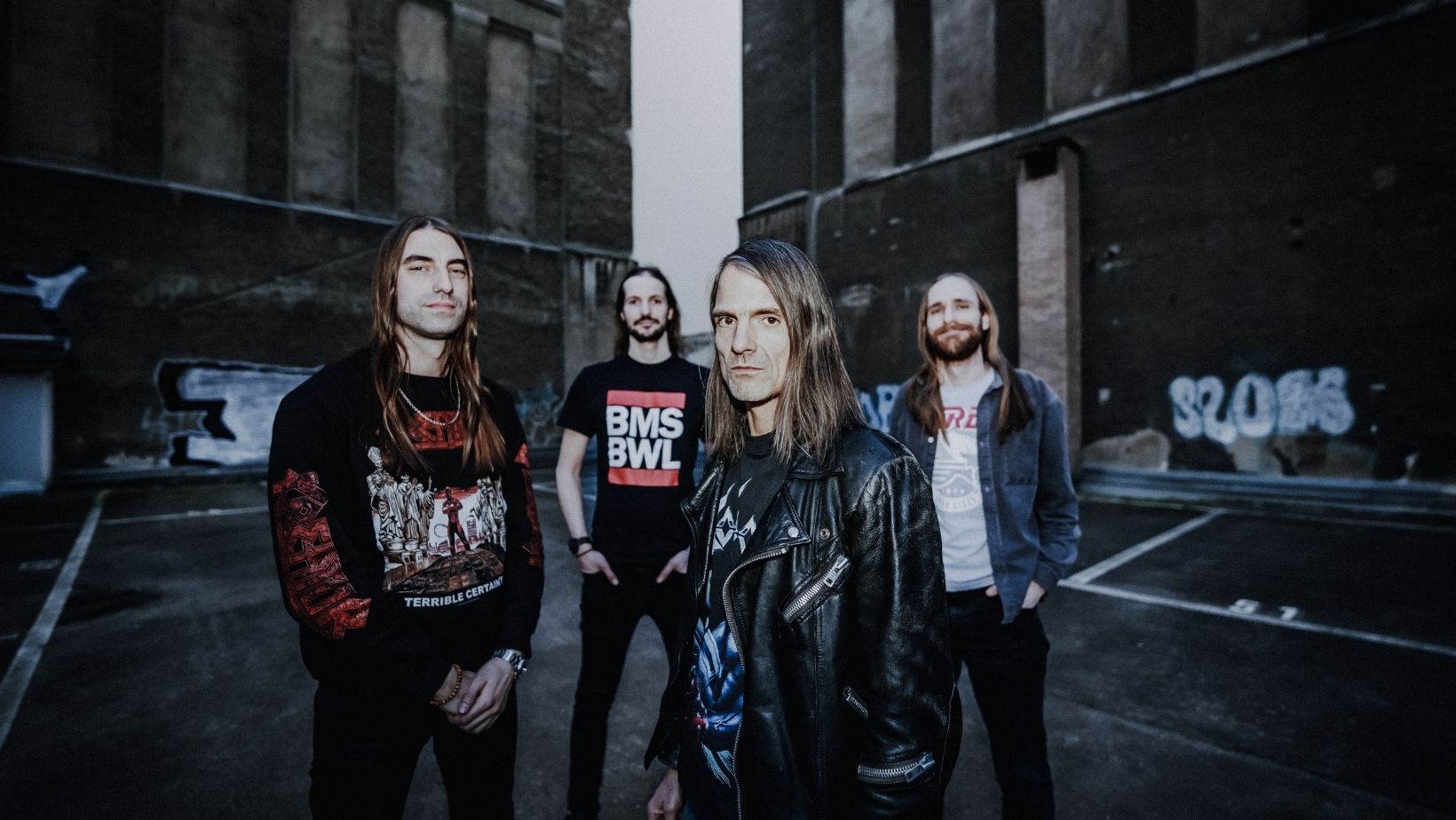
'We Are the Night' opens this framework up with a broader approach to its chorus. SPACE CHASER understand that Thrash Metal does not have to function solely through speed and aggression, and that a strong chorus can also make a song more effective in a live setting. 'No Gods, No Dawn' continues the same high-tempo approach with a darker riff character. What stands out particularly across these first four tracks is that they do not feel like disconnected ideas, but rather different facets of the same compositional philosophy. At the same time, this exposes the album’s first significant weakness: the opening standard is so high that everything that follows is inevitably judged against it.
Around the middle of the album, SPACE CHASER shift toward a more Punk-oriented, dirtier and more direct approach. '8 Minutes' is one of the clearest examples. Its short, angular structure pushes the technical side of Thrash into the background, while Andy Brings’ guest vocals add an extra layer of grit. The fact that Brings contributes not only as a guest but also to the album’s production alongside Jan Oberg is significant to the sonic character of "Razorblade Bay". The resulting production is not a muffled recording that imitates old-school aesthetics; instead, it has a modern Thrash mix that preserves the guitars’ sharpness, the impact of the drums and the weight of the bass.
The album’s production choices are particularly important at this point. It moves somewhat away from the more dominant and dense production character of the previous releases. At first glance, this change could be viewed as a step backward; however, considering the more Punk- and Speed Metal-influenced sections of "Razorblade Bay", the slightly more open and rough-edged sonic palette supports the music’s directness. The guitars are not over-polished, the drums do not succumb to a sterile triggered feel, and the bass frequencies have enough room within the mix. The aim of the production, then, is not to recreate the feel of an old-school recording, but to preserve the physical hardness of the music within modern recording standards.
'We Bow To None' and 'Blade Serpents' continue this direction. 'We Bow To None' in particular is one of the tracks that demonstrates why Leo Schacht’s vocal approach works within the album’s musical framework. Schacht makes no attempt to imitate Rudzynski’s vocal character. His voice is rawer, less acrobatic and more direct, but that difference ceases to be a disadvantage, particularly on tracks where the Punk influence becomes more pronounced. The way the vocals sit over the guitars establishes a different center of gravity rather than trying to present the band’s new era as a continuation of the previous lineup.
This is where the most important consequence of the change becomes apparent. Following a vocalist change, the easiest option would have been to turn the new voice into as close a copy of the old one as possible. SPACE CHASER do the opposite. Schacht handling both rhythm guitar and vocals naturally requires a new performance balance between the two roles, but nowhere on the album does it feel like an artificial solution. There are moments when the vocals may sit slightly too prominently in the mix, but their overall placement prevents them from sounding like an element simply added to the songs after the fact.
That said, the album’s middle section does not fully sustain the intensity of its opening. '8 Minutes', 'We Bow To None' and 'Blade Serpents' are by no means weak tracks; on the contrary, they broaden the album’s Thrash/Speed/Punk triangle. But after the riff density and structural variety of the first four songs, the breaks and turning points become less pronounced here. Given SPACE CHASER’s technical capabilities, a few unexpected tempo changes, a sharper riff transition or a stronger contrast that disrupted the internal structures of these songs could have strengthened the album’s second half. The problem is not a lack of material, but the comparison created by such a high standard.
With 'Even The Score' and particularly 'The Coffin', the band accelerates again. The forward drive of the drums and the tighter connections between the guitar riffs re-establish the momentum of the album’s opening. The closing 'Razorblade Bay (Reprise)', meanwhile, functions as a brief return that frames the album rather than simply repeating the title track. The total running time of 32:43 also supports this approach. Instead of stretching their songs beyond necessity, SPACE CHASER condense their ideas; in this genre, that is particularly important. Thrash Metal’s energy works more effectively when it is not diluted by unnecessary repetition.
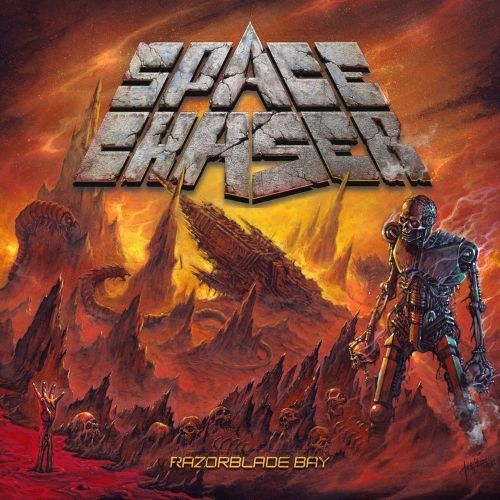
The album’s visual side is equally tied to its musical approach. Mario E. López’s cover directly connects its science-fiction aesthetic to a vast and threatening extraterrestrial landscape. The science-fiction and horror motifs SPACE CHASER have employed for years are not merely decorative here; they share the same aesthetic language as the music’s fast, aggressive and occasionally grotesque character. What matters is that rather than directly copying an eighties science-fiction image, the artwork carries that tradition into a contemporary metal presentation. In that respect, there is a clear consistency between the visual and musical identities.
Ultimately, "Razorblade Bay" does not attempt to rewrite Thrash Metal’s basic vocabulary. Its real achievement lies in keeping different dialects of that vocabulary — the harshness of German Thrash, the high tempos of Speed Metal and the directness of Punk — together within SPACE CHASER’s science-fiction-driven identity. Leo Schacht’s move to the microphone does not create a radical rupture that redefines the band’s position; instead, it shifts the center of gravity within an existing framework. That makes one of the album’s most interesting aspects less about creating a new SPACE CHASER than demonstrating that a lineup change does not necessarily have to disrupt the band’s fundamental compositional logic.
"Razorblade Bay" is less a quickly consumed nostalgia product than an examination of how traditional Thrash Metal can be sustained through contemporary production and arrangement practices. Although the extraordinary intensity of the opening is not maintained at quite the same level across the second half, the album’s refusal to leave unnecessary space within its nearly 33-minute runtime is significant. SPACE CHASER are not looking to expand the genre’s boundaries or introduce entirely new elements here; instead, they are testing which elements within those boundaries still function effectively. The new vocal arrangement passes that test. The main area left for improvement is ensuring that the band’s already high standard of riff writing is distributed more evenly across the entire album.

https://spkr.store/collections/space-chaser
https://www.facebook.com/testimonyrecords
https://www.instagram.com/testimony_records
https://spacechaser.bandcamp.com/album/razorblade-bay-2