
ALBUM REVIEW
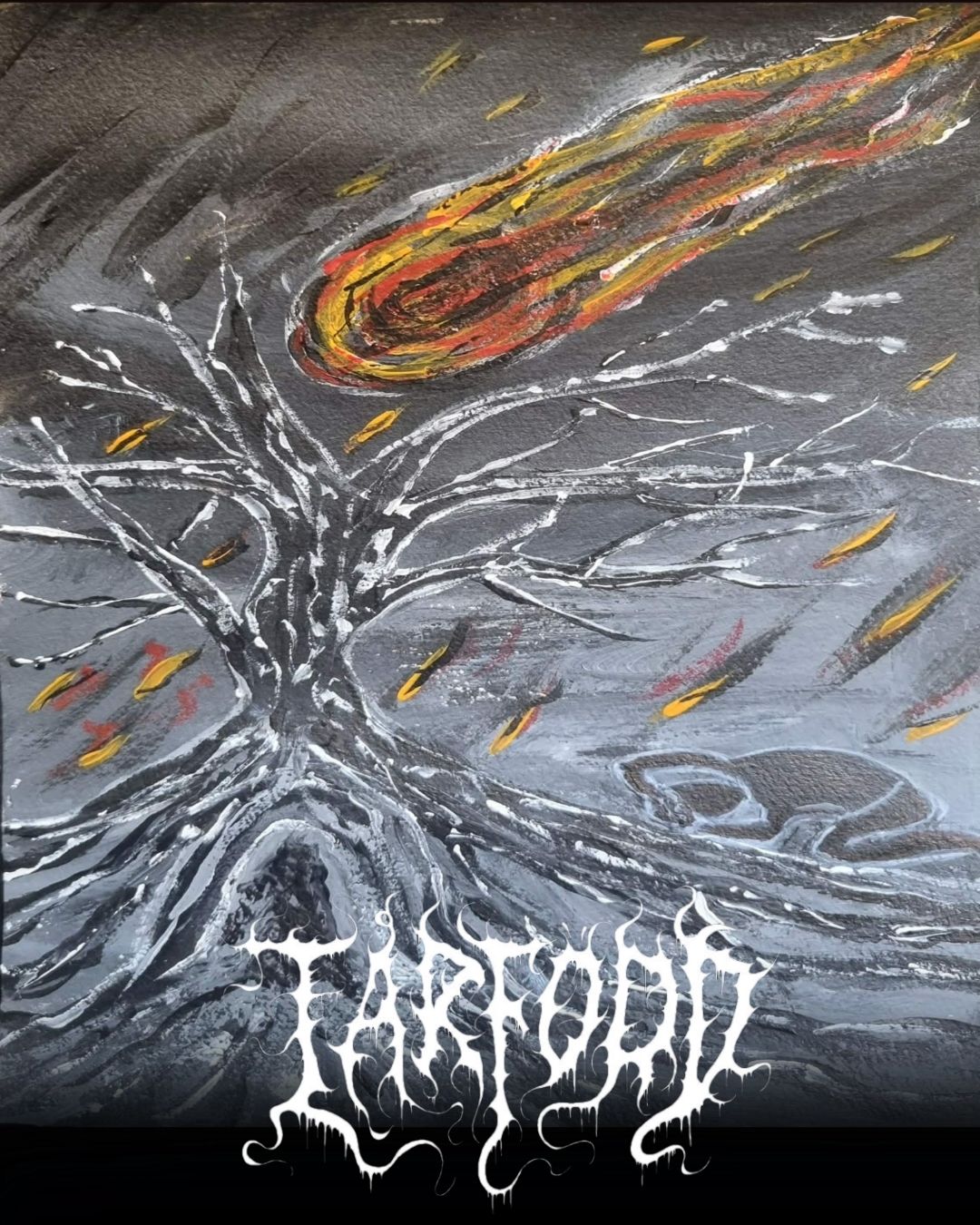
TÅRFÖDD – Skyfall
Dense Atmosphere Between DSBM and Post-Black Metal
The Sweden-based solo project TÅRFÖDD, hailing from Skellefteå, continues its prolific discography shaped under the control of Simon Lindgren with “Skyfall”. Positioned between post-black metal and DSBM, this mini-album is built on a compositional approach that reconstructs melodic cores rooted in acoustic guitar through dense layers of distortion. Across four extended compositions, the repeated reworking of the same motifs with varying intensity and orchestration turns the EP into a closed narrative revolving around a single idea, both structurally and aesthetically.
“Skyfall” is fundamentally based on a two-layer compositional logic: an open, motif-driven melodic framework carried by acoustic guitar, and the constant reframing of tremolo-black metal blocks built upon it. Lindgren’s writing approach is less about riff generation and more about repositioning short melodic cells across different levels of intensity. For this reason, the EP’s opening track “Förödelse” presents, rather than a conventional ambient introduction, the harmonic core of all forthcoming material in its stripped-down form.
Here, the acoustic guitar does not merely establish atmosphere; it functions as a “harmonic skeleton” that pre-defines the main motifs later repeated under distortion. This choice also marks a clear distinction from many examples within the DSBM/atmospheric black metal spectrum: instead of dramatic entrances and exits, the same melodic idea is rewritten at varying levels of intensity.
The second track is almost a direct orchestral transformation of the first. As the guitars shift into tremolo riffs, the harmonic content remains unchanged; what changes instead is density and frequency distribution. This places the piece within a logic of “layering” rather than traditional compositional development.
Drum programming becomes the structural backbone at this point. Transitions between blast sections and more open, mid-tempo passages establish dynamics without interrupting the melodic continuity of the guitars. However, the mechanical grid precision is noticeable, particularly in transitions; the absence of micro-rhythmic fluctuations associated with human performance leaves certain breaks feeling overly sterile.
The vocal approach is split between two aesthetic directions: low, cracked scream tones are embedded within the guitar wall, while clean vocal entries fail to carry the same intensity. Although the clean vocals are used to create contrast, their frequency and dynamic positioning within the mix prevent them from delivering a strong dramatic impact, leaving them more as a superficial layer.
The third track represents the most rhythmically “anchored” section of the EP. Here, Lindgren adopts a more controlled use of acoustic-ambient transitions to construct a riff-centered form. The mid-tempo opening allows the guitars to expand through heavier chord blocks, while the subsequent acceleration foregrounds the driving role of the drums.
The critical aspect of this track lies not in the repetition of melodic material, but in the shifting rhythmic context of those repetitions. As the same guitar phrases reappear across different tempo layers, their meaning changes, reinforcing the EP’s overarching idea of a “catastrophic cycle.”
However, the bass line is once again reduced almost entirely to low-frequency support beneath the guitar wall. Lacking a distinct melodic or rhythmic identity, harmonic depth is expanded, but vertical separation remains limited.
The final track is structurally framed as a climax, yet essentially delivers the most intensified repetition of the formula used throughout the EP. The pattern of acoustic introduction → slow buildup → distortion eruption → return to acoustic fracture unfolds here in its longest form.
The synth layers play an important role at this stage: they do not alter the harmonic content of the guitars, but instead widen the stereo field by adding a low-density fog across the frequency spectrum. This use keeps the synths at the level of a “spatial reverb extension” rather than a compositional element—expanding atmosphere without redefining structure.
At this point, the EP’s fundamental limitation becomes evident: while there is dramatic expansion, formal variety remains restricted. Differences between tracks are primarily built through changes in intensity and orchestration, while radical rhythmic or structural breaks are rare.
The production approach is deliberately unpolished. While the guitars create a wide stereo wall, the midrange occasionally collapses into itself, causing a loss of detail. This increases atmospheric density, but also makes separation within complex layers more difficult.
The placement of acoustic guitars in the mix is more effective: brought forward with low reverb, they function as a “reference point” within the density of the electric guitars. This stands out as one of the EP’s strongest aesthetic decisions, as the acoustic material operates not only as contrast but as a structural anchor.
The “rawness” emphasized in the band’s information is partially reflected here; however, this sense of roughness comes across less as an organic performance quality and more as a controlled production choice. In other words, the result is aesthetically raw, yet technically a highly calculated and deliberate construction.
“Skyfall” sits in a clearly defined transitional space between depressive black metal and post-black/atmospheric structures. However, this transition is less about generating a new synthesis between two worlds and more about repeatedly presenting the same melodic core across different surfaces.
For this reason, the claim of “experimental expansion” does not fully hold up. Acoustic passages, synth haze, and structured dynamic shifts frame the composition rather than transform it. Variation, rather than innovation, remains the dominant logic.
Listening to “Skyfall” requires following a structure where a single idea is rewritten across different intensity levels rather than expanded into new conceptual territory. This approach creates a consistent and controlled aesthetic in terms of guitar writing, but the repetition of similar dramatic arcs across four long compositions limits compositional variety.
As a mini-album, “Skyfall” clearly defines its position within the scene: a DSBM-oriented approach that avoids technical excess, treats melody as a structural carrier, and builds atmosphere through shifts in intensity. While this approach occasionally produces a strong sense of cohesion, it also struggles to suppress a sense of structural repetition in places.
Ultimately, the record constructs a coherent melodic-intensity architecture within itself; however, this architecture is based not on expansion, but on deepening through variation.
OZAN