
ALBUM REVIEW
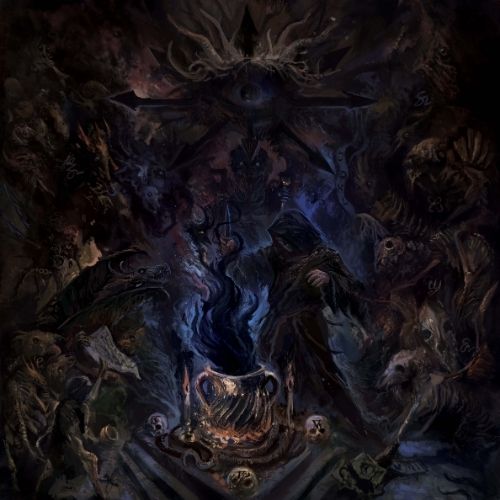
Temple ov Ahriman – Heretics of Consensual Reality
Black Metal Meets D-Beat
Austin, Texas-based Temple ov Ahriman positions itself as a striking project within the contemporary black metal landscape, built around a compositional approach anchored in a one-man core. With Thornicator at its center, the project establishes an aesthetic framework that merges the legacy of second-wave black metal with melodic lines closer to D-Beat and the Finnish school. Heretics of Consensual Reality demonstrates how this approach is organized in full-length format for the first time, revealing how riff-centric thinking produces an overall sense of structural cohesion.
The album rests on a framework that fuses riff-driven second-wave black metal aesthetics with melodic strands reminiscent of D-Beat and the Finnish tradition, yet instead of dissolving these into a homogeneous style, it constructs a fragmented architecture of tension. The core compositional idea does not rely on constant acceleration or atmospheric expansion, but rather on shifts between rhythmic harshness and melodic openness within short cycles. This approach becomes particularly evident in the guitar writing: tremolo melodies often avoid forming uninterrupted flows, instead being segmented by block chord transitions, thereby layering a frostbitten contour and a physical weight onto the riffs simultaneously.
The opening track “War in Heaven” operates through drummer Servitor’s (performances recorded by Kfir Gov) refusal to keep straight blast patterns static, instead breaking them with micro-transitions. These fractures make the Finnish-leaning melodic guitar lines more legible within the mix. Thornicator’s vocal approach, rather than relying solely on high-pitched screams, is layered with occasional lower-register support, functioning not only as a top-layer assault but also as a rhythmic instrument within the mix. Sekt’s guest vocal appearance is not used to create a conventional “beauty and the beast” dichotomy, but rather to open a brief harmonic expansion point, enhancing the track’s dramatic scope without shifting its compositional center.
“Wrath of Iblis” foregrounds acceleration through sharper tremolo structures, while compact chord blocks inserted between the guitars prevent the music from dissolving into a continuous atmosphere. Notably, blast beat intensity is not kept at maximum throughout; Servitor opens transitional space with short fills, allowing the guitar riffs to produce a segmented sense of assault rather than fluid aggression. As a result, the track functions less as a pure display of speed and more as a controlled line of rhythmic tension.
With “Infernal Imperium,” the D-Beat influence becomes more pronounced. Guitar writing is deliberately simplified here: the repeating main riff generates a rhythmic push closer to Black ’n’ Roll territory. This simplicity is not a lack of technicality, but rather a compositional choice that anchors listener perception to rhythm. The marching quality of the drums pulls the track away from constant blast intensity, introducing a “marching” character that becomes a key dramaturgical shift in the album’s overall speed architecture.
“SPQB” stands as one of the most direct compositions structurally. Here, guitars operate on a raw Black ’n’ Roll surface, while the vocals shift toward a more rhythmic articulation. The use of gang vocals (contributed by Misery, Val Rozar, and Von Hammerblast from the Brüka circle) adds a polyphonic layer to the composition, though this multiplicity does not create an orchestral expansion; instead, it functions as a massed rhythmic accent. The track mirrors its historical reference (the Roman imagery and SPQR deformation) on a musical level: its structure is built on a repeating riff cycle that generates collective impact rather than controlled chaos.
In the album’s second half, “White Death” slows the tempo and shifts guitar writing into a more cyclical form. The tremolo lines here rely less on progressive melody and more on repetitive motif construction. This repetition creates a sense of physical weight rather than atmospheric expansion. However, in the final section, the guitars open into more melodic phrasing while double kick intensity increases, leaving the built tension suspended rather than fully resolved—suggesting a deliberate aesthetic of “non-completion.”
The title track “Heretics of Consensual Reality” stands out for its more explicit use of layered vocal textures. Thornicator’s combination of high-pitched screams and deeper vocal tones creates a brief internal dialogue effect. The guitars, meanwhile, continuously pull back ascending melodic tendencies with harsher rhythmic blocks, directly translating the track’s conceptual premise (the conflict between reality and perception) into musical behavior.
“Baphomet’s Kiss” and the closing piece “Beyond the Veils of Maya” occupy the album’s widest compositional space. In particular, “Baphomet’s Kiss” introduces a genuinely layered sense of development: the initial raw riff expands in the middle section with additional melodic lines, giving the track an evolutionary rather than linear form. Here, D-Beat and blast beat transitions function not merely as tempo shifts, but as structural turning points. However, this expansion does not always fundamentally transform the guitar writing; in certain passages, new elements feel more like surface-level density rather than a reconfiguration of the core riff logic.
The closer “Beyond the Veils of Maya” presents the most controlled escalation structure on the album. Guitars enter in successive layers, building the composition through gradual intensity rather than linear progression. Servitor’s drumming is initially restrained and later becomes more aggressive, shaping the track’s dramatic arc into a steadily rising tension curve rather than a final explosive climax. Even so, the escalation never fully resolves; the piece is deliberately left open-ended, preserving the album’s central aesthetic idea of a “non-closed structure.”
On the production side, the mix emphasizes midrange guitar presence to preserve riff clarity. The snare is dry and positioned as a direct point of attack, marking a conscious departure from the distant, reverb-heavy aesthetics of second-wave Norwegian black metal. Keyboards do not dominate the arrangement; they are used sparingly, adding atmospheric density only during transitions without disrupting the guitar-centric core. The bass largely follows the guitars as a supporting layer; in slower sections, greater independence could have enhanced the low-end depth of the record.
Overall, Temple ov Ahriman effectively utilizes the strengths of its one-man compositional structure: there is no stylistic fragmentation in the guitar writing, and all tracks adhere to a unified riff logic. However, this same cohesion occasionally becomes limiting in terms of vocal variation and bass presence. While the album successfully combines D-Beat and Finnish black metal influences, it tends to juxtapose these elements rather than fully synthesizing them into a hybrid language.
Ultimately, Heretics of Consensual Reality presents a black metal model built on rhythmic fractures, riff repetition, and controlled shifts in velocity rather than continuous blast-driven intensity. In line with current tendencies in the scene, it navigates the intersection between melodic black metal and D-Beat; however, it does not consistently push these intersections toward radical reconfiguration. What it offers is not an ever-expanding compositional field, but rather a disciplined examination of a shared core riff logic across varying speeds and densities—positioning the record less as reinvention, and more as a methodical variation within a defined aesthetic framework.
OZAN