
ALBUM REVIEW
The Circle of the Elect – Kaoskarma
A Confident Debut in Atmospheric Black Metal

Kharkiv-based new black metal entity The Circle of the Elect brings together seasoned musicians who have chosen to keep their identities concealed, and with their debut album Kaoskarma, they aim to reinterpret the established language of atmospheric black metal through a disciplined compositional approach. Written and recorded in Ukraine, the album embraces an aesthetic that conveys the notions of destruction and renewal not through an overt conceptual narrative, but through the rhythmic flow, simmering tension, and structural balance of its songs. The question is whether this anonymous collective can step out from beneath the shadow of its formidable influences and establish an identity of its own.
From its opening moments, Kaoskarma rejects a vision of black metal built on melodic grandeur or relentless speed, instead embracing a compositional philosophy centered on rhythmic discipline, controlled tension, and layered atmosphere. Rather than constantly driving its riffs toward climactic peaks, The Circle of the Elect maintains a sense of unease by balancing measured mid-paced passages with sudden bursts of acceleration. This approach allows the album to achieve its own aesthetic cohesion independently of the wartime circumstances under which it was created. Kaoskarma does not attempt to represent the chaos of the outside world directly; instead, it channels that unrest through the internal pulse of its songs and the unresolved tension embedded within them.
One of the album's greatest strengths lies in its refusal to build atmosphere solely through extended keyboard passages or dense layers of reverb. The guitars continuously weave complementary melodic lines, while many of the riffs rely on subtle variations in repetition to create a hypnotic sense of movement. These repetitions never lapse into stagnation, as shifting rhythmic accents from the drums and the guitars' occasional transition into a more aggressive register keep each section dynamically alive. Particularly during the mid-tempo passages, the riff writing presents a far gloomier, more urban character than the nature-driven aesthetic often associated with Ukrainian atmospheric black metal. Although occasional similarities to Drudkh emerge through the melodic language, the album is ultimately defined by a more mechanical and tightly controlled compositional voice.
The drumming serves as another essential pillar of that structure. Blast beats are not deployed merely to generate intensity; instead, they function as structural ruptures that amplify the impact of the slower passages surrounding them. As a result, the songs avoid remaining trapped within a single dynamic plane, instead breathing and evolving organically. The bass guitar, while often remaining in the background, expands the atmosphere through its dirty, organic tone, filling the dense frequency spectrum created by the guitars. Its reluctance to step into the spotlight feels like a deliberate production decision, as the album consistently prioritizes a unified wall of sound over individual instrumental performances.
A similar philosophy applies to the vocals. Retaining their raw character, the rasped delivery functions less as a vehicle for dramatic expression than as an additional layer within the overall sonic texture. Rather than emphasizing lyrical intelligibility, the vocals settle between the guitars and drums as another compositional element. The occasional "ugh" exclamations evoke subtle echoes of Celtic Frost, but these nods remain just that—brief references that never evolve into defining characteristics of the album's identity.
The keyboards are employed with equally notable restraint. The cold synth textures that emerge most prominently during the third piece never alter the melodic framework of the compositions; instead, they deepen the atmosphere by filling tonal space. Consequently, rather than assuming the dominant cinematic role often heard in modern atmospheric black metal, the keyboards remain secondary tools that reinforce the tension already present within the compositions. This measured approach helps preserve the album's fundamentally guitar-driven character.
The production stands among the album's strongest artistic decisions. The balance struck between the density of the guitars and the clarity of the drums prevents the recording from surrendering either to lo-fi nostalgia or to an overly sterile modern production aesthetic. The mix retains a slightly hazy character while allowing individual details to remain audible, enabling the guitar layers to create a broad atmosphere without collapsing into one another. The fact that the album was recorded in Ukraine is not, in itself, technically significant; however, the recordings' natural abrasiveness and unpolished character work in complete harmony with the music's overall aesthetic direction.
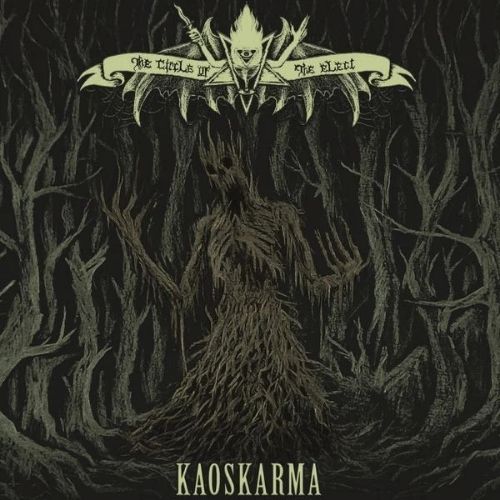
The decision to title the tracks exclusively with Roman numerals complements the album's anonymous identity, although its artistic contribution ultimately remains limited. The mystery surrounding the unnamed songs and the concealed musicians never overshadows the music itself, yet it also creates a certain emotional distance that limits the listener's personal connection. In this sense, the album's visual and conceptual presentation reinforces its anonymous, ritualistic atmosphere without introducing a particularly transformative aesthetic dimension.
Kaoskarma does not seek to redefine the boundaries of contemporary atmospheric black metal through radical experimentation. Instead, it establishes its own identity by preserving the traditional backbone of black metal while emphasizing rhythmic control, balanced production, and consistently realized atmosphere. Its most obvious shortcoming is its roughly 27-minute running time, which prevents many of its ideas from developing into a broader dramatic arc. Even so, the remarkably consistent quality maintained across its five compositions goes a long way toward offsetting that limitation.
Demanding patience and careful attention from its audience, this is an album that places greater emphasis on the cumulative flow between its compositions than on the immediate impact of individual riffs. On its debut, The Circle of the Elect chooses not to rewrite the vocabulary of black metal, but to refine its existing aesthetic language through disciplined and confident songwriting. As a result, Kaoskarma succeeds not through bold claims of innovation, but by establishing itself as a mature and assured debut that builds its atmosphere upon structural coherence, earning a solid place within the contemporary Ukrainian black metal landscape.
OZAN