
ALBUM REVIEW
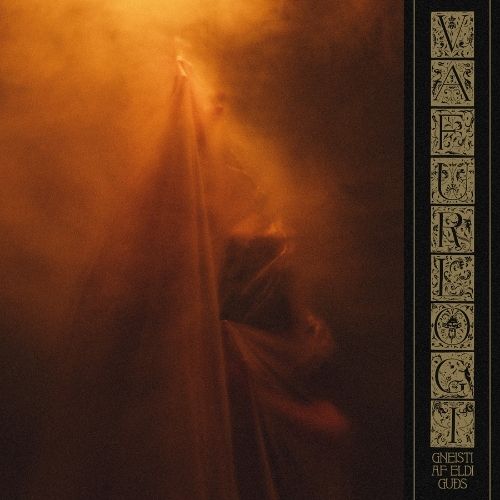
Vafurlogi - Gneisti af eldi Guðs
Icelandic Black Metal
Based in Iceland’s contemporary black metal continuum, Vafurlogi positions itself as a reinterpretation of the aesthetic lineage that crystallized around Svartidauði and Sinmara. The project’s second album, “Gneisti af eldi Guðs,” reworks compositional ideas spanning many years, fusing 1990s reference points in melodic black metal with the hardened language of the later orthodox wave within a single crucible. This record is not merely a continuation, but can also be read as an attempt to reconstruct the band’s compositional identity within a more clearly defined architectural framework.
From its opening seconds, the album locks its riff writing not into melodic fluidity but into a controlled architecture of tension. The guitars often operate less as explicit “theme carriers” and more as continuously reshaped harmonic surfaces; while the tremolo lines reference the melodic black metal vocabulary of the 1990s, these references are treated less as nostalgic reproduction and more as a constantly modulated pool of motifs. The refusal of riffs to resolve in clear cadential closures keeps the tonal center in constant motion, preventing the music from ever fully “settling,” even in passages that shift into mid-tempo pacing.
The drum performance is not a static backbone of this structure, but rather a triggering force that continuously redirects it. Ragnar Sverrisson’s playing does not merely create dynamic contrast between blast beats and mid-tempo transitions; it also reorients the harmonic trajectory of the guitars. Especially in opening tracks such as “Af heilagri heift,” the tempo map is constructed through layered ruptures rather than linear progression, revealing a compositional logic driven by process rather than narrative. The drums function less as a “leveling” force and more as a “fragmenting” one, repeatedly interrupting and reconstructing the fluidity of melodic structures.
The bass guitar’s placement in the mix reflects a characteristic approach often found in the Icelandic scene: it is not merely a filler element, but an active secondary layer shaping the low-mid spectrum beneath the riffs. This becomes particularly evident in tracks such as “Vitjun,” where the chromatic descents of the guitars are not only supported by the bass but at times thickened and subtly redirected by it. This interaction grants the compositions not only melodic clarity on the surface, but also a substantial physical weight.
The vocal approach constructs a dual-layered expression that extends beyond traditional black metal shrieking. On one level, there is a primary vocal line that mirrors the rhythmic contours of the guitars with aggressive precision; on another, spoken word passages and lower-register vocal interventions introduce secondary structural accents. The spoken passages in “Af heilagri heift,” for instance, are not merely atmospheric embellishments, but structural ruptures that temporarily redefine the track’s rhythmic flow. These interventions heighten the album’s dramatic density while simultaneously preventing it from progressing along a single continuous line.
One of the album’s most distinctive technical traits is its sustained postponement of resolution in guitar lead work. Melodic lines rarely conclude as completed phrases; instead, they either dissolve into other harmonic movements or fragment into repeating motifs. This approach is especially clear in the self-titled track “Vafurlogi,” where lead guitars are not used to generate hooks, but to construct an ever-expanding melodic field. This can be read as a deliberate deviation from the classic melodic black metal model of repetition-driven consolidation.
On the production side, Stephen Lockhart’s mixing approach avoids merging guitar layers into a homogeneous block, instead preserving them as separated yet spectrally overlapping elements. As a result, the guitars are not perceived as a single wall of sound, but as interlocking yet individually legible surfaces. The extensive use of reverb does not primarily create emptiness or spatial abstraction; rather, it enhances the continuity of harmonic transitions, meaning the production serves less to generate atmosphere and more to render the compositional architecture visible.
The additional instrumentation on the album—piano, clean guitar passages, and limited synth interventions—functions not as external decoration disrupting the core riff logic, but as brief “reset points” that redirect internal compositional dynamics. The piano sections in “Af heilagri heift” and in the closing long-form piece do not soften the melodic intensity; instead, they sharpen the resonance of what precedes them. However, at certain points these interventions remain closer to transitional devices than to true structural transformations; particularly in some mid-section atmospheric passages, they function more to smooth continuity than to fundamentally alter the composition.
Tracks such as “Vitjun” and “Að handan” lean on chromatic riff structures associated with Swedish melodic black metal, yet this influence rarely solidifies into a governing compositional model. Instead, it remains a surface-level reference that emerges only in specific sections. This further positions the album as a multi-layered language rather than a straightforward stylistic synthesis.
“Gneisti af eldi Guðs” constructs a compositional framework that continuously expands yet rarely reaches full resolution. While the album contains clear peak moments, these rarely function as closures; instead, they tend to operate as the beginning of new tension arcs. This transforms the record from a linear sequence of climaxes into a more cyclical and interwoven structure.
Ultimately, the album treats 1990s melodic black metal references not as a fixed stylistic frame, but as malleable material for reworking. However, this reworking does not always reach radical transformation; at times, the boundary between enrichment and decorative repetition remains deliberately ambiguous. As a result, the listening experience demands engagement not as a linear narrative, but as a constantly realigned structural field. Vafurlogi here is not expanding the boundaries of the genre so much as maximizing compositional density within them.
OZAN