
ALBUM REVIEW
VULGAR MEPHITIS - From Dust
Brutal, technical, complex, and controlled death metal.
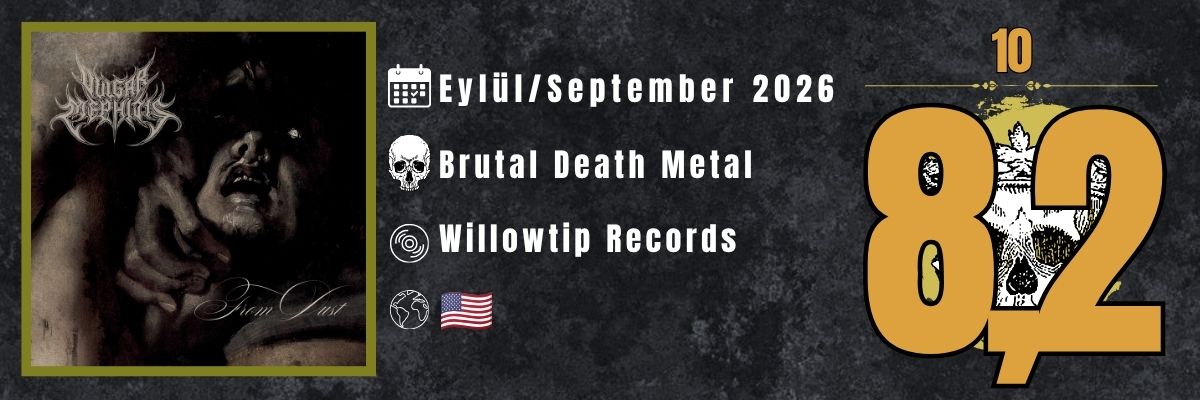
Pittsburgh-based VULGAR MEPHITIS stand out as a four-piece that combines the physical weight of brutal death metal with the sharp, unpredictable riffing of technical death metal. Moving away from the linear structures of their 2022 three-track debut EP, the band have expanded their compositional approach with the addition of Dan Martin and Nick Bentzel, turning toward more complex rhythmic breaks and angular riff structures. Released through Willowtip Records, "From Dust" represents this transformation as a debut full-length that pushes compositional boundaries while retaining the directness of its brutality.
The first thing that defines the album is not speed itself, but the way speed is fractured. Rather than constantly charging forward, the riffs interrupt their own momentum with sudden stops, sharp directional shifts, and heavy low-frequency blows. Nick Bentzel's drumming is not merely the metronomic backbone of this structure; from blast beats and neck-snapping hits to brief stop-start passages and rhythmic breaks, it is an active force that constantly redirects the compositions. As a result, the album moves away from the familiar linear aggression of brutal death metal and toward the more unpredictable compositional approach of technical death metal.
Behind this change lies a creative transformation within the band's lineup. Dan Martin and Nick Bentzel joining the band after the 2022 debut EP expanded a songwriting approach that had previously been handled solely by Jay Schweinberg and Jacob Toy. In the band's own words, the "straight up brutal" and linear structures of their earlier material have now given way to more complex song arrangements. "From Dust" is the direct result of that shift. The riffs do not merely follow one another; they veer into different tempos, pauses, and tonal tensions, constantly rebuilding the internal architecture of each track.
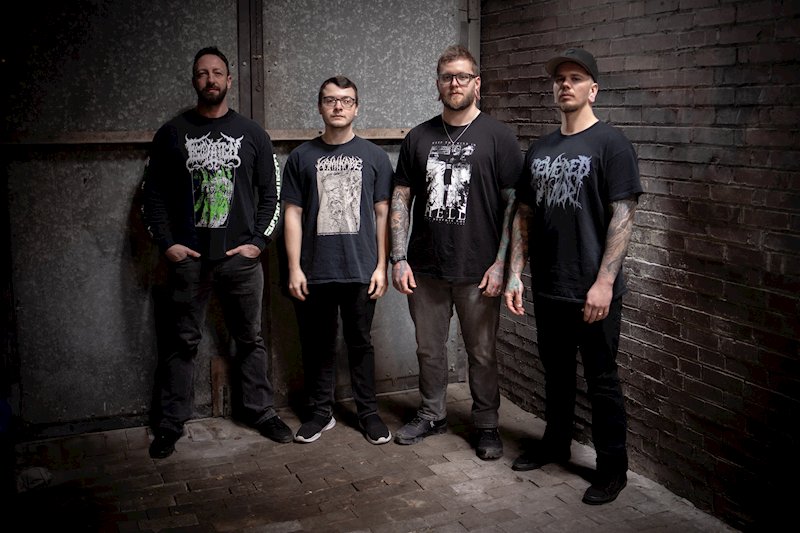
Dan Martin's guitars provide the album's most pronounced field of movement. Layered under heavy distortion, the riffs are in almost constant flux, accompanied by sharp, angular chord movements. The guitar can suddenly settle into a low-register groove before shifting into high-pitched, winding, restless lead lines, carrying "From Dust" from its brutal death metal foundation into the more intricate language of technical death metal. The kinship with bands such as Spawn of Possession, Defeated Sanity, and Deeds of Flesh becomes apparent here, but VULGAR MEPHITIS do not use these influences merely to produce flashy instrumental performances. The grooves function as structural connections that preserve the backbone of the songs, particularly between their most intensely dense passages.
'To Dust' is one of the clearest examples of this. Although the track is fast and aggressive, it does not rely solely on high tempos. Heavy low-frequency blows are broken up by brief cuts, the drums suddenly increase their rhythmic density, and the guitars create lines that coil around the main riff and change direction. Jay Schweinberg's bass also takes on a more prominent position in the mix here, creating fluid movement rather than merely providing frequency support beneath the guitars. What is particularly interesting is that so many directional shifts do not strip the song of its memorability. This is precisely the band's strongest answer to one of technical death metal's recurring problems: as complexity increases, identity tends to diminish.
Nick Bentzel's drumming is the second major pillar of this approach. What makes the performance impressive is not simply its speed, but the way the drum kit determines the directional shifts within the compositions. The transitions between blast beats, sudden stops, and heavier grooves happen so frequently that the drums often do not follow the guitars from behind; instead, they determine where the guitars will turn next. The technical drumming on the opening track, 'From Dust', establishes the album's approach within its first few minutes, while in more frenetic sections such as 'Martyr', that same intensity occasionally reaches a point where it threatens to overshadow the other elements of the composition.
This is also where the album's central tension emerges. VULGAR MEPHITIS are a band that do not want to lose control. Returning to more balanced, slower passages after their most complex sections allows them to preserve the physical weight of brutal death metal. 'Peer Into The Abyss' and 'Gorging Greed' represent the album's more controlled side in this respect. Yet on certain tracks, particularly in the most densely instrumental sections, the band's technical capabilities are allowed to move ahead of the composition itself. The uninterrupted instrumental intensity of 'Martyr' is a clear example. The band regains its footing afterward, but the sense remains that these controlled passages are actually among the album's most effective moments.
Jacob Toy's vocals, meanwhile, keep this technical intensity within the framework of brutal death metal rather than pulling it toward deathcore. His guttural delivery fits the heavy, physical guitar tone, and despite his background as a deathcore vocalist, his performance does not lean too heavily on the genre's contemporary breakdown and vocal-showcase habits. The limited use of pig squeals across the album is another consequence of this choice. Rather than competing with the technical complexity of the compositions, the vocals function as a more direct layer of aggression laid over them.
The production is another important detail in determining the band's position within the genre. "From Dust" has a cleaner, more separated sound than the excessively murky and muddy approach often associated with brutal death metal. This clarity increases the audibility of the technical guitar movements and Bentzel's drumming without stripping the music of its physical weight. At the same time, Jay Schweinberg's bass does not always sit prominently enough in the mix. Moments when the bass becomes more apparent, such as on 'To Dust', are therefore particularly valuable, creating a more organic area of movement that can fill the space between the band's guitars and drums.
The real distinction, however, emerges from the fact that the band does not expand the brutal death metal formula solely through technicality. The atmospheric approach introduced on 'Scorn Of My Flesh' develops into a much more pronounced compositional device on the album's closing track, 'Wounds'. At roughly five minutes, it is comparatively long for the record, and toward its final section it abandons the boundaries of a standard brutal death metal track in favor of an eerie Latin (?) hymn/chant passage. The value of this section does not lie in its inclusion as exotic decoration, but in the way it adds a different ritualistic layer to the album's violence-centered structure. Even so, it is clear that the band has room to take ideas of this kind further.
The jazzy touch in 'Exterminating Profane' serves a similar function. Such deviations demonstrate that VULGAR MEPHITIS do not simply want to be a faster, more technical brutal death metal band. Yet across the album as a whole, these ideas are not dominant enough to transform the underlying compositional system. They remain brief side paths branching off from the existing structure. And that is precisely why the most interesting aspect of "From Dust" is not how experimental it is, but how controlled it remains despite its capacity for experimentation.
This restraint is both the album's advantage and its limitation. On one hand, the band's music never gets trapped in the sterile showmanship of technical death metal; grooves and the physical weight of brutal death metal remain at the center of the compositions. On the other, had the stranger, more atmospheric, and more structurally ambitious ideas that emerge toward the album's latter stages been developed further, VULGAR MEPHITIS's position within the genre could have become considerably more distinctive. As it stands, the band does not abandon the basic vocabulary of brutal death metal; they simply make the sentence structure of that vocabulary considerably more complex.
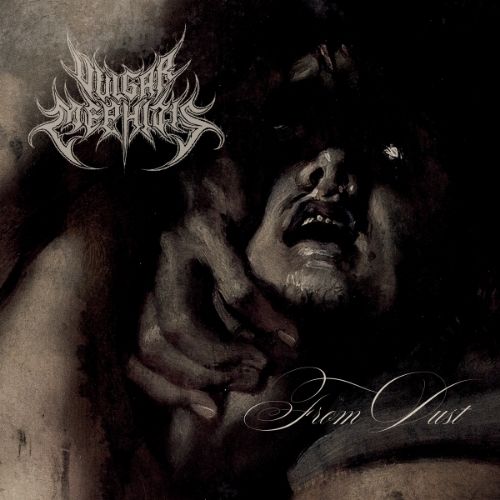
Leon Humphrey's cover artwork and the looping character of the lettering design also support this approach on a visual level. Rather than translating the music's extreme technical side into a sterile "shred" aesthetic, the artwork retains a dirtier and more grotesque identity. This is important because the musical objective of "From Dust" is likewise not to turn technicality into a prestige marker in itself, but to expand the composition without sacrificing the physical weight of brutal death metal.
Ultimately, "From Dust" clearly demonstrates that VULGAR MEPHITIS have moved from the linear brutal death metal approach of their 2022 EP toward a more complex compositional language. The album's strength lies in its ability to preserve the balance between technical performance and brutal weight for much of its duration; its limitation lies in the fact that it has yet to fully bring the experimental territory it opens up into the center of its identity. Its place on the Willowtip Records roster is therefore not based solely on its level of extremity: in an oversaturated field of brutal death metal, VULGAR MEPHITIS build their identity less through riff density than through structural deviations.
"From Dust" is an album that asks the listener to follow the arrangements beneath the surface-level speed. At its best, it holds complexity and weight within the same composition; at its weaker points, technical density becomes an idea sufficient unto itself. The band's real potential will be determined by how fully they choose to bring the stranger and more unpredictable side already present on this album to the forefront next time around.
