
ALBUM REVIEW
Wailin Storms – The Arsonist
Southern Gothic Blues Punk & Doom-tinged Sound
Wailin Storms stand out as one of the rare American bands constructing a distinct sonic architecture where blues punk and doom influences intersect within a Southern gothic rock framework. Their fifth album, The Arsonist, marks a transitional point in which this trajectory is reshaped through an analog recording aesthetic and a broader sense of atmosphere. Rather than pushing genre boundaries in a radical sense, the band opts here to refine their darker, organic sonic language into a more streamlined form.
As expected, the album is built on a conceptual framework that places riff organization and production aesthetics on the same plane. From the opening moments, the guitars remain firmly rooted in a blues punk lineage, yet instead of traditional “riff analysis,” they unfold through repetitive, semi-ritualistic cycles. The most crucial feature of these cycles is their avoidance of harmonic resolution; most chord progressions refuse to settle into a clear cadence, remaining suspended instead. This keeps the material at a weight leaning toward doom, while structurally anchoring it in the Southern gothic rock tradition as a middle ground.
The production approach plays a decisive role here. The analog recording process, helmed by Matt Talbott, results in guitars that, unlike high-definition modern metal mixes, operate with rounder transients and a natural sense of compression. Rather than intensifying the aggression of the riffs, this choice draws them into a more immediate, physical performance quality—particularly on tracks like “Dead End” and “Heart of Mine.” However, this analog aesthetic does not always translate into heightened dramatic character; in certain passages, the midrange density of the mix limits the separation between guitar layers, partially flattening the potential for more intricate riff stratification.

The rhythm section establishes the album’s most distinctive field of tension. Mark Oates’ drumming does not strictly adhere to conventional doom or sludge patterns: ride cymbal work and tom transitions often disrupt the groove’s forward momentum, repositioning the internal dynamics of the track rather than propelling it. This approach becomes especially evident on pieces like “The Wind,” where the rhythmic structure operates less as a fixed pulse and more as a sequence of subtle fractures. The result is an album that feels not “slow and static,” but rather “slow and fluid.”
The vocal performance functions as the primary carrier of Justin Storms’ narrative-driven writing. Yet what matters here is not dramatic intonation, but rhythmic placement. The vocals often operate less as a melodic line layered over the riffs and more as an additional narrative stratum filling the spaces between them. This invites comparisons to Nick Cave or early Danzig, though the resemblance remains largely confined to vocal demeanor rather than evolving into a fully realized compositional drama.
One of the album’s clearest points of expansion lies in its use of keyboards and organ. Ben Melton’s Rhodes and piano contributions, particularly on “Heart of Mine” and the closing section, briefly refract the guitar-centric framework into a different harmonic perspective. While these Rhodes textures evoke a Twin Peaks-coded “bar ambience,” they function more as atmospheric veils than structural elements that reshape the riff writing itself. The key question here remains whether the keyboards meaningfully expand the composition or simply add surface-level texture; in most cases, the album leans toward the latter.
Track architecture is generally non-linear, designed more like a wave form than a traditional structure. Songs move through rises and falls in intensity rather than clear verse-chorus divisions. However, this approach does not always generate a sense of dramatic development. In the middle stretches, some tracks rely heavily on variations of the same riff cell under different dynamics, which limits the feeling of structural progression. In contrast, “The Arsonist” and the closing track stand out by constructing more defined arcs of tension, forming the compositional peaks of the record.
The analog character of the production, paired with its stated rejection of “AI slop” and overproduced aesthetics, does not translate into a purely oppositional stance in practice. The album does move away from sterile modern mixes, but this distance does not automatically equate to a more “human” result. In certain passages, the lo-fi impression feels less like a deliberate aesthetic decision and more like a byproduct of reduced separation, creating a space where intent and technical outcome do not fully align.
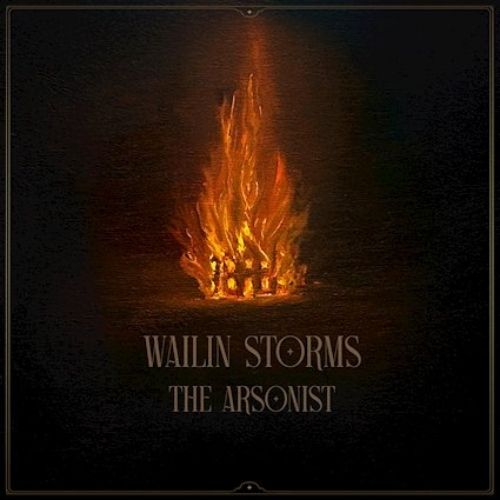
Visually, the cover artwork by Justin Storms, centered on a Magritte-referencing image of a single burning house, operates through a strict minimalism that mirrors the album’s shifting sonic density. Yet the same question persists here: does the visual language expand the musical identity? While the artwork clearly reinforces the fire motif on a thematic level, it does not introduce an additional layer that reflects the record’s rhythmic and harmonic variability. It remains primarily a framing symbol rather than an integrative visual extension.
Overall, The Arsonist does not so much expand the framework of Southern gothic rock and blues punk as it compresses it through analog production aesthetics and an emphasis on organic performance. The record’s strongest aspect lies in the rhythmic tension generated by the guitar–drums–vocals triad, while its most limiting factor is the way additional instrumentation—particularly keyboards and atmospheric layers—often results in surface expansion rather than structural transformation.
This is an album that demands active listening, not because of overt complexity, but because it requires attention to how intensity is redistributed rather than how riffs develop in a linear sense. Yet this process does not always open up new compositional layers. Wailin Storms refine their identity here rather than expand it, leaving the question of whether this refinement truly pushes genre boundaries—or simply polishes existing ones—as the record’s central point of contention.
OZAN
https://open.spotify.com/artist/2e1J5JQpROgSuT7RcsUbZ2
https://music.apple.com/us/artist/wailin-storms/451185826
https://wailinstorms.bandcamp.com
https://www.youtube.com/@wailinstorms7