
ALBUM REVIEW
WINDSWEPT - A Sign of the Cloven Hoof
Dark, melodic black metal turning limitations into strength.
WINDSWEPT, the Ukrainian band, brings together the familiar building blocks of black metal—such as the uninterrupted flow of tremolo guitars, the intense drive generated by blast beats in high-tempo passages, and high-pitched, feral vocals—as the structural foundations of its compositional approach on its fourth full-length, "A Sign of the Cloven Hoof," an album that places its stylistic and creative methodology at the center. Yet the album's true character emerges not so much from these tools themselves as from the moments when they recede and allow the guitars to expand into more melodic territory. Spread across roughly 35 minutes and consisting of just five tracks, the album, particularly in its longer compositions, prefers to reconstruct the same riffing logic at different levels of intensity rather than simply piling layers onto repetition.
The strongest aspect of this approach is the guitar work. WINDSWEPT does not use riffs merely to generate speed; instead, it maintains a constant tension between tremolo lines and more clearly defined melodic passages. With the guitars sounding remarkably full in the low and mid frequencies, the production gives these riffs a physical weight rather than the thin, distant guitar aesthetic associated with classic black metal. Even so, the melodic lines are never pushed into the background. On the contrary, particularly when the band steps away from continuous blast beats during the longer passages, the motifs created by the guitars become the album's most distinctive elements.
The 11-minute opener, 'Behind the Masks of Piety', is the most comprehensive example of this compositional approach. The track begins with high-pressure guitars, sharp drumming, and vocals that remain almost constantly in attack mode. The intensity of the opening section forces the listener to grasp the whole rather than follow the finer details of the riffs. But when the tempo and intensity are brought down in the second half, the music simultaneously becomes more melodic and more defined. What matters here is that the slowdown does not feel like an atmospheric section simply attached to the track. As a continuation of the preceding riffing logic, the transition genuinely expands the composition's structure. This is where WINDSWEPT's most convincing idea regarding extended compositions lies: rather than filling time, it gives the same material a different dramatic weight.
'Buried Face Down' tests this method in a shorter form. The roughly five-minute track initially rests on an almost unyielding black metal aggression, before quickly taking on a more melodic and controlled character. When it accelerates again, the shift does not split the song into two separate identities; instead, the contrast becomes the composition's primary mechanism of movement. The melodic sections on the album therefore function not as atmospheric decoration, but as structural tools that alter the way the riffs are perceived.
The rhythm section is likewise used in a highly direct manner to support this structure. In the faster passages, blast beats and dense drum patterns propel the guitars' tremolo movement forward, while the reduced rhythmic density at mid and slower tempos makes the guitars' melodic details more apparent. What is particularly notable here is that WINDSWEPT never completely abandons the genre's fundamental aggression when changing tempos. Even the slower sections offer no sense of relief; because the harshness of the guitar tone and the sharpness of the vocals remain intact, the music merely changes its speed of movement. As a result, the album's atmospheric side is neither soft nor pastoral in the conventional sense; instead, it creates a framework in which even melody has to emerge through hard surfaces.
The vocals are among the most pronounced elements of this harshness. The high-pitched, intensely vicious screams create a deliberate contrast with the melodic side of the guitars. Particularly during the longer melodic sections, the tension between the vocals and this aesthetic sharpens the coldness that could be described as the music's "wintry atmosphere." While the guitars occasionally open up, the vocal performance never softens to the same degree. Thus, even when the melodic passages move toward black metal's atmospheric side, the album's fundamental harshness remains intact.
In this respect, "A Sign of the Cloven Hoof" nods toward different edges of contemporary black metal without surrendering itself to any kind of fusionist approach. The combination of old-school aggression with a fuller, more modern production creates a directness that can recall MARDUK's more warlike periods. At the same time, WINDSWEPT's music cannot be reduced to the formula of fast and aggressive black metal alone. The extended melodic passages, shifts in tempo within the tracks, and hypnotic use of repetition push the album toward a more atmospheric and epic territory. Yet this epic quality is not built through orchestration, keyboards, or broad cinematic layers, but directly through the riff architecture of the guitars.
The album's thematic direction also aligns with this musical austerity. Its material, drawing on Ukrainian demonology and the early stories of Mykola Gogol, is not presented as a decorative layer of folklore added onto the music afterward. Instead, it occupies the same aesthetic ground as WINDSWEPT's already dark, harsh, and ritualistic black metal language. The band's deliberate restraint is important here. "A Sign of the Cloven Hoof" does not attempt to expand its instrumentation in order to step outside the genre; it seeks distinction through the way it employs its traditional tools.
That choice comes with a cost. All five tracks share a strong common riffing language, which gives the album cohesion, but the same quality occasionally reduces the distinction between individual songs. Particularly on a first listen, identifying the compositions as separate entities is not easy, owing to the album's dense production and similarly paced riff structures. 'Towards the Abandoned Church' reveals a more pronounced weakness in this regard; its guitar, rhythmic, and atmospheric components do not reach as convincing a point of convergence as they do elsewhere on the album. The material itself is not poor, but it naturally falls behind because it does not reach the same level of structural tension established by the rest of the record.
This also reveals the limits of WINDSWEPT's music. "A Sign of the Cloven Hoof" makes no claim to redefining the genre's traditional tools. Instead, it reinforces its own aesthetic territory by controlling the balance between tremolo riffs, blast beats, harsh vocals, and melodic transitions. Considering how extensively contemporary black metal continues to expand through atmosphere, folk influences, dissonance, and experimental instrumentation, this approach appears particularly deliberate. WINDSWEPT's answer is not to increase variety, but to turn restriction into a compositional advantage.
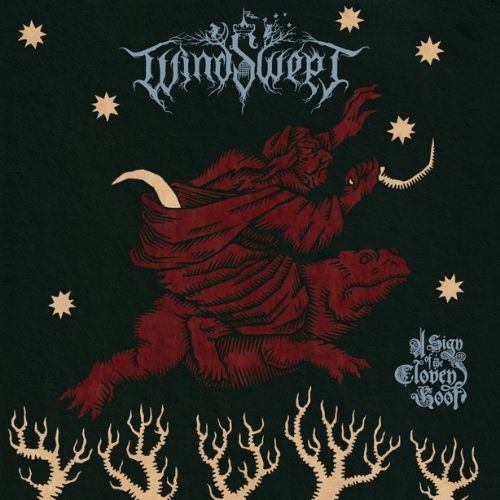
The restrained approach to the cover artwork also corresponds with this musical attitude. The visual identity does not attempt to explain the music's already established dark and ritualistic character through unnecessary detail. This simplicity feels like the visual counterpart to the album's broader principle of avoiding ornamentation. Just as directly as the music is built around riffs, the cover remains equally controlled.
"A Sign of the Cloven Hoof" is therefore less a black metal record designed for quick consumption than a work that gradually establishes its own mechanism of repetition within the listener's perception. The longer tracks can initially resist because of their density, but once attention is given to where the melodic sections enter, how the tempos connect, and how the same riffing logic acquires different weights, the album's underlying architecture becomes clearer. WINDSWEPT is not looking to expand the boundaries of the genre here, but to explore how much space can be created within them. The result is a record far removed from the conspicuous experimentalism of contemporary black metal, yet one with a distinct identity precisely because it places its own limitations at the center of its composition.

facebook.com/windsweptukraine
primitivereaction.com
primitivereaction.bandcamp.com
facebook.com/primitivereaction666