
Album Review
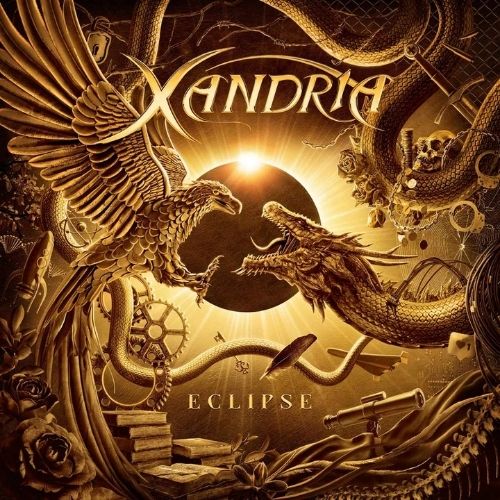
XANDRIA - Eclipse
XANDRIA expands its formula without truly transcending it.
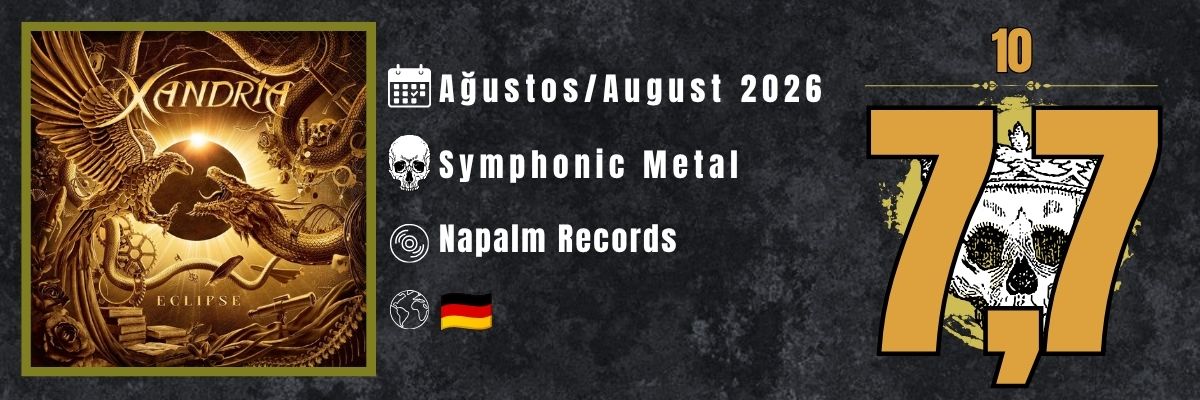
“XANDRIA have become one of the enduring names in symphonic metal over a career spanning more than a quarter of a century, bringing together the genre’s grandeur, orchestration and metallic weight. The band’s second studio album with its new lineup, “Eclipse”, revisits their familiar aesthetic vocabulary through modern guitars, folk textures and cinematic orchestration. Centered on Marco Heubaum’s songwriting approach and Ambre Vourvahis’ versatile vocal performance, the album raises the question of how far XANDRIA can push their established symphonic metal formula.
With “Eclipse”, XANDRIA bring big melodies, modern metal guitars, film-score-scale orchestration and folk textures into the same compositional pool. Yet the album’s real question is not how many of these elements are present, but how many genuinely serve the structure of the songs. Marco Heubaum’s songwriting still rests on a familiar symphonic metal framework: strong guitar riffs, rising orchestral layers, expansive choirs and huge choruses. What makes the difference is that this formula is being applied for a second time with the same lineup, while Ambre Vourvahis’ vocal performance has now become an even more pronounced part of the band’s musical identity.
“Eclipse” should therefore be understood less as XANDRIA’s attempt to change genres than as an effort to expand their own formula. Heavier modern metal guitar tones and passages with a breakdown-like character are placed alongside classic symphonic metal orchestration. Yet the album’s strongest moments are not necessarily those with the greatest number of layers, but those in which those layers leave room for one another.

The brief instrumental introduction 'Syzygy' serves as a controlled prologue, establishing the album’s cinematic side. The title track that follows immediately reveals the band’s core aesthetic by combining the weight of the guitars with orchestral arrangements. The tightness of the rhythm guitars, rooted in modern metal, is set against the breadth of the strings and choral layers, while Ambre Vourvahis moves between clean vocals, operatic highs and strategically deployed growls. What matters here is that Vourvahis is not merely a vocalist carrying high-register melodies. The rock character in her voice creates a human-centered weight, particularly within the dense orchestration.
This quality is more apparent on 'Colours'. The song’s melodic core is built in an extremely direct fashion, with the memorability of the chorus relying heavily on the vocal melody. The arrangement, meanwhile, constantly tries to make the song sound bigger through guitars and orchestral layers. The result is effective, but this is also where “Eclipse”’s central dilemma emerges: XANDRIA sometimes loses sight of the difference between making an already effective melody bigger and actually developing it. Vourvahis’ performance closes that gap to a considerable extent, but a strong vocal performance does not always encounter songwriting of equal strength.
'The Shannon's Home' brings the album’s folk side to the forefront. McAlbi’s use of Tin Whistle and Low Whistle is not simply a matter of adding a different instrumental color; it shifts the song’s melodic character toward a Celtic sensibility. At the same time, the folk element is layered onto the existing symphonic metal structure rather than fundamentally transforming the way the guitar riffs function. The song therefore broadens XANDRIA’s sonic palette without altering their compositional logic to the same degree. The Celtic textures recalling certain periods of NIGHTWISH are no coincidence either; the band is reusing established reference points from within the genre.
As 'The Grand Delusion' moves between heavier guitars and dramatic orchestration, the role of the rhythm section across the album becomes increasingly important. At first glance, the production creates a clean, expansive and high-budget impression. Yet in some sections, the density of the orchestral and choral layers pushes the physical weight of the bass and drums into the background. For massive arrangements to work effectively in symphonic metal, the metallic backbone needs not only to be heard but felt. “Eclipse” sometimes polishes that foundation a little too heavily. Particularly when the dense orchestration swells, if the contrast provided by the rhythm section is not pronounced enough, the music can feel more compressed rather than bigger.
'Wave Of Tanis' is one of the clearest examples of the album approaching the boundaries of its formula. Its broad melodic structure and 1980s stadium-rock sensibility add a different color to XANDRIA’s established symphonic metal aesthetic. However, the idea does not fully transform the song’s underlying compositional language. Instead, it adds a different melodic and production perspective to the existing framework. Its impact is therefore significant, but not revolutionary. Even so, it serves a purpose by preventing the album from becoming too uniform.
By contrast, 'Northstar' demonstrates how XANDRIA can achieve more by intervening less. The space created by the acoustic guitars allows Vourvahis’ vocals to move to the forefront, while the song gradually expands toward an orchestral climax. The strength of the arrangement here does not come from constantly adding new layers, but from the dynamic differences between the elements already in place. When the song connects its quieter and louder sections, the dramatic effect emerges in a more natural way.
'Masquerade' seeks a similar balance. The contrast between dynamic drumming, acoustic guitars, harder guitar transitions and deep growls strengthens the song’s theatrical character. XANDRIA do not completely abandon the showy side of symphonic metal here, but instead of filling every available space with orchestration, they move between different textures. This is one of the album’s more successful approaches to arrangement.
One of the album’s most contentious sections is 'The Last Generation'. Piano, strings, children’s choir and a powerful guitar layer carry the song toward a grand dramatic finale. Yet as the number of tools employed increases, the songwriting does not deepen to the same extent. The song relies on a succession of grand gestures to heighten its emotional impact. When this approach remains too faithful to the traditional theatrical language of symphonic metal, the distance between what the music wants to say and how it chooses to say it begins to widen. 'The Poetry Of The Real World', meanwhile, occupies the opposite end of the spectrum with its lighter and more melodic construction, although it occasionally struggles to carve out its own space among the album’s heavier pieces.
And then comes 'Lore'. Running for more than eight minutes, the closing track attempts to bring all of the album’s tools together within a single structure: high-energy guitars, choirs, operatic vocals, folk textures, strings and expansive orchestration. Ally Storch’s violin contribution is particularly important here, because the instrument is not used merely as a background color; it becomes one of the musical carriers of the song’s folk character. The track’s strength lies not in its length itself, but in its ability to connect its different sections. At the same time, the structure occasionally moves by adding new ideas one after another, and some of the transitions could have been more effective with tighter dramaturgy. Even so, it is clearly one of the tracks that best demonstrates the musical scope of “Eclipse”.
The album’s lyrical framework also runs parallel to this contrast between light and shadow. While it addresses contemporary social developments, anxiety about the future and the increasingly troubled state of the world, its narrative never surrenders entirely to darkness. The contrast between 'The Last Generation' and 'The Poetry Of The Real World' in particular gives concrete form to the album’s balance between hope and anxiety. At its most successful, the way these themes translate into the music does not rely on directly dramatizing the lyrics, but on the contrasts within the arrangements.
This is where Ambre Vourvahis’ role once again becomes decisive. Her transitions between a powerful rock-oriented mid-register, operatic high notes and growls prevent XANDRIA’s sound from becoming tied to a single vocal technique. Particularly in the more restrained arrangements, you can hear her vocals genuinely driving the melody forward. This points to one of the important conclusions of “Eclipse”: XANDRIA’s potential for future development may lie less in adding more orchestration or larger choirs than in adopting more selective arrangements built around Vourvahis’ individual character.
Because the album’s fundamental problem is not a lack of ability, but excess. XANDRIA have the tools to do almost everything: modern guitars, classic symphonic metal orchestration, folk instruments, choirs, operatic vocals and strong melodies. But when all of these elements come into play at once, some songs pile too much decoration onto their own melodic core. This is particularly noticeable at a time when the genre itself is becoming increasingly modernized. Symphonic metal no longer has to be a formula in which orchestration simply makes metal riffs bigger; “Eclipse” occasionally pushes against that boundary, but for the most part chooses to remain within it.
From this perspective, the album is not a turning point in which XANDRIA redefine the genre. It is instead a work that rearranges the band’s existing aesthetic tools around a higher production standard, a broader melodic scope and Vourvahis’ versatile vocal performance. At its best, this approach is highly effective; at its weaker moments, the same tools suppress the music’s natural movement.
“Eclipse” demands a form of listening that pays attention not only to the big choruses, but also to the balance between orchestration and the metallic backbone. Beneath structures that initially appear impeccably polished, it becomes possible to distinguish which arrangement decisions genuinely move a song forward and which merely increase its scale. XANDRIA’s next step could take shape precisely here: not adding more layers, but deciding which layers are actually necessary. “Eclipse” does not fully answer that question, but it clearly demonstrates that the musical material at the band’s disposal remains strong enough to produce different results within the established boundaries of symphonic metal.

https://xandria.bandcamp.com/music