Album Review
XENTRIX – Allied with the Enemy
Traditional thrash metal with melodic and rhythmic variation.

XENTRIX’s seventh studio album, "Allied with the Enemy", follows 2022’s "Seven Words" with eleven tracks that draw on different periods of the band’s career while remaining firmly rooted in traditional thrash metal’s emphasis on speed, aggression and riff-driven songwriting. The record brings XENTRIX’s distinctive thrash sound together with the genre’s defining characteristics of the 1980s, filtered through a contemporary production approach. What stands out is the band’s ability to diversify its established sound by incorporating different rhythmic patterns, melodic transitions and controlled tempo changes into its new material without losing its identity.
The opening track, 'Rip Saw', quickly moves from its drum-driven introduction and spoken samples into sharp guitar riffs. Forceful rhythmic accents and high-speed passages alternate throughout, while the guitar solos find their place without disrupting the flow of the compositions. The short title track, 'Allied with the Enemy', follows with more direct and memorable riffs, bringing the album’s melodic side into focus. XENTRIX’s songwriting places greater emphasis on memorable riffs and internal balance than on technical showmanship. As a result, the faster passages never descend into an uncontrolled display of instrumental prowess.
'Killer Unknown' and 'On Burned Remains' further highlight the rhythm section’s contribution to the character of the songs. The former opens with a groove-oriented passage before the accelerating drums, working alongside the rhythmic movement of the guitars, give the track a different sense of momentum. On the latter, an acoustic guitar introduction gives way to a heavier arrangement as the distortion returns. Such transitions prevent the album from becoming trapped in a monotonous approach to speed. In particular, the interplay between the guitars’ melodic excursions and the forceful rhythm section helps XENTRIX introduce different dynamics within the boundaries of traditional thrash metal.
'Nil by Mouth' and 'Doomsday Hook', meanwhile, represent the album’s more aggressive side through their angular riffs, straightforward structures and forceful rhythmic accents. The transition from the unsettling tones at the beginning of the former into its rapidly developing guitar passages gives way to a more pronounced rhythmic fluidity on the latter. The two-part guitar solo in 'Doomsday Hook' also stands out as a section that serves the composition without overstaying its welcome. This is where XENTRIX’s musical maturity becomes apparent: technical proficiency is never allowed to overshadow the songwriting, instead helping the compositions take shape more effectively.
The album’s most distinctive detour comes with 'The Dark Eternal'. Opening with melancholic guitar textures and clean vocals, the track introduces another dimension to Jay Walsh’s vocal approach. Known for his forceful and relatively straightforward delivery, Walsh adopts a more melodic style here, changing the song’s atmosphere in the process. Although the extended use of clean vocals takes the track away from conventional thrash metal territory, the decision never feels out of place within the album’s overall flow. On the contrary, it creates a contrast that makes the heavier sections that follow hit harder. The track’s melodic approach also nods towards traditional heavy metal and power ballads, marking a clear departure from the direct and aggressive songwriting that defines the rest of the record.
With 'Where the Madness Lies' and 'Snake in Waiting', XENTRIX return to a more dynamic and varied approach to songwriting. The shifts within the guitar riffs and changes in tempo make both tracks among the album’s more compelling moments. 'No Bridges Left to Burn' combines weighty guitar tones with accessible melodic elements, while 'We Drink the Same Poison' brings the record to a close with a series of varied instrumental passages. Together, these final tracks demonstrate that the band is not exclusively reliant on high-speed thrash metal, but can also find different approaches to suit the individual character of each composition.
There is a clear divide among the source reviews when it comes to the production. While some regard the album’s clean, clearly defined mix as an asset that complements the band’s songwriting, others who favour a rougher, more abrasive sound feel that this approach slightly diminishes the music’s aggression. The clarity of "Allied with the Enemy" makes the guitars and Walsh’s vocals easy to distinguish within the mix. On the other hand, listeners who favour the raw, unrestrained feel often associated with 1980s thrash metal recordings may find the result somewhat sterile. Ultimately, the band’s approach appears less a matter of technical limitations than a deliberate preference for making the details of the instruments and compositions clearly audible.
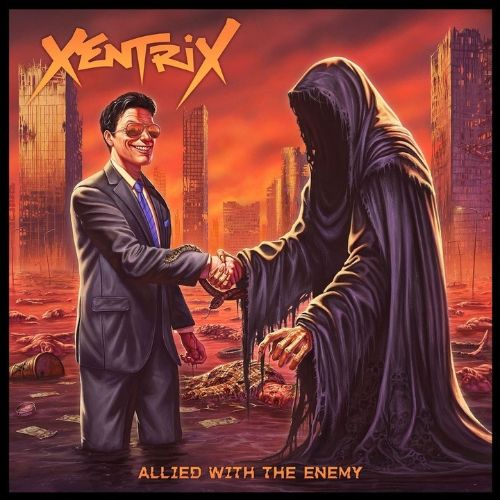
The album’s visual identity follows the same traditional direction as its music. Its artwork evokes the aesthetic of Ed Repka, serving as an unmistakable reference to the band’s place in thrash metal history and the visual language of the 1980s. While this choice reinforces the music’s nostalgic dimension, it also raises questions about the album’s ability to establish an identity of its own. Although XENTRIX’s riff writing and arrangements are effective, their proximity to traditional Bay Area thrash metal conventions occasionally makes it difficult for the band to establish a truly distinctive musical signature. The more straightforward tracks, in particular, lean heavily on familiar riff formulas. Songs such as 'Where the Madness Lies' and 'Snake in Waiting', however, demonstrate that the band is capable of introducing enough variation to move beyond these limitations.
To bring things together, "Allied with the Enemy" is an album that makes its allegiance to thrash metal’s past a defining part of its identity while bringing that allegiance to listeners through a contemporary approach to performance and production. XENTRIX’s lack of interest in pursuing radical innovation is not inherently a shortcoming; the real limitation lies in the fact that, despite avoiding the feeling of being confined to a particular era, some of the compositions struggle to move beyond the genre’s familiar formulas. Nevertheless, rhythmic variety, melodic transitions and carefully structured songwriting keep the album engaging. A satisfying record for those who appreciate the defining characteristics of old-school thrash metal, "Allied with the Enemy" does more than simply reproduce the genre’s legacy; it demonstrates that there is still plenty of life in the songwriting traditions that shaped it.
