Album Review
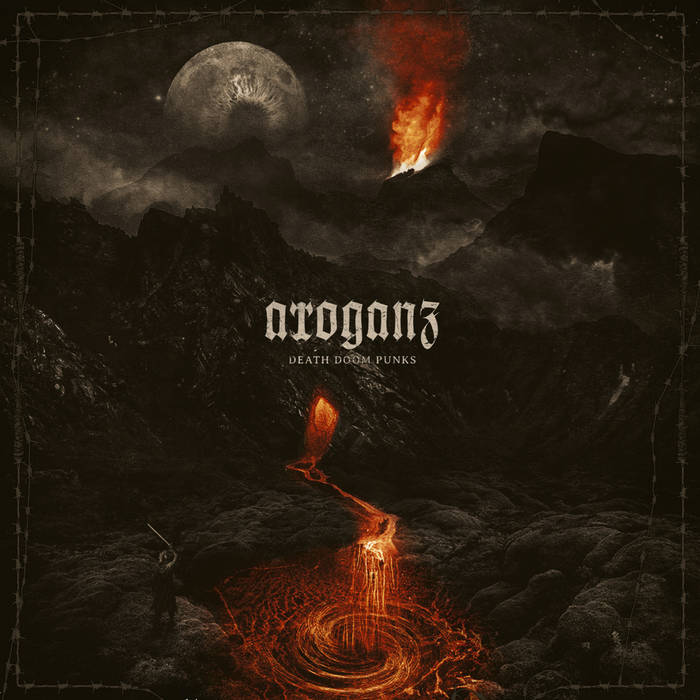
Arroganz - Death Doom Punks
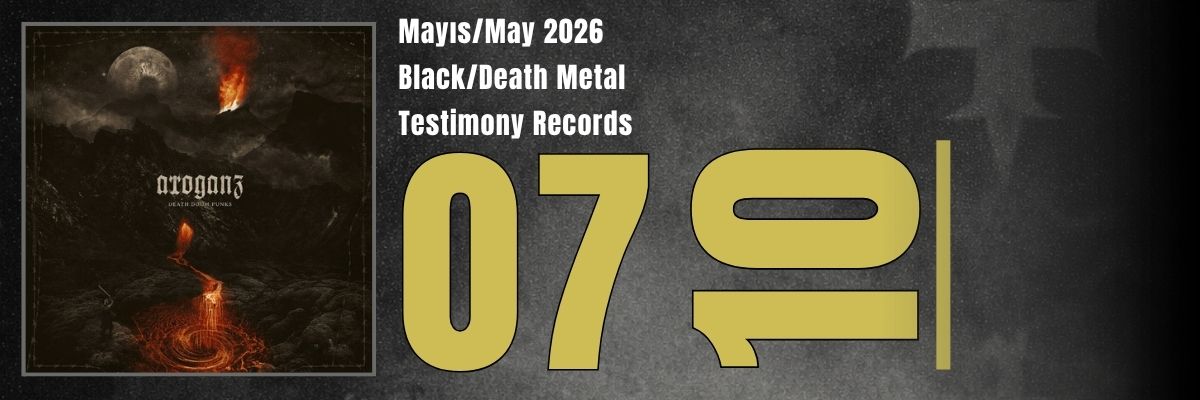
A German trio returns with their seventh studio album, and this record, titled “Death Doom Punks”, immediately constructs a framework that tests its claim of transcending genre labels through the sound itself.
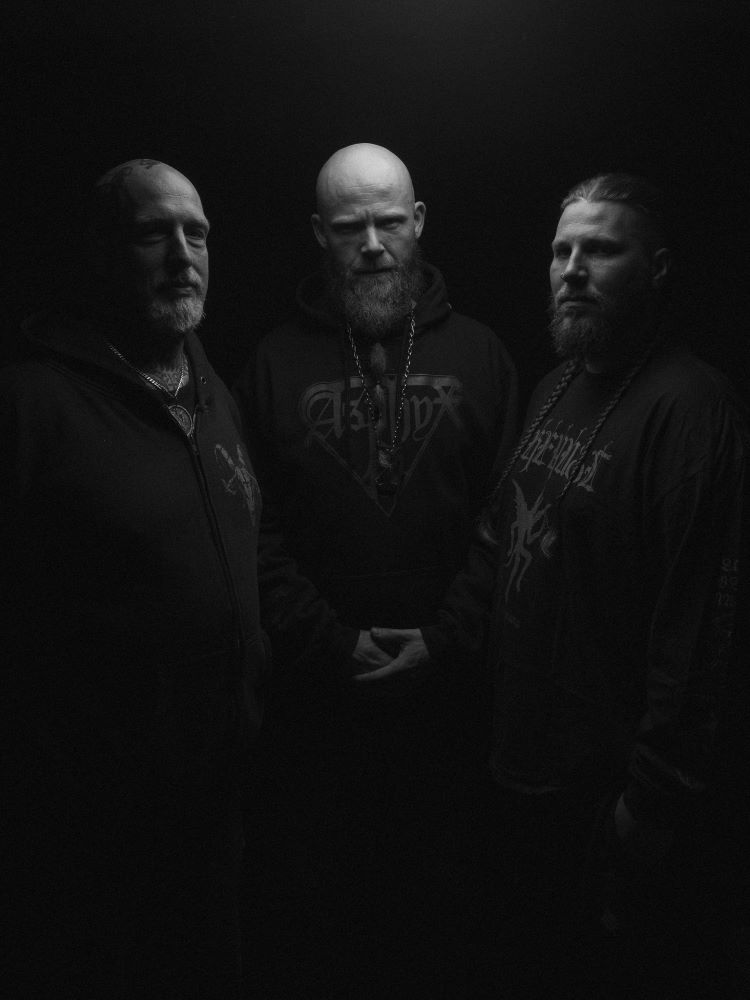
ARROGANZ’s “Death Doom Punks” does not so much dissolve the promised trio of death metal, doom, and punk into a unified aesthetic identity as it operates through a compositional approach that lets these three strands grind against one another on the same surface. The riff writing largely leans on classic death metal articulation: mid-tempo palm-muted progressions, block-chord movements at times reminiscent of the Bolt Thrower school, and more open, hardcore/punk-derived simple chord stabs that coexist within the same tracks. Yet the defining trait of this material is less the presence of these elements than the sense of sequencing that often fails to fully bind them together.
The opening track, “Die For Nothing,” lays out this approach directly. Guitars move through compressed low-to-mid register riff patterns without excessive ornamentation, while the drums shift between blast beats and straightforward punk accelerations. These transitions generate sharp sectional breaks rather than organic tension. The vocal line is deliberately pushed into the background, with the growl functioning more as a rhythmic layer; the focus is less on lyrical intelligibility and more on a percussive sense of repetition. This choice reduces the anti-war thematic framing less into dramatization and more into a structural repetition mechanism.
With “Under Scarred Skin,” the role of the bass in the mix becomes more pronounced. Here, the bass is not merely harmonic support but a driving layer that alters the direction of the riffs. Particularly in sections where it locks in with distortion, the upper frequency range of the guitars recedes, creating a denser low-end compression that edges closer to doom metal. However, this intensity does not permeate the track’s overall structure; instead, it emerges in specific moments before dissipating again.
The title track, “Death Doom Punks,” represents the most explicit attempt at the album’s triple-stylistic premise. Here, tempo shifts aim to construct a more deliberate dramatic architecture, moving between fast death metal passages and slower doom segments. Yet these transitions are built on contrast between sections rather than an evolutionary development of riff logic. In the doom passages, guitar sustain increases, but the palm-muted pressure of the rhythm guitar never fully dissolves, preventing the two aesthetic worlds from truly transforming into one another. As a result, the track feels less like a fusion of styles and more like a sequence of styles placed side by side.
Tracks such as “Anti-Ideology” and “Arsenic Bath” represent the more fluid side of the album. In “Anti-Ideology,” in particular, the drum writing is more flexible, with more controlled transitions between blast beats and groove-based hardcore rhythms. The guitar riffs here also adopt a more fragmented structure, moving through short, repeating cells rather than a single continuous motif. This partially turns the album’s overall sense of structural fragmentation into an advantage, as the recurring motifs begin to function as a connective framework rather than a dividing one.
In contrast, tracks like “Arsenic Bath” and “Incubus’ Vains” offer a more accessible surface through melodic introductions and more open riff structures. However, the core compositional issue remains unchanged: it is not the ideas themselves, but the way they are stitched together that defines the outcome. In particular, abrupt directional changes in the rhythm guitar often create a sense of segmentation rather than a coherent tension curve.
On the production side, the album exhibits a highly variable character. The drums at times sit aggressively at the front of the mix, while in other passages they recede to make space for guitars and bass. This inconsistency does not clearly resolve whether it is a deliberate exercise in dynamic control or a structural balancing issue, but it does create a constantly shifting focal point throughout the listening experience. The generally recessed placement of the vocals, combined with their repetitive phrasing, becomes another factor that limits the dramatic impact of the songs.
One of the album’s more notable aspects is the bass guitar’s occasional role as a near-lead instrument. Particularly in moments where distortion is applied, it forms a layer that actively steers the guitar riffs, pushing ARROGANZ’s sound away from standard death metal conventions and toward a more industrial or technical death metal-adjacent density. However, this potential never solidifies into a consistent compositional strategy, remaining instead in the realm of intermittent flashes.
Overall, “Death Doom Punks” presents its stylistic references with clarity, yet chooses to place them side by side rather than dissolve them into a unified compositional logic. This approach keeps the album in constant motion, but simultaneously weakens the connective force between its parts. The riff writing, particularly in moments approaching the Bolt Thrower and Asphyx lineage, generates a stronger sense of identity, while punk and doom influences largely remain additional layers surrounding that core.
The album’s live potential appears as a natural extension of its fragmented structure. The sudden tempo changes and riff breaks create a sense of disjointedness in the studio version, but may translate into a more direct and physical impact in a live setting. In this sense, “Death Doom Punks” positions itself as an album driven more by moments of intensity than by long-form compositional cohesion, producing strong individual ideas in places, while remaining more limited in developing those ideas into sustained structural statements.