
Album Review
Jungle Rot - Cruel Face of War
There are plenty of bands carrying the torch of 1990s American death metal with contemporary production standards, but very few manage to do so without suffering some degree of identity erosion. On “Cruel Face of War”, Jungle Rot moves precisely along that line: neither a sterile revival act leaning on nostalgia, nor a stylistic pivot chasing the technical exhibitionism of modern extreme metal. The album’s core philosophy remains firmly intact; mid-tempo heaviness, rhythmic impulses rooted in punk and crossover, directly effective riff structures, and a groove-oriented songwriting approach that constantly forces a physical reaction from the listener.
Once the opening intro quickly fulfills its function and transitions into “Apocalyptic Dawn”, the album’s aesthetic framework becomes immediately clear. The guitars are high-gain without sounding over-compressed; the tone still carries an organic layer of grime. Chris Djuricic’s production and Dan Swanö’s mix/mastering approach are crucial here because the album avoids the digital sterilization trap so common in modern death metal recordings. The drums are powerful and pronounced, yet retain the feel of a live performance rather than falling into a trigger-heavy mechanical character. This especially strengthens the physical relationship between the palm-muted, thrash-rooted dual guitar movements and the drumming underneath them. Jungle Rot’s music functions not through technical complexity, but through impact and momentum; that’s why the “breathing” nature of the mix directly amplifies the album’s effectiveness.
The title track, “Cruel Face of War”, neatly summarizes why the band still remains relevant within underground death metal. The song does not fundamentally present overly complex ideas, yet the placement of the riffs and the constant forward push of the groove generate relentless momentum. The sections reinforced with “hey” vocals are clearly written with live performance in mind; the goal here is not atmosphere-building so much as provoking a collective physical response. That sense of directness is precisely what many contemporary death metal bands lose beneath excessively layered arrangements.
One of the album’s strongest qualities is its ability to control intensity through density rather than sheer speed. “Maniacal” is the clearest example of this. The track becomes more threatening when it slows down, not when it accelerates. The atonal guitar touches and the use of rhythmic space give the song a more oppressive character despite remaining within classic OSDM parameters. At times, there’s a decaying quality reminiscent of Obituary, particularly in the way the guitars leave notes unresolved, sustaining constant tension. However, Jungle Rot approaches this not through the swampy atmosphere of their Floridian counterparts, but through a harsher, more militaristic rhythmic discipline.
“Radicalized” is one of the album’s most visible intersections between death metal and hardcore/crossover influences. What matters here is that the band never drifts into deathcore territory. Instead of relying on breakdown logic, the song prioritizes stomp and physical weight. The riffs carry rhythmic emphasis while still functioning from a thrash/death foundation. That distinction is essential to the album’s identity because Jungle Rot builds groove not through modern metalcore aesthetics, but through an old-school sense of street-level aggression.
The role of the bass throughout the album is also noteworthy. James Genenz rarely settles for simply thickening the guitars; especially during the mid-tempo sections, he fills the underside of the riffs with an additional layer of hostility. This becomes particularly noticeable on tracks like “Suffer in Silence” and “Blade of Betrayal”. While the bass and drums generate a constant forward-driving pressure, the guitars increasingly function as the element that dictates direction. Spenser Syphers’ drumming avoids technical grandstanding but remains highly controlled; rather than leaning on relentless blast beats, he works through groove transitions and carefully placed double bass emphasis.
Structurally, one of the album’s most curious moments is “Rot Riffs”. Its almost instrumental short-form construction works as a transitional piece within the album flow, yet the vocals feel awkwardly inserted rather than organically integrated. Since Jungle Rot typically excels through directness and clarity, these half-formed ideas slightly disrupt the precision maintained elsewhere on the record. In a way, this also highlights where the band is strongest: short, forceful songs locked firmly onto their target.
Dave Ingram’s guest appearance on “Horrors Vile” is an important detail because the track gains more than the feeling of a simple guest spot; it also adopts a dirtier, heavier tone that edges closer to the Benediction school of death metal. At this point, the album’s connection to the 1990s death metal tradition becomes even more visible. However, what separates Jungle Rot is the way they use nostalgia not as atmospheric romanticism, but as functional riff craftsmanship. The band references the past without turning its music into museum aesthetics.
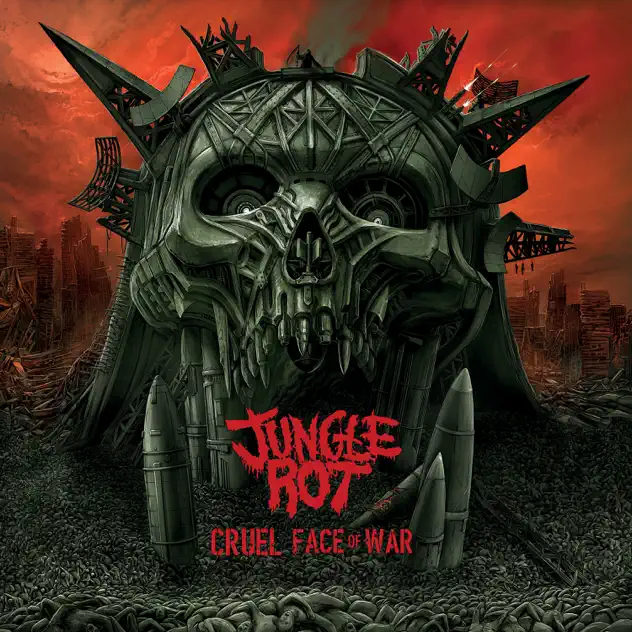
The cover artwork and overall war-driven visual identity also operate in direct alignment with the album’s musical approach. The warfare theme is not used to construct something dramatic or epic, but rather to visually reinforce the music’s brute-force mentality. Instead of embracing the overly cinematic or digitally polished visual language common in modern extreme metal, the band opts for a more traditional underground death metal aesthetic. That consistency strengthens the album’s overall character.
The important thing about “Cruel Face of War” is that it never attempts to expand the boundaries of death metal. That is precisely where the album succeeds, because Jungle Rot refuses to dilute its identity under the pressure of innovation. Unlike many contemporary death metal bands positioning themselves through technical extremity, dissonance, or atmospheric expansion, this album remains focused on riff economy and physical impact. In theory, that approach may seem conservative, but Jungle Rot’s songwriting remains tight enough to prevent the record from feeling like mere nostalgic repetition.
“Cruel Face of War” is not a death metal album that demands concentration; it’s one that works directly on the body. It invites rhythmic reaction rather than technical analysis. Jungle Rot is not constructing a new identity here; instead, the band refines the aesthetic language it has built over more than three decades into a form that feels more controlled, more focused, and stronger from a production standpoint. In today’s death metal landscape, even maintaining such a clear sense of direction has become a distinctive statement in itself.