Album Review
AZATOTH - Carnal Lust of Blasphemy
Dark, rotten, aggressive, pure cave metal.
Hi everyone, how’s it going? Man, Antalya is absolutely roasting :( ... Sun, I hope I get to love your corona and your balls separately. Just like Earth, I’m sending some extra love to your atmosphere too. Stop discriminating against Antalya when it comes to sunlight already!!! Anyway, what was I saying? Death metal! Obviously, my brain has melted, so bear with me.
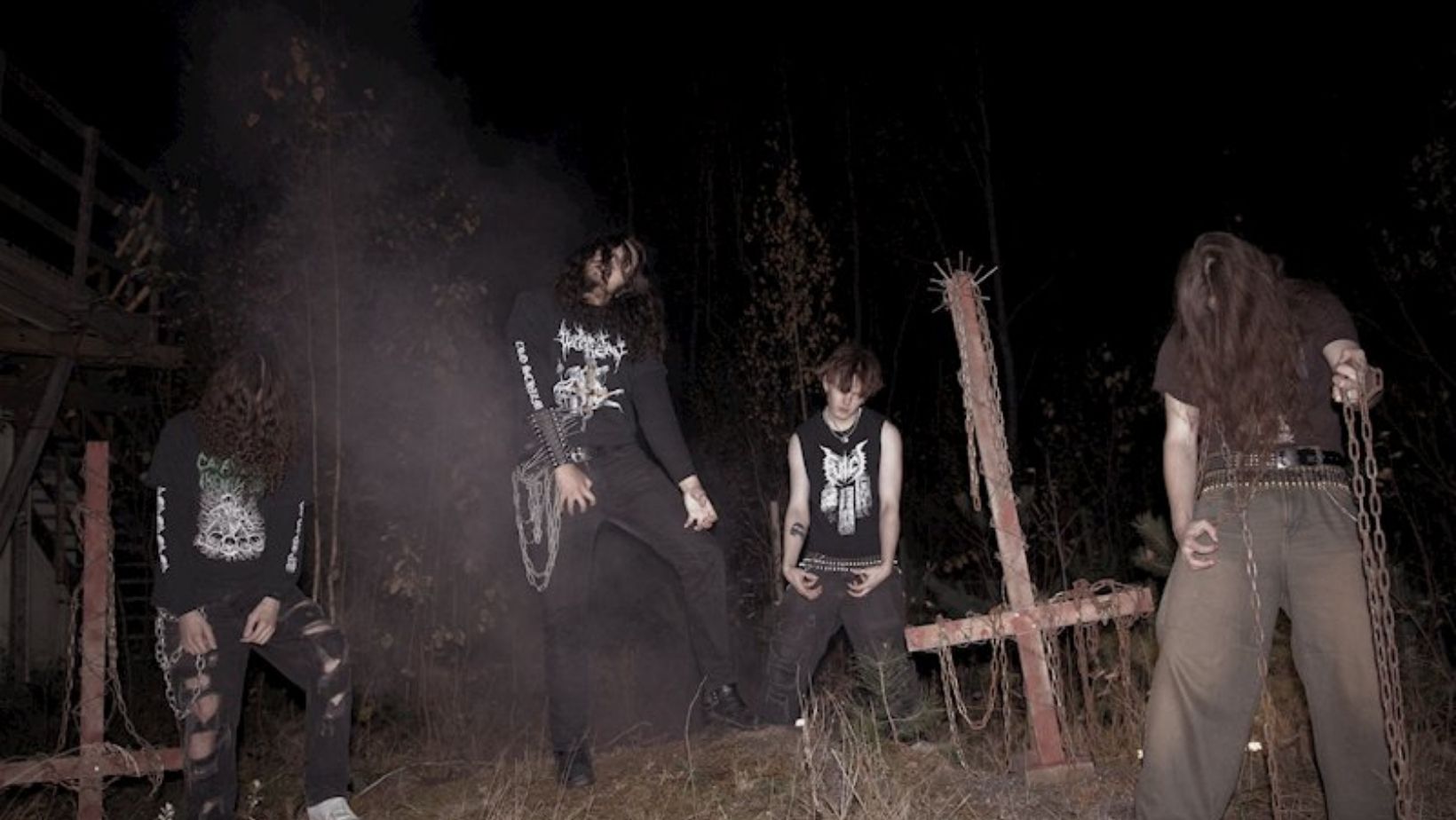
Now then, there are some albums that tell you exactly what they want to do within their very first seconds. They don’t need to spend ages introducing themselves or handing you a CV saying, “We’re influenced by this, we come from there.” AZATOTH’s debut full-length, Carnal Lust of Blasphemy, is exactly that kind of album. What these youngsters in their early twenties are telling us here is pretty simple: cause damage, destroy, rot, and, if possible, leave the whole place smelling like a graveyard while you’re at it.
Hailing from Vantaa, Finland, AZATOTH describe themselves in their band bio as occupying a triangle between old-school Finnish death metal, ’90s American death-grind, and bestial black metal. But after listening to the album from beginning to end, I think that description puts a little too much emphasis on the American death-grind side of things. Because the main vein running through Carnal Lust of Blasphemy is much more firmly rooted in old-school Finnish death metal.
And this isn’t merely a genetic trace naturally carried by a band from Finland. While listening to the album, names like Danish Phrenelith, Canadian Tomb Mold, and, particularly in terms of atmosphere and riffing, bands from our own neck of the woods such as Hyperdontia and Engulfed also spring to mind. So what we have here is less an American death-grind assault and more a vision of death metal pulled from the depths of a cave and fed by dark melodies.
Flooding Human Remains opens the album with a bleak atmosphere. The vocals are dominant and suffocating, while the guitars don’t so much support that suffocation as sink right into it. The fluidity of the riffs is important here, because AZATOTH knows the difference between being “filthy” and being “clunky.” The drums move together with the guitars, keeping the aggression alive without disrupting the song’s overall cohesion.
The following Veins of Rotten Blood makes it even clearer how much importance the band places on guitar melodies. Harmonies that feel like they’ve crawled straight out of a graveyard combine with scattered whispers and ominous noises, making the atmosphere even denser. The solos aren’t showpiece sections in the traditional sense; they’re more like death sirens heard from a distance. What AZATOTH are doing here isn’t simply playing death metal—they’re putting an image inside death metal.
Abomination of the Underworld is one of the tracks that showcases the band’s compositional side. Beginning with a heavily toned bass guitar, the song opens up around the 2:20 mark before slowing down and increasing its intensity again four minutes in. The way the outro closes in a manner related to the intro also gives the track a nice atmospheric quality. The riff doesn’t simply start and stop; it goes somewhere and comes back.
Of course, it’s not all sunshine and roses. Abhorrent Reincarnation opens with a drum solo and throws the listener straight into the middle of the pit. Once J. Das’s vocals kick in, the assault is complete, and the guitars are capable of carrying that energy. However, the excessive repetition of the guitar riff running in the background at one point unfortunately foreshadows a small issue we’ll encounter from time to time throughout the album. When you catch a good riff, the temptation to keep looping it can inevitably become tiresome. Thankfully, the album makes up for it before too long.
Sulfuric Paths to Agony is, in my view, the undisputed peak of the album. Its runtime of more than six minutes initially makes you wonder, “Have they stretched this out too much?” But once the track starts, that question loses all meaning. Because here, length isn’t a burden—it becomes an advantage. The vocals, guitars, drums, and atmosphere give one another room to breathe; the song expands without losing its grip.
Being able to carry a death metal track beyond the six-minute mark is an achievement in itself. Especially considering that the band occasionally pushes up against the limits of repetition in shorter sections, Sulfuric Paths to Agony is particularly successful in this regard. Its atmosphere, vocals, and dramatic guitars gather all of the album’s darkness into a single point. If there’s one track on Carnal Lust of Blasphemy where we can say, “This is where AZATOTH have really shown what they want to do,” it’s definitely this one.
The following Interlude (Awaiting the Oncoming) is the album’s breathing point. Since I don’t have the band’s lyrics, I can’t interpret the album’s story in definitive terms; all I have are the track titles and the music itself. But the title “Awaiting the Oncoming” is clear enough: it makes you think, “Something is coming.” And for a short while, we wait.
Blasphemous Flesh, with J. Das’s vocals entering at around the 15-second mark, instantly recalls a “GO!” command that sounds like it could have come straight from L-G Petrov’s mouth. The good thing is that the guitars don’t lose any energy after this opening. Quite the opposite: with their chainsaw-like sound, the guitars carry the assault ignited by the vocals.
Extinguished Souls of Putridity leans back toward tone and atmosphere. The opening of the hissing guitars and the guttural groans rising from J. Das’s throat continue the sense of decay that has permeated the album from the beginning, albeit in a different form. This is also where you begin to understand why AZATOTH seem to love the word “putrid” so much: they’re trying to create that sense of decay not only in the track titles, but within the songs themselves.
And after this entire journey, everything closes with Putrid Altar of Eternal Decay. I think it’s the right track to close the album. It’s also the album’s most technically dense piece. The way the riffs connect, the variety of the transitions, and the overall movement are more pronounced than on the preceding tracks. Yet AZATOTH never slips into a “look how technical we can play” attitude here. The technicality never takes precedence over the song’s character. It’s still the same darkness, the same suffocation, the same decay.
The production plays just as important a role as the music itself in creating this world. While Carnal Lust of Blasphemy attempts to capture a “cave metal” aesthetic, it doesn’t pile the instruments on top of one another and leave the listener buried beneath a wall of sound. Quite the opposite: it gives you what you need to hear in the right doses.
The character of the guitars, the weight of the bass, the aggression of the drums, and J. Das’s suffocating vocals can all be heard without becoming disconnected from one another. The album is filthy, dark, and heavy, but it doesn’t needlessly wear out your ears. In that respect, Juuso Hämäläinen and Roni Levo have done a good job on the production side. Especially in a genre like this, they understand the difference between being “muddy” and simply sounding like mud.
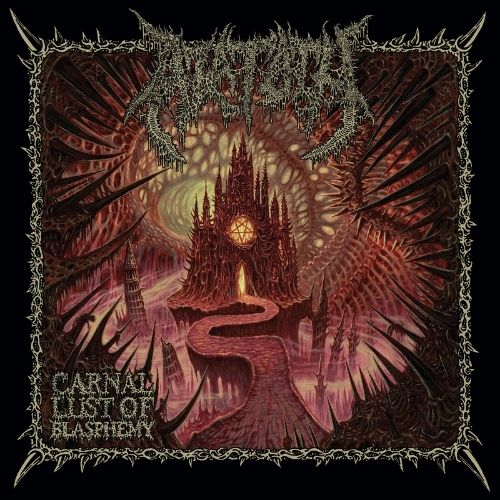
The same sense of cohesion carries over into the visual side. The album cover created by Slimeweaver directly reflects the death, decay, and darkness contained within the music. The color palette also feels perfectly at home within the album’s sonic world. You don’t encounter one AZATOTH when you look at the cover and another when you listen to the album; the visual and sonic sides enter through different gates of the same hell.
All in all, the desire for damage and destruction is extremely strong on this album. AZATOTH’s music has a very clear expression of it. Fast drums, dramatic riffs, dark guitar melodies, and vocals rising from the depths of the throat all serve the same purpose: they want to leave as heavy an atmosphere as possible hanging over the listener, and they succeed.
But the best thing about the album is that the band doesn’t turn the music into completely uncontrolled chaos while doing so. The “putrid fucking death metal chaos” description from the press release sounds good, but when we actually listen to the album, we see that this isn’t simply a chaos machine. There’s a serious level of attention paid to riff writing. The guitar melodies define the atmosphere of the songs, the drums aren’t there merely to generate speed, and the solos step in where they need to.
They don’t abandon their purpose when the tempo drops, either. Only the form of the assault changes. When they’re fast, they tear you apart; when they slow down, they crush you. That’s why, to me, Carnal Lust of Blasphemy is death metal in the truest sense, but above all, it’s “cave metal.”
AZATOTH aren’t a band that have figured everything out yet. Some riffs repeat more than they need to, and there are sections where they could have made bolder choices. But they’ve accomplished the most important thing for a debut full-length: they’ve created an atmosphere of their own.
And if they’re capable of writing a track like Sulfuric Paths to Agony, it’s not hard at all to imagine them taking this dark world much further on their next album.
For now, let’s place the final stone upon the altar and walk away.
