Album Review
CARBON TOMB - Passage to a Neutron Star
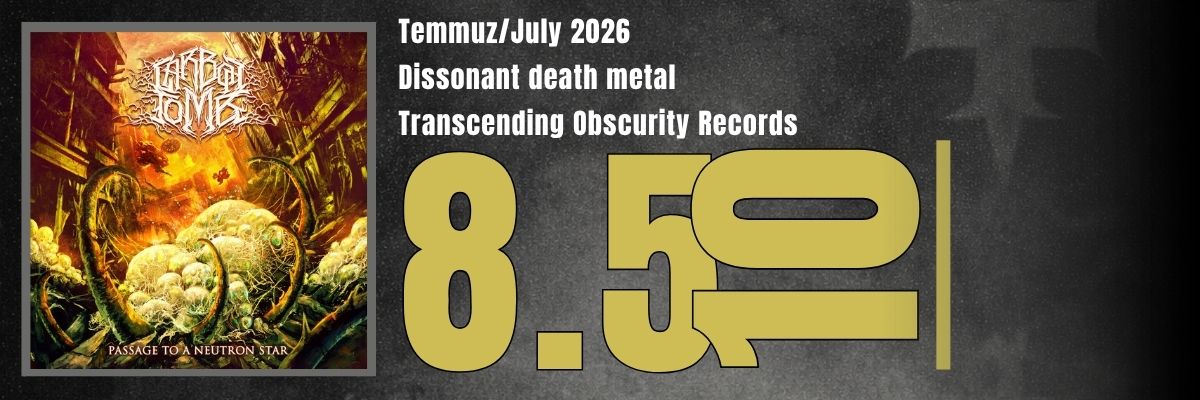
As dissonant death metal has increasingly boxed itself into a space that is more technical, denser, and more abstract over the last several years, many bands have started equating complexity directly with compositional depth. More often than not, this approach causes riffs to lose their sense of direction, while songs devolve into little more than interconnected clusters of tension. Carbon Tomb, however, attempts to establish a different balance throughout Passage to a Neutron Star. The album still leans heavily on the chaotic harmonic language of dissonant death metal, but it does so through songs that remain in constant motion, possess clearly defined transition points, and preserve a rhythmic sense of direction. The core issue here is not technical showmanship; it is the creation of tension that never loses its structural integrity, even while appearing uncontrollable.
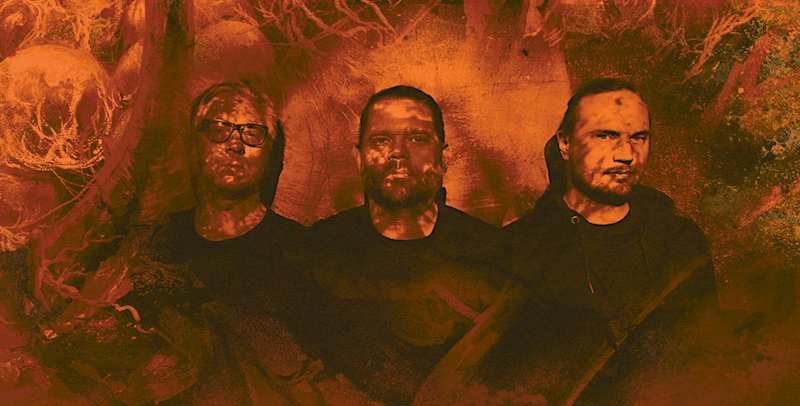
At first glance, the album’s guitar writing evokes the classic post-Ulcerate dissonance aesthetic: high-frequency tremolo clusters, chord voicings grinding against one another, and tonal centers that perpetually refuse resolution. Yet Carbon Tomb’s riff approach never fully dissolves into atmosphere. Unlike many modern dissonant death metal bands, the riffs here do not merely create texture; they also carry the internal logic of the songs themselves. The constantly shifting alternate-picked passages in “Reversed Head Renewal,” in particular, function less as a force dragging the track into amorphous chaos and more as the main engine propelling it forward. As the guitars generate an unnerving vibrational sensation in the higher frequencies, the drums’ constant tempo-breaking transitions make the music seem to consciously reject any stable rhythmic foundation. Despite this, the songs still leave behind distinct turning points in memory; the album’s greatest success emerges precisely here.
The role of the bass guitar is critical to this structural clarity. In most dissonant death metal productions, the bass merely behaves like a low-frequency extension of the guitars, whereas here it possesses a tangible physical weight within the mix. Particularly during the slower, doom-influenced sections, the bass’ resonant movements allow the songs to breathe. For that reason, the album’s occasionally expanding, spacious character does not feel like a mere production choice; it becomes a direct component of the composition itself. The heavier-tempo passages inserted between the blast beat intensity are not included simply to give the listener a moment of rest. These sections reestablish the impact of the riffs by preventing the album from collapsing under a constant state of high tension.
The drum performance, meanwhile, never easily surrenders to the reflexes of modern technical death metal. Mikael’s playing is less about flashy technical exhibitionism and more about guidance and momentum. Blast beats are, of course, used extensively, but the album’s real dynamism comes from its constantly shifting points of emphasis. Many tracks create a sensation of rhythmic instability; rather than sustaining a straightforward groove, the drums continually destabilize the songs. This approach significantly amplifies the music’s physical weight, especially when combined with the guitars’ chaotic harmonic structure. Carbon Tomb’s crucial distinction, however, lies in its refusal to turn this rhythmic fragmentation into a purely abstract mathematical exercise.
The vocal performance reinforces this balance as well. The contrast between Richardt’s shrill screams and Jeppe’s cavernous growls does not merely generate dynamic variety; it also shapes the dramatic intensity of the material itself. Particularly in the more black metal-influenced passages, the screamed vocals merge with the guitars’ sharp frequency character, pulling the music away from straightforward death metal brutality and toward a more paranoid atmosphere. Even so, this black metal influence functions less as an element that fundamentally transforms the album’s identity and more as an aesthetic expansion that redirects the tension in certain sections. Carbon Tomb is engaging more in tonal manipulation than genuine genre fusion here.
One of the album’s most striking aspects is its refusal to position complexity in opposition to accessibility. Modern dissonant death metal often presents deliberate resistance toward the listener as a form of aesthetic superiority. Passage to a Neutron Star, however, organizes its technical density around distinct motifs, recurring rhythmic ideas, and controlled repetition. On tracks like “Of God’s Neglect,” the palm-muted riffs arriving after clean guitar passages grant temporary direction to the album’s constantly unresolved tension. These passages do not function as atmospheric ornamentation, but rather as transitional points that reconstruct the dramatic architecture of the songs.
A similar balance exists on the production side as well. The mix lacks the sterile sheen typical of modern technical death metal; instead, it aims for a more organic and physical density. The guitar tones especially grind against each other in the mid frequencies, causing the riffs to generate pressure more than clarity. Even so, the album never collapses into complete murkiness. Because the drum attacks and bass movements remain sufficiently separated within the mix, the density stays manageable. This choice helps establish the album’s “cosmic” aesthetic not through exaggerated layers of ambience, but through sheer sonic mass itself.
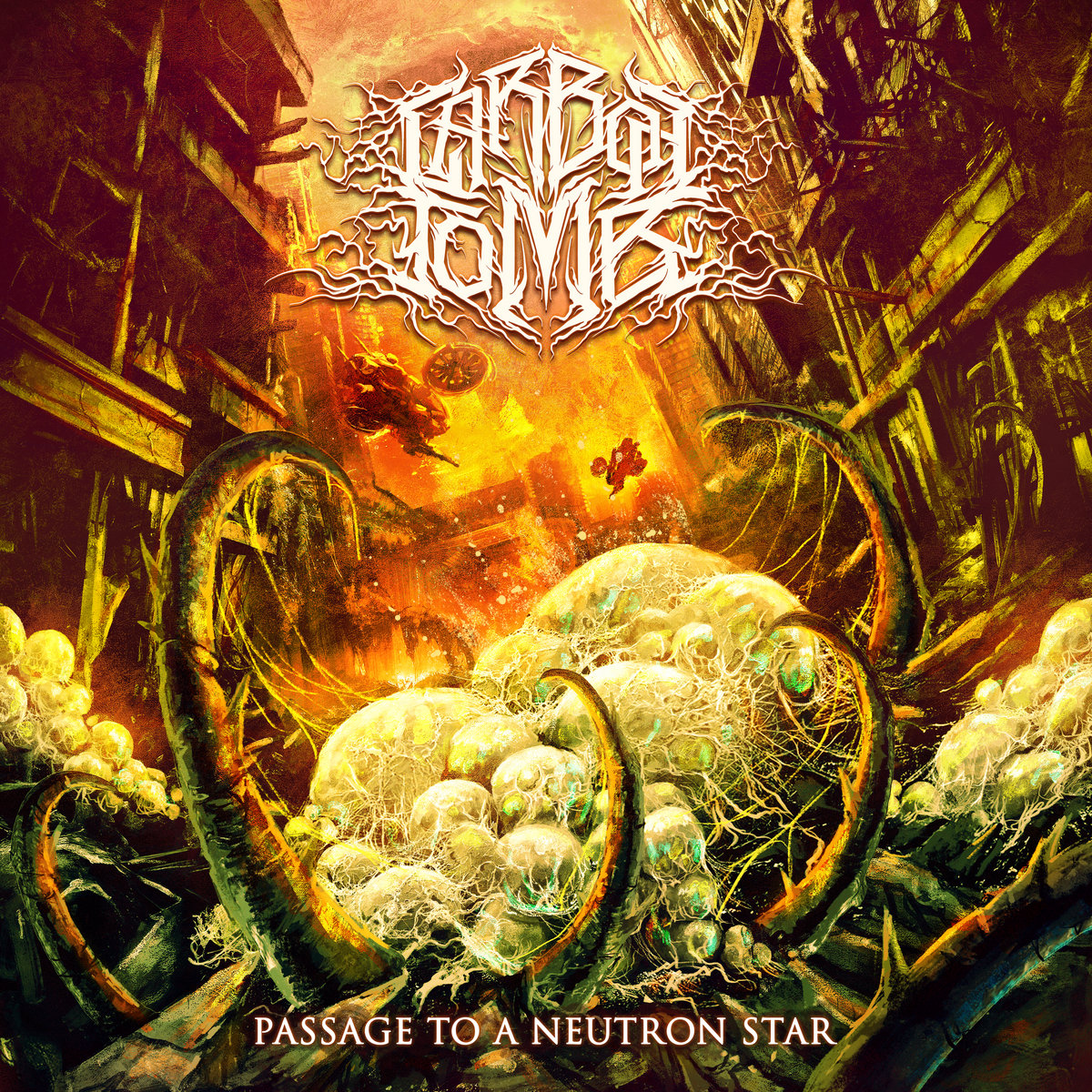
A similar approach can also be felt in the artwork. While the cover art by Graphic No Jutsu aligns with the album’s science fiction-inflected title, it avoids becoming trapped in the excessive digital hyper-detailing often found on many modern technical/dissonant death metal covers. Rather than attempting to represent the music’s complexity literally, the visual aesthetic provides a framework that reinforces its cold, unstable spatial atmosphere. This remains consistent with the album’s broader philosophy: making complexity functional rather than perpetually visible.
Ultimately, Passage to a Neutron Star is not an album that radically redraws the boundaries of dissonant death metal. What Carbon Tomb achieves instead is something more controlled and likely more sustainable: restoring structural coherence to a genre language that has become increasingly amorphous in recent years. The album demands from the listener not only the analytical focus required to unravel its technical details, but also the patience to follow the internal movement logic of the songs themselves. Because Carbon Tomb’s success lies not merely in how complex the band can play, but in knowing when that complexity should transform into direction, when it should become physical pressure, and when it should open into controlled emptiness. As a result, the Danish outfit enters the global metal scene with a debut full-length that is powerful, ambitious, and raises expectations for what lies ahead.
OZY
Carbon Tomb Bandcamp
Official Transcending Obscurity Site
Transcending Obscurity Facebook
Carbon Tomb Facebook
Carbon Tomb Instagram
Official Label YouTube Channel
Label US Store
Indiemerch Store