
Album Review
DYSGNOSTIC - End Whispers
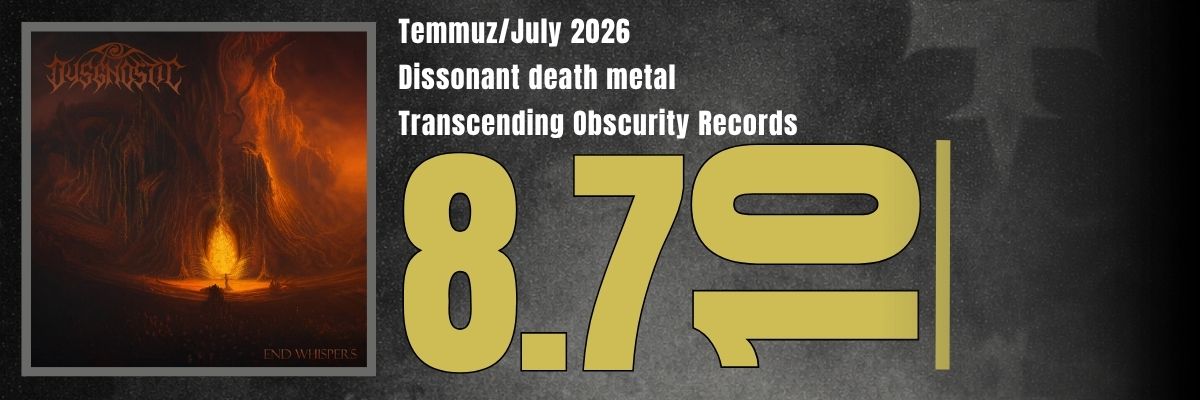
Dysgnostic’s second album, End Whispers, doesn’t feel like a definitive rupture where the band completely abandons its former brutal death metal instincts; rather, it carries the sense of a controlled reconstruction in which those roots are dissolved and reshaped into another form. The foundation of the album is still built upon the physical intensity of death metal, but that intensity is no longer constructed through direct destructive force. Instead, it emerges through constantly shifting riff organizations, unresolved harmonic tension, and rhythmic displacements. Because of this, the album’s weight stems not merely from the amount of distortion, but from the music’s systematic refusal to place the listener on stable ground.
The framework Dysgnostic constructs here is less about repeating the familiar “aesthetic of chaos” commonly associated with modern dissonant death metal and more about organizing chaos through a specific internal logic. While the influence of the post-Gorguts dissonant tradition is clearly present in the guitar writing, the band never turns it into purely abstract technical exhibitionism. The riffs continuously mutate, yet the songs frequently cling to short motifs capable of lingering in the memory. That is one of the album’s crucial strengths: it does not build complexity at the expense of memorability. Instead of falling into the sense of “mechanical disorder” that traps many dissonant death metal bands, the recurring melodic fragments and specific rhythmic accents here allow the material to leave a lasting imprint.
“The Last Refrain” stands as one of the clearest examples of this approach. The track opens with reverberating guitar notes carrying a sense of mourning, yet this introduction does not function like an atmospheric prelude added merely for effect; it prepares the tonal foundation for the harmonic collapse that follows. The subsequent blast-beat eruptions and twisting riff sequences create less of a classic brutal death metal aggression and more of a feeling of controlled disintegration. As the drums constantly shift direction, the dissonant layers stacked by the guitars prevent the piece from progressing in a linear fashion. Even so, whenever the band increases the tempo, the music never becomes entirely amorphous; certain motifs continuously return, preventing the composition from collapsing into itself.
One of the most striking aspects throughout the album is the relationship between the drums and guitars. Richardt Olsen’s performance is not merely concerned with generating technical density; the drums are often used to disrupt or redirect the tension created by the riffs. The blast-beats do not function as conventional extreme metal “peak moments” here. On the contrary, in many transitions they make the rhythmic balance of the songs even more unstable. This approach reinforces the album’s hypnotic dimension because the listener is constantly forced to adapt to new accent patterns.
The bass guitar, meanwhile, leaves an immediately noticeable impact. Particularly during the slower passages, the chosen bass tone creates a secondary harmonic field that further expands the dissonance of the guitars. This allows the album’s sense of “darkness” to stem not simply from distortion density, but from the idea of tonal irresolution itself. The reason the music consistently feels unsettling lies less in aggression than in the fact that no harmonic center is ever allowed to become fully secure.
A similar sense of balance is present in the production as well. End Whispers refuses to lean into the sterile, excessively polished production approach dominating modern extreme metal, yet it also avoids adopting an artificially obscured old-school aesthetic for the sake of nostalgia. Instrument separation matters here because Dysgnostic’s music operates through detail. In particular, the placement of the guitar layers within the mix becomes the primary factor enabling the album’s feeling of “orchestrated chaos.” At many moments, several different dissonant movements can be heard simultaneously, but the mix never collapses them entirely into one another. Because of this, the album reveals new connections upon repeated listens.
The vocal approach also serves the album’s overall aesthetic direction. The gutturals and scream-like vocals function less as tools for constructing a dramatic front-facing character and more as extensions of the instrumental tension itself. Keeping the vocals slightly recessed within the mix suggests that texture is prioritized over lyrical clarity. This choice strengthens the album’s atmospheric dimension because the human voice here does not act as a narrator, but rather becomes another layer within an increasingly tension-filled structure. In this sense, Thomas Fischer delivers particularly impressive work.
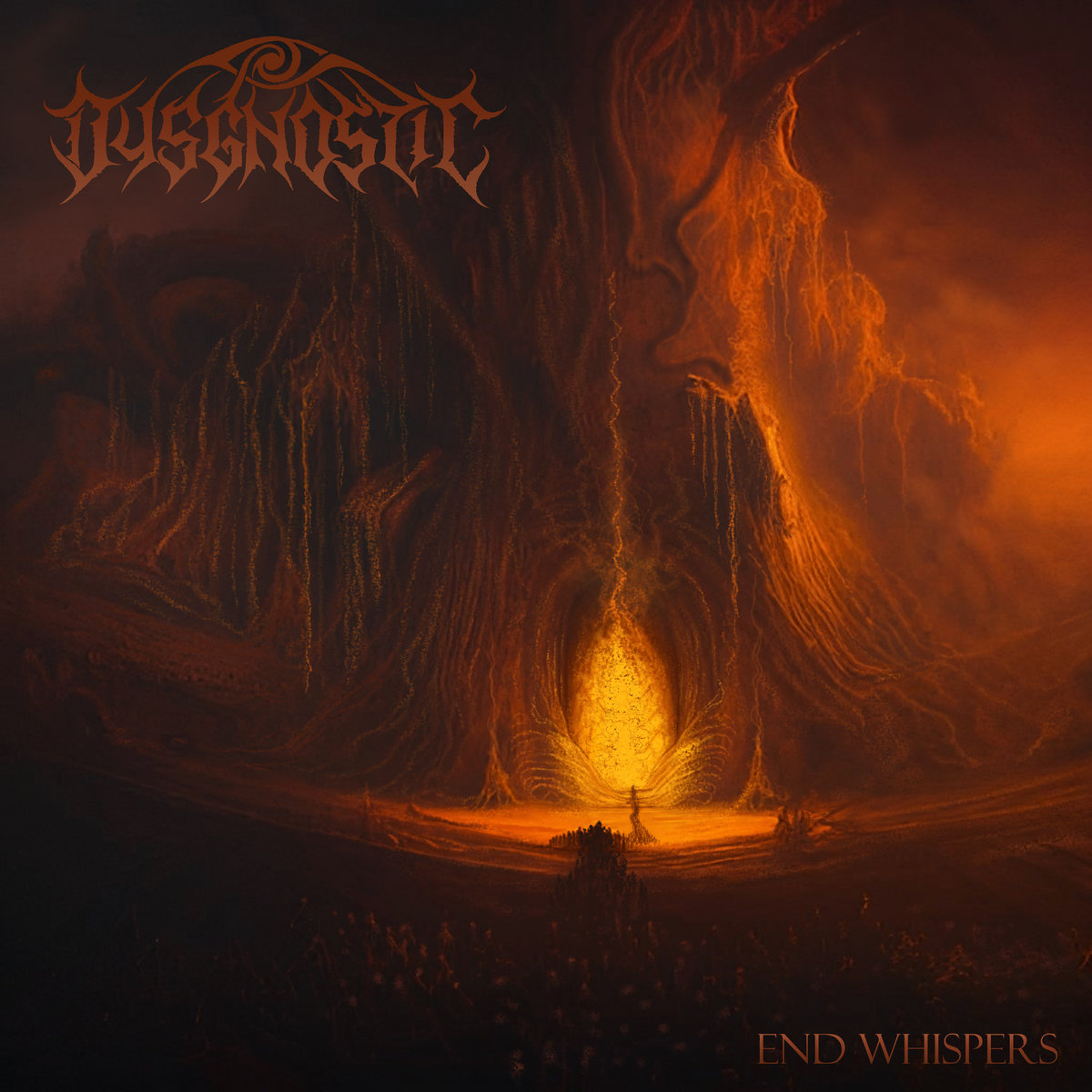
The album’s visual aspect also aligns closely with its sonic identity. Although the Belial NecroArts cover artwork leans toward the abstract cosmic horror aesthetic frequently seen within contemporary dissonant death metal circles, it never feels entirely generic. The use of organic and indefinable forms translates the album’s constant sense of structural deformation into visual language. At this point, the artwork functions as more than a mere atmospheric complement; it visually reinforces the music’s notion of formless yet controlled movement. The dominance of dark yellow, red, and intermediary tones also gives the artwork a particularly strong appearance on the band’s merchandise.
Dysgnostic’s real achievement lies in not attempting to market its technical and progressive tendencies through claims of “forward-thinking” innovation. The album does not become randomly convoluted simply to appear experimental. The changes made genuinely affect the compositional logic. In particular, their ability to transition toward a more patient, layered, and cerebral form without entirely losing the physical intensity inherited from their brutal death metal roots pushes the band closer not only to technical death metal circles, but also to the more atmosphere-driven wing of the contemporary dissonant death metal scene.
End Whispers is not an easily digestible album because it demands more from the listener than merely enduring intensity; it asks them to follow structural relationships. Yet this is precisely where the album’s strength emerges: rather than turning complexity into an identity performance, Dysgnostic places it at the center of the music’s method of generating tension. That transforms the album from merely being a “difficult” death metal record into one of the more controlled and thoughtfully constructed examples of how contemporary extreme metal engages with dissonance. With End Whispers, Dysgnostic continue to develop their craft while steadily climbing upward within the death metal landscape.
OZY
Dysgnostic Bandcamp
Official Transcending Obscurity Site
Transcending Obscurity Facebook
Dysgnostic Facebook
Dysgnostic Instagram
Official Label YouTube Channel
Label US Store
Indiemerch Store
Label Europe Store