

Album Review
Loneshore - Nothing Left to Deconstruct

When it comes to extreme metal bands emerging from Brazil, the reflex still leans more toward thrash metal or bestial metal, yet Loneshore — releasing its sophomore album through Willowtip Records — occupies a space that consciously pushes against that geographical expectation with Nothing Left to Deconstruct. The album’s core identity is built around merging the atmospheric scope of post-metal with the structural discipline of progressive metal on the same axis; however, it achieves this not through the sterile virtuosity reflex of contemporary progressive metal, but through a riff-centered sense of dramatic flow. The songs are lengthy, layered, and constantly open to directional shifts, yet the primary objective of these compositions is not technical exhibitionism, but the creation of perpetual motion and sustained tension.
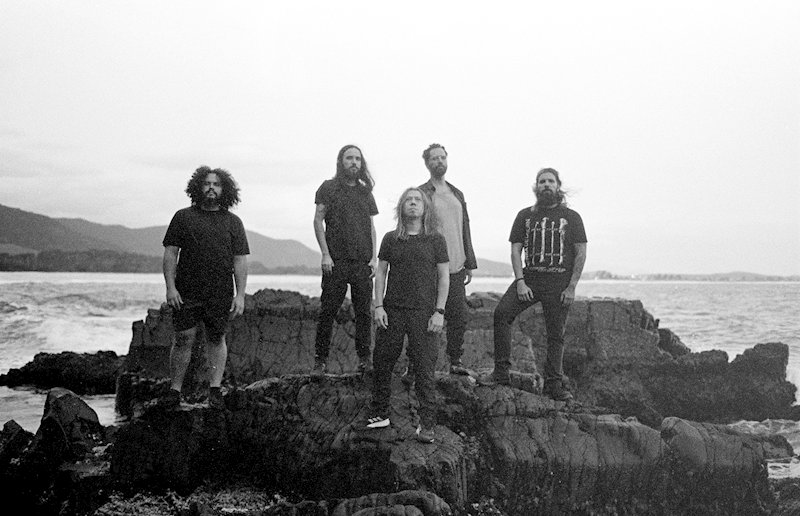
Throughout the record, the guitar writing becomes the main vessel carrying this approach. The dense distortion tone anchored heavily in the low-mid frequencies merges with harmonically unresolved transitions, creating a structure that never fully allows the riffs to “settle.” In that sense, the album preserves progressive metal’s sequence-driven compositional logic while utilizing the expansive atmospheric sensibilities of modern post-metal. In many sections, the rhythmic emphasis is constructed directly through groove, yet this groove never devolves into a loose, sludge-like heaviness. While the drums constantly generate a forward-driving momentum, the guitars behave more like expanding and contracting layers. As a result, the album’s aggression stems not from blast beat saturation, but from the harmonic pressure that continuously escalates the tension.
One of the more striking aspects here is the band’s refusal to constantly foreground its technical capability. Progressive death metal influences reminiscent of Pia Mater can certainly be felt, yet Loneshore often buries complex passages within the atmosphere rather than openly displaying them. This choice strengthens the album’s dramatic flow because the songs function less like collections of isolated sections and more like singular structures in a perpetual state of transformation. Particularly in the transitional passages, the use of acoustic or semi-clean layers functions not merely as decorative contrast, but as structural breathing spaces recalibrating the impact of the dense distortion blocks.
The vocals, meanwhile, emerge as one of the album’s more unexpectedly central elements. Whereas many modern post-metal records attempt to dissolve vocals into the atmosphere, the vocal lines here are positioned far more prominently. Luiz Felipe Netto’s performance goes beyond a theatrical touch; it functions more as a narrative device steering the center of gravity within the compositions themselves. Although this makes the album’s emotional dimension more visible, the music’s dark character never drifts into melodrama. There is a melancholic sensibility that recalls Katatonia, yet Loneshore builds it not through gothic fragility, but through a sense of structural collapse.
The production further reinforces this approach. Netto’s production and mixing work is exceptionally clean, yet that clarity never fully surrenders to the kind of digital sterilization so common today. Magnus Lindberg’s mastering, in particular, broadens the density of the low frequencies in a controlled manner while preventing the details buried within the guitar walls from disappearing entirely. Still, there are moments where the recordings feel somewhat over-controlled. The intended sense of desolation is conveyed with considerable success, though a more organic drum tone or slightly looser guitar layers could have made certain climactic moments feel more physically imposing.
The atmospheric details employed across the album are equally significant. The ambient layers surfacing in the background and the occasional traces of woodwind textures never push the music directly into avant-garde territory; rather, they remain auxiliary elements expanding the existing post-metal framework. Loneshore’s approach becomes important here because the band never turns these experimental elements into a self-conscious search for identity. These details do not overshadow the riff writing; instead, they deepen the spatial dimension of the compositions. Consequently, the album’s distinctiveness stems not from exotic instrumentation, but from its ability to naturally fuse the technical discipline of progressive metal with post-metal’s sense of scale.
The artwork by David Preissel and the use of 35mm photography also serve as important components completing the album’s aesthetic dimension. Visually, the record avoids the glossy sci-fi aesthetic often associated with modern progressive metal, instead constructing something more analog, weathered, and physical. This choice aligns seamlessly with the music’s controlled yet collapsing architecture. Considering the album’s harmonic language constantly generates a feeling of dissolution, the non-sterile texture of the visual presentation becomes a deliberate extension reinforcing the musical content itself.
That said, the album’s weaker moments deserve acknowledgment as well. Certain atmospheric transitions linger longer than necessary, and particularly in the closing stretch, the dramatic ascent the album builds never quite arrives at the devastating resolution it seems to promise. Loneshore creates continuously expanding tension, yet the sense of release that tension leaves behind occasionally feels incomplete. Even so, this does not seriously damage the record’s overall replay value because the band’s true success lies less in crafting isolated peak moments and more in sustaining the listener within a constant state of moving intensity.
Nothing Left to Deconstruct is a record that reinterprets contemporary post-metal’s obsession with atmosphere through the lens of old-school progressive metal compositional thinking. It is not an experimental manifesto attempting to radically dismantle genre boundaries; instead, it reorganizes the existing aesthetic vocabulary into something more controlled, more dramatic, and more structural. That ultimately becomes the defining factor that makes Loneshore more than merely “emotional progressive post-metal”; it is also what allows the band to define its position within modern extreme metal more consciously, without hiding its riff writing behind atmosphere.
OZY