
Album Review
VERDUN - Abyssal Womb
VERDUN’s third album, “Abyssal Womb”, arriving after seven years of silence, does not entirely abandon the slow-moving, mud-caked massiveness inherent to the sludge/doom tradition, even as the band’s sound has clearly been reinforced by whatever evolution and experience accumulated during that long absence. What the record ultimately reveals, however, is that its true direction is shaped by a dissonant black metal tension that keeps this weight in constant motion. The riff writing here operates less through the grinding repetition logic of classic sludge and more through an economy of aggression that continuously generates pressure. The songs waste no time on extended ambient transitions or atmospheric build-ups, instead locking directly onto the central riff framework, and that decision defines the album’s entire rhythmic character. VERDUN’s music remains crushingly heavy; the difference is that this heaviness no longer feels static, but driven forward with a persistent sense of momentum.
The album’s most striking quality lies in how the guitars constantly shift between two separate functions. On one side, the low-tuned, thick-toned riffs create an almost physical pressure, while on the other, the shrill and wounded melodic fragments surfacing in the upper frequencies prevent the material from collapsing into complete monolithic density. “La Lame et la Chair” stands as one of the clearest examples of this approach. The opening riff possesses a structure that feels both murky and surprisingly legible; rather than dissolving into total chaos, the dissonance keeps the tension inside the riff permanently alive. Although VERDUN edge toward the territory of modern dissonant sludge here, the point is not technical complexity, but increasing tonal unease while preserving the physical impact of the riffs. As the tempo rises following the brief rupture in the song’s middle section, the groove logic of the drums becomes noticeably more aggressive, and the track’s second half begins to acquire an almost hardcore-derived kinetic energy.
The rhythm section is the true backbone of the album. Florian Celdran’s bass tone is not merely a supporting force reinforcing the sound; it behaves like an independent center of gravity within the mix. Particularly during the groove-oriented passages, the bass guitar’s non-mechanical, slightly swaying tone injects the songs with a sense of organic menace. The drums, meanwhile, avoid the “toppling forward” sensation so common within sludge and instead play with a constant forward-driving impulse. The hard, dry character of the snare tone creates a clear structural spine amidst the guitars’ blurred layers. Because of this, the album never completely sinks into mud, even during its densest moments.
While David Sadok’s vocals carry a throat-ripping violence rooted in black metal, the function of the performance extends beyond sheer aggression. The vocals frequently become the element stabilizing the tonal center of the riffs. As the guitars continuously generate dissonances that seem eager to unravel, the sharp and intelligible rhythmic emphasis of the vocals prevents the songs from falling apart. What VERDUN achieve here is a more primitive, more naked language of violence by distancing themselves from the dramatic vocal approach often associated with post-metal influenced atmospheric sludge bands. That choice causes the album to function through tension and pressure rather than emotional catharsis. Viewed from that angle, it also becomes clear that David’s choices in vocal execution fully achieve their intended purpose.
“Funeral of the Cosmic Knight” is one of the tracks that reveals the album’s compositional mentality on a broader scale. While the main structure moves with the tempo of a funeral march and retains the weight of doom metal, the shrill guitar harmonies drifting through the upper layers prevent the song from becoming trapped within pure funeral doom darkness. The “cosmic” sensation here does not emerge from ambient ornamentation, but from high-frequency resonances buried deep within the low-end. This is also one of VERDUN’s greatest strengths: they never stop the music in order to create atmosphere. The atmosphere is generated directly from the internal structure of the riffs themselves.
The production follows contemporary extreme metal standards without turning into a sterile modern metal mix. Instrument separation is remarkably clear, yet the surfaces of the tones remain rough rather than polished. The slightly worn texture of the guitars and the bass density within the mix — intense enough to feel almost filthy — heighten the album’s physical impact. At this point, what VERDUN are doing is not simply sounding “heavy”; they are consciously organizing the frequency architecture of heaviness itself. The constant dominance of the low-mid frequencies in particular sustains the album’s unresolved sense of tension.
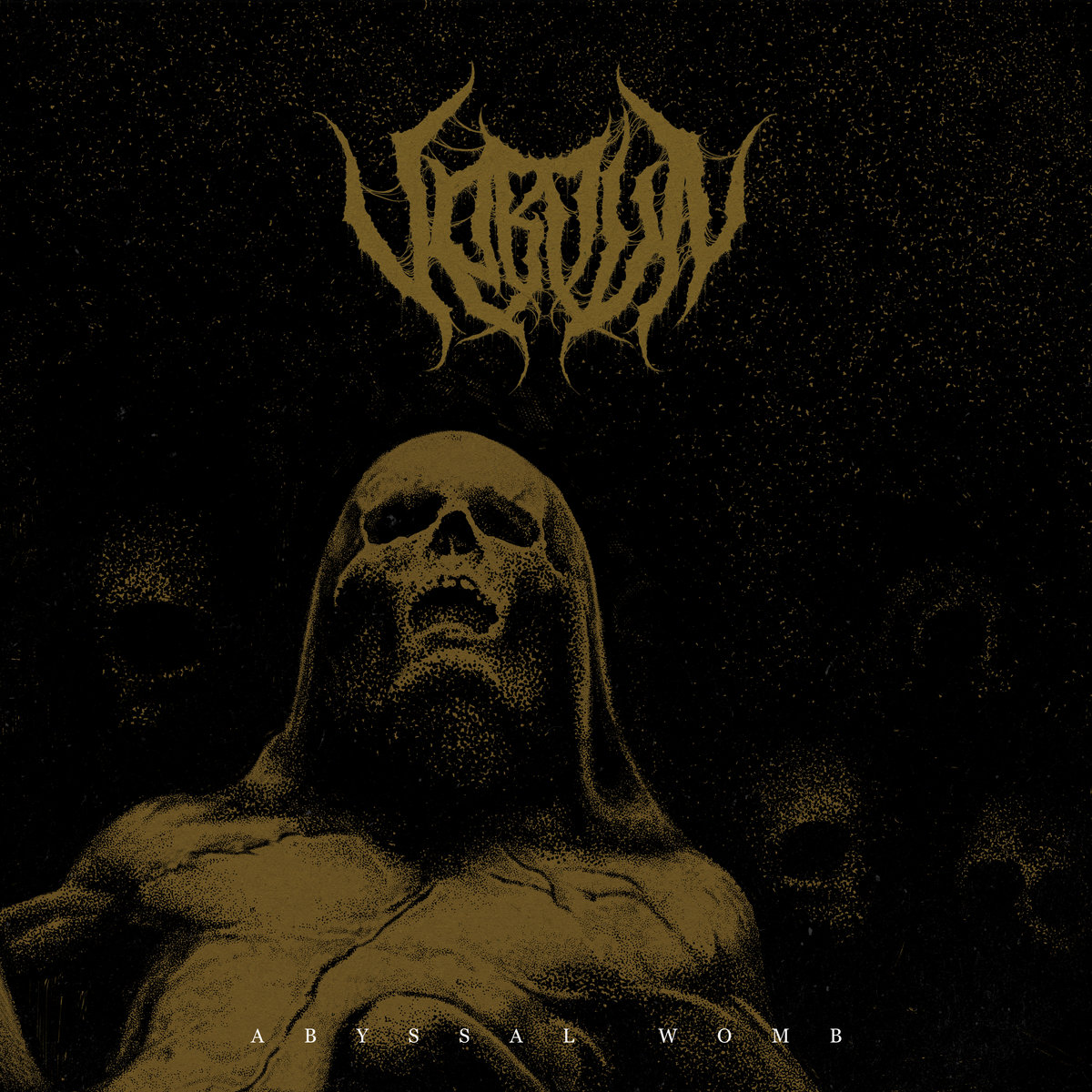
The cover artwork created by David Sadok also aligns with this musical approach. Its visual language embraces the familiar dark symbolism of contemporary sludge/blackened doom aesthetics, but instead of pursuing an overly detailed or theatrical direction, it favors a more organic and decayed surface quality. That mirrors the album’s musical character perfectly: VERDUN are not chasing flamboyant experimentation, but attempting to compress existing genre components into a denser and more aggressive form.
The most important aspect of “Abyssal Womb” is its ability to shift the balance points within the genre without trying to appear overtly experimental. While preserving the weight of sludge, the album internalizes the aggressive fluidity of black metal on a structural level. Because of this, VERDUN’s music neither surrenders entirely to a doom-centered sense of collapse nor dissolves into the abstract chaos of dissonant black metal. As a valuable detail, it is also possible to hear the aggressive yet elegant black metal tonality that French black metal bands introduced to the scene during their rise in the early 2000s reflected throughout this record.
Rather than patience, the album demands physical adaptation from the listener; it proposes a listening experience in which the riffs constantly push forward and the intensity rarely loosens its grip. VERDUN may not radically dismantle the boundaries of the genre here, but by reorganizing sludge’s clumsy mass through an aggressive sense of movement, the band sharply hardens its own position.
OZY
Verdun Bandcamp
Official Transcending Obscurity Site
Transcending Obscurity Facebook
Verdun Facebook
Verdun Instagram
Official Label YouTube Channel
Label US Store
Indiemerch Store
Label Europe Store