
ALBUM REVIEW
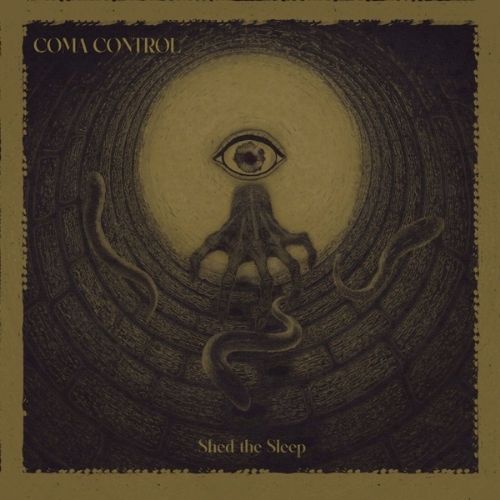
COMA CONTROL - Shed the Sleep
Technical, melodic, dark, dynamic progressive death.
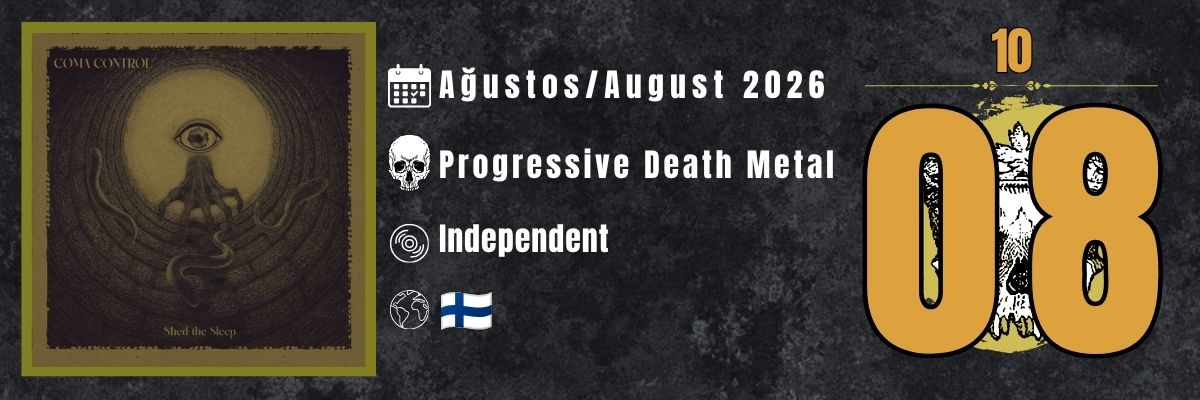
COMA CONTROL weaves the technical density of progressive death metal through complex riffs and constantly shifting rhythmic structures without allowing the music to become a mere display of virtuosity. “Shed the Sleep” builds a constantly shifting framework within individual compositions, setting heavy and aggressive passages against melodic, atmospheric, and more subdued sections. What makes the layered arrangement all the more remarkable is that the entire record was composed and performed single-handedly by Finnish musician Tapio Honka.
The album opens with “Transcience.” Defined by acoustic guitar and restrained vocals, the track does not simply prepare the listener for the intensity of what follows, instead briefly opening up space for the album’s melodic and atmospheric side. “Seething Hunger” then sharply increases the contrast. Rather than turning the technical guitar work, bass, and drums into separate showcases, the instruments move together within the same compositional motion, keeping the track’s intensity under control. The rhythm section is not merely a foundation supporting the guitars; it is an active component that continually shifts the direction and tempo of the riffs. The vocals display the same flexibility, moving between deep gutturals and higher-pitched screams, while clean vocals appear at key moments to bring the material’s melodic side to the foreground.
One of the most striking qualities of “Shed the Sleep” is that its technical density never completely sacrifices clarity. “Inherently Unmet” is a good example. After a dark and tense opening, the track moves into more intricate guitar passages, yet these transitions never feel like sections simply stitched together to showcase technical ability. This is also why the song manages to maintain the listener’s structural focus despite its length. Honka turns the frequent time changes into an integral part of the songs’ dramatic movement.
That approach takes a different form on “Well of Absence.” Pulling back from the technical heaviness of the preceding tracks, the arrangement gives the melodic guitar work greater prominence. These melodies serve the album’s atmospheric side without stepping outside the framework of death metal. “Post Aware,” meanwhile, establishes a more energetic and dynamic structure, expanding the album’s rhythmic vocabulary. Its greatest strength is that the time changes never become a succession of technical exercises. Honka’s guitar and rhythm writing is constantly shifting direction, yet the composition retains its underlying momentum. This is one of the points where the album’s technical proficiency is most convincingly transformed into musical expression.
“Apathy’s Abundance” is built around a more direct sense of aggression. Sudden vocal entrances, sharper riff movements, and the appearance of clean vocals at specific points heighten the contrast within the track. The clean vocals serve an important function here: they are not used to soften the material, but rather to emphasize the tonal and atmospheric differences between the heavier sections. As a result, the use of clean vocals throughout the album moves beyond the decorative role they can sometimes occupy in progressive death metal and becomes an integral part of the arrangements.
The closing track, “Immersed in Whispers,” presents the album’s compositional approach on its broadest scale. Beginning with clean vocals and piano, the song gradually divides into contrasting rhythmic and tonal sections. At certain moments, bass lines take the lead, while elsewhere the guitar riffs assume control. The transitions between quieter, melodic passages and heavier sections prevent the track from becoming an extended version of a single riff idea. The fact that such a long and constantly shifting composition remains functional makes Honka’s discipline as an arranger particularly evident.
The guitars are naturally the album’s most prominent element. The sharp tone, technical passages, dense riffing, and occasional solo-oriented sections clearly represent the technical strain of progressive death metal. At the same time, it is important that the album does not place the entire burden of its weight on the guitars. Rather than disappearing beneath them, the bass and drums function as active carriers of the time changes and structural shifts. This collective movement is one of the main reasons “Shed the Sleep” gives the impression of a multi-instrumental ensemble despite being the work of a single musician.
At certain points, the album’s musical language recalls the technical approach of BETWEEN THE BURIED AND ME. The constantly evolving riffs, song structures that veer in unexpected directions, and combination of different intensity levels within the same composition all point toward a similar aesthetic territory. However, COMA CONTROL is already moving beyond mere imitation and beginning to establish a character of its own. This is where the real potential of “Shed the Sleep” lies: while drawing from the established vocabulary of technical progressive death metal, it attempts to personalize that language by giving greater weight to melodic and atmospheric passages.
At this point, the album’s technical density is both an advantage and a potential limitation. As the number of riffs, transitions, and time changes increases, the compositions inevitably demand greater attention. COMA CONTROL, however, generally balances that risk through disciplined arranging. The fact that the longer tracks manage to maintain interest demonstrates that technical display never takes precedence over composition. Still, “Shed the Sleep” should not be expected to reveal all of its ideas on a first listen; the transitions within its structures and the relationships between the instruments become increasingly apparent with repeated listens.
For that reason, “Shed the Sleep” positions itself within progressive death metal not as a radical departure attempting to tear down the genre’s boundaries, but as a serious work that combines the technical tradition with its melodic and atmospheric side through a broader compositional approach. Here, the one-man production model becomes less a showcase of ability than an advantage that keeps all of the album’s instruments centered around the same musical vision. COMA CONTROL’s next step should be to further define its own riffing and arranging language rather than simply adding more complexity to its existing technical capacity. Because the most compelling aspect of “Shed the Sleep” is not how much it can do, but the fact that, amid all this movement, an individual voice of its own is beginning to emerge.

https://comacontrol.bandcamp.com/