
Album Review
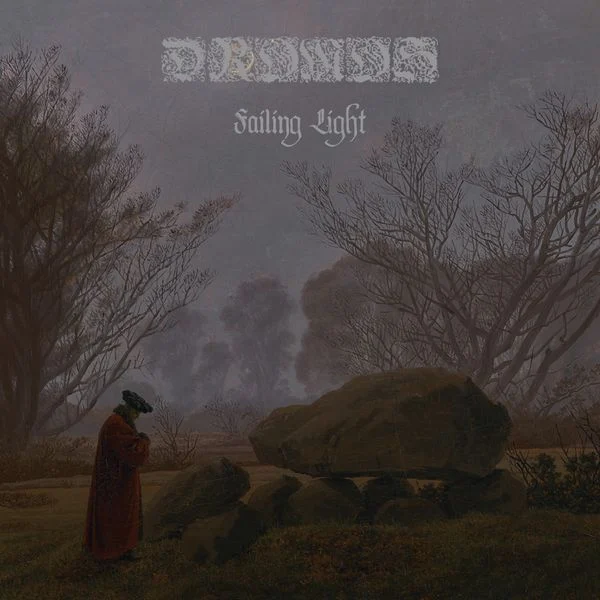
Dromos - Failing Light
When it comes to doom metal, the “Made in England” label has always carried a certain pull. Especially since the ‘90s, England has produced unforgettable bands within the genre and delivered remarkable albums to the metal scene. At first glance, DROMOS also bears that same mark capable of immediately shaping perception in a positive direction.
Although the structure DROMOS builds throughout Failing Light leans on funeral doom’s familiar “slowness = heaviness” equation, the album’s defining trait lies less in its tempo than in a construction that reveals itself gradually, almost like a novel that unfolds the deeper it is read. The three-track, forty-six-minute format initially evokes the genre’s traditional patience-demanding formula; however, the band’s approach goes far beyond merely stretching riffs and thickening the atmosphere. Here, the guitars continuously generate new harmonic shadows, while the songs create spaces that expand inward rather than moving in a linear fashion. Because of this, the album’s impact comes less from sheer “crushing weight” and more from the way it pulls the listener inside.
There are unmistakable traces of the old Peaceville death/doom aesthetic in DROMOS’ music. Yet the band never uses it as a direct nostalgic reproduction. In particular, the warm yet never muddy mid-range character chosen for the guitar tones opens up a more organic space, standing in contrast to the sterile and overly digital density common in modern funeral doom. This approach also makes the album’s psychedelic side more visible, because the guitars function not merely as riff-carrying instruments but as constantly vibrating atmospheric layers. The distortion often creates a foggy depth rather than behaving like a solid wall.
One of the most striking elements from the very beginning of the album is DROMOS’ use of riff transitions not for dramatic peaks, but for hypnotic continuity. While the genre’s common tendency to revolve around a single idea is certainly present here, the band keeps the internal tension of the songs alive through subtle harmonic shifts. This becomes especially apparent in the restrained yet guiding use of the drums. Rather than creating emphatic movement, the rhythms often function as a fixed backbone carrying the sheer volume of the guitars. As a result, the music is shaped through slow accumulations instead of sudden eruptions.
The vocal approach is also directly tied to the album’s atmospheric ambitions. Deep growls and more splintered screams preserve the classic funeral/death doom lineage, while the use of clean vocals introduces an unexpected fragility into the material. However, these clean passages never assume the melodramatic role commonly associated with gothic doom; instead, they create temporary openings that diffuse the density of the songs. Especially when considered alongside the brighter guitar passages emerging within “Death Is Silence,” this choice allows the album to shift direction momentarily rather than remaining in uninterrupted darkness. Still, DROMOS’ success lies precisely in not exaggerating these contrasts. The sense of hope here does not function as dramatic salvation, but merely as the fog thinning for a brief moment.
Perhaps the album’s most compelling aspect is the way its psychedelic influences genuinely affect the compositional logic itself. In many contemporary doom bands, psychedelic textures remain little more than reverb-drenched transitions or cosmic aesthetic ornamentation, whereas within Failing Light, this approach actively alters the flow of the songs. The twenty-minute-plus “Sinking,” in particular, carries its hazy and nearly meditative opening toward heavier territories over time while rejecting the classic doom logic of escalation. The piece feels written not to “reach a climax,” but to pull the listener progressively deeper inward. Because of this, the album’s sense of length does not merely become an endurance test, as is often the case with many funeral doom records; it gains a structural function.
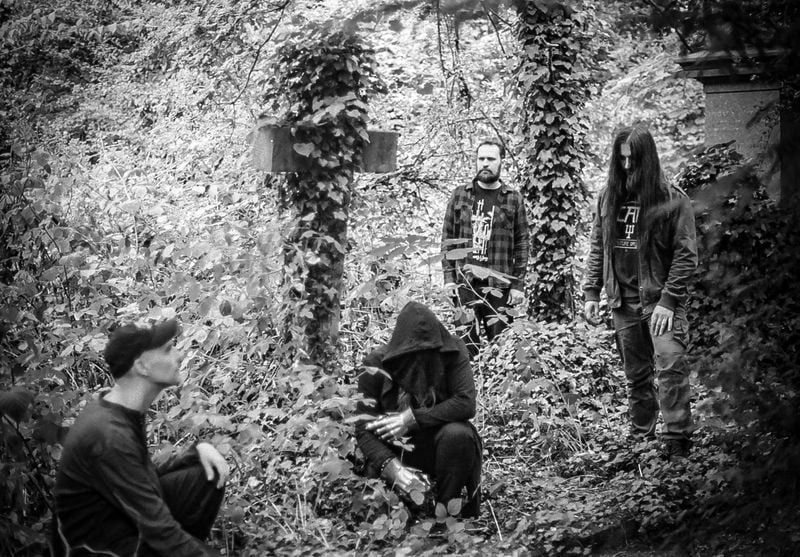
DROMOS’ underground pedigree — with members emerging from death metal, industrial, and experimental heavy music scenes — is palpable within the album’s texture, yet the band never turns this into flashy genre fusion. Industrial or avant-garde influences never fully surface directly; instead, they reveal themselves through the production’s spatial sensibility and in the way the songs dissolve and reassemble around a fixed center. In this respect, the album approaches a modern “post-heavy” aesthetic without entirely surrendering to that scene’s addiction to dramatic crescendos. At its core, DROMOS still thinks in funeral doom terms; it simply reorganizes that language through broader atmospheric tools.
A similar level of awareness exists on the production side as well. The album sounds massive, yet it behaves differently from modern doom mixes that attempt to physically crush the listener through extreme low-end pressure. The bass guitar rarely emerges as a separate character; instead, it thickens the density of the songs by reinforcing the foundation beneath the guitars. This gives the music a smokier character overall. Meanwhile, the drums’ carefully recessed position within the mix strengthens the album’s cinematic sense of space. Had the percussion been pushed more aggressively to the front, this hypnotic flow could easily have fractured.
Failing Light is not an album that radically breaks the boundaries of funeral doom. What DROMOS achieves instead is a careful reorganization of the genre’s old atmospheric weight through contemporary psychedelic and post-heavy sensibilities. And this is exactly where the album’s strength emerges: in its ability to use experimental ideas not as decorative layers, but as structural tools that alter the way the songs breathe. This approach places DROMOS beyond being merely a “heavy” band, situating them within a more deliberate strain of funeral doom where duration and repetition become fundamental compositional elements.
As we move into a season that hints at summer, with warmer weather and longer days approaching, listening to funeral doom may not seem like the first instinct for discovering something new. But for those particularly devoted to the genre, experiencing Failing Light will undoubtedly feel like time well spent.
OZY